 Anacortes Siding
 Burlington's Weather Is Harder on a Roof Than It Looks
Burlington sits inland from Anacortes, but it still gets the same marine-influenced weather pattern that defines Skagit County: long stretches of drizzle broken up by hard, driving rain, damp air that lingers under tree cover, and a wet season that can run from October well into spring. Salt-tinged air moving in off the Salish Sea reaches this far inland often enough to matter, especially on metal fasteners, flashing, and gutter hardware that aren't rated for it. None of this is dramatic on its own. It's the accumulation — months of moisture sitting on a roof deck, moss holding water against shingles, fasteners slowly corroding — that turns small problems into real ones.
A roof in a drier climate can get away with minor flaws for years. A roof in Burlington usually can't. Gaps in flashing, a cracked pipe boot, or a shingle that's started to curl will find water faster here, and that water will find its way into the decking, the insulation, or the drywall below before most homeowners notice anything beyond a faint stain.
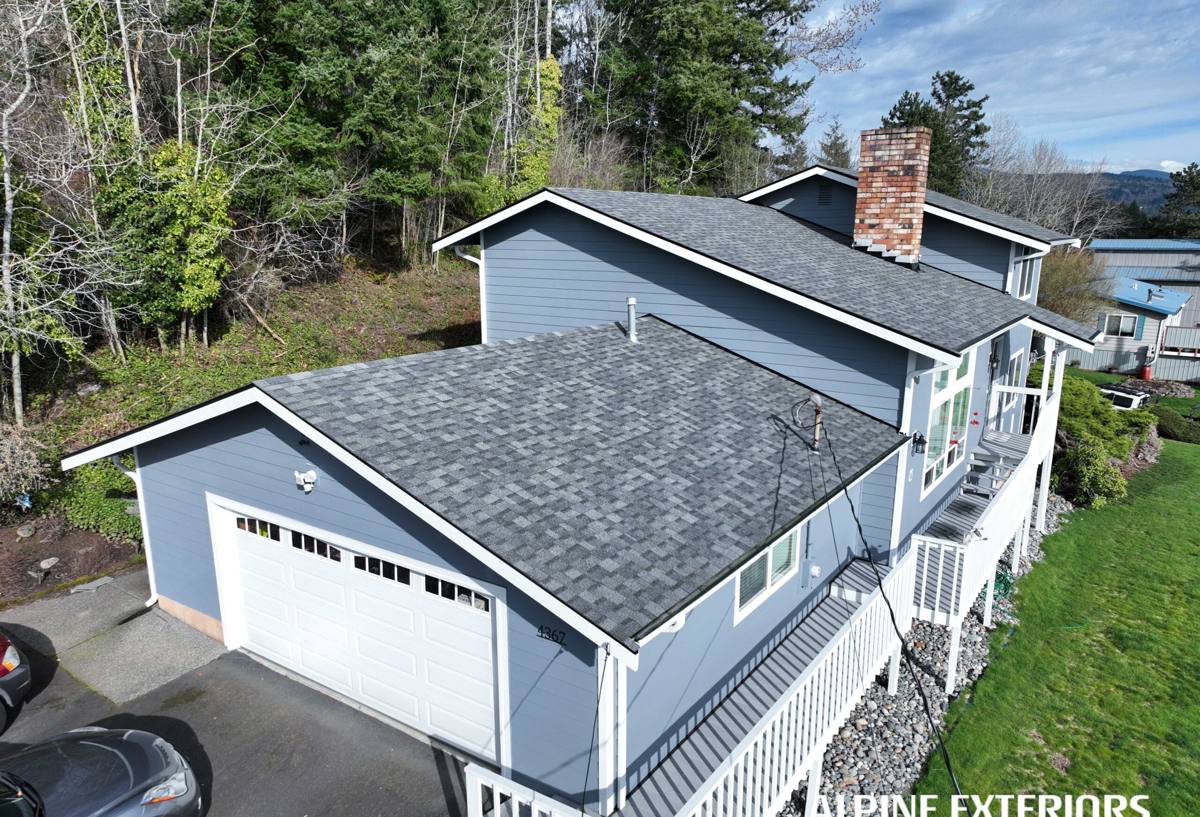
The Roof Repair Issues We See Most Often Around Burlington
Every roof is different, but after years of working Skagit County roofs, the same handful of problems show up again and again on repair calls in and around Burlington:
- Moss and algae buildup on north-facing slopes and anywhere tree cover keeps a section of roof shaded and damp longer than the rest.
- Flashing failures around chimneys, skylights, and the places where a roof meets a wall or dormer — these are the most common leak points on any roof, and the ones a quick visual inspection often misses.
- Clogged or undersized gutters that back up during heavy rain, sending water up under the shingle edge or drip edge instead of off the roof.
- Worn valleys where two roof planes meet and water volume concentrates — a high-wear area that shows its age faster than open field shingles.
- Aging cedar shake sections on older homes in the area, which need different repair judgment than composition shingle.
- Wind-lifted or cracked shingles after a storm, sometimes with damage that isn't visible from the ground.
Why the Damage Isn't Always Where the Stain Is
Water travels. A ceiling stain in a bedroom can trace back to a flashing gap ten feet away, following a rafter or the underside of the decking until it finds a low point to drip through. This is why a proper roof repair starts with tracing the actual path of the water, not just patching the spot that's visibly failing.
Moss, Algae, and Skagit County's Long Wet Season
Moss on a roof isn't just an appearance issue — it's a moisture problem with a green cover on top of it. As moss establishes itself under shingle tabs and along butt joints, it holds water against the roofing material long after the rest of the roof has dried out. Over a wet season, that constant dampness accelerates granule loss on composition shingles and can lead to rot on the decking underneath if it goes unaddressed for multiple seasons.
Shaded, north-facing roof sections and areas under overhanging trees are the most common spots we find heavy moss growth in this area, simply because they dry out slower than the rest of the roof. Removal has to be done carefully — a pressure washer set too aggressively will strip granules and shorten the life of a shingle roof faster than the moss would have. We hand-clean and use low-pressure methods, then look at longer-term prevention: zinc or copper control strips near the ridge, trimming back tree canopy where it's practical, and making sure the roof has proper airflow so it isn't staying wet longer than it needs to.
Repair or Replace? How We Make That Call
Not every roof problem needs a full roof replacement, and we don't default to recommending one. The decision usually comes down to a handful of concrete factors we walk through during inspection:
| Factor | Points Toward Repair | Points Toward Replacement |
|---|---|---|
| Roof age | Under 15-20 years, one isolated issue | Near or past the shingle's rated lifespan |
| Extent of damage | Localized to one flashing point, valley, or section | Spread across multiple slopes or repeated leak locations |
| Decking condition | Solid, dry decking under the damaged area | Soft, delaminated, or rotted decking found during inspection |
| Shingle condition elsewhere | Rest of the roof is granule-intact and flat | Widespread curling, cracking, or granule loss |
| Repair history | First repair needed in this area | Same spot has been patched before and keeps leaking |
When a repair is the honest answer, we say so. A well-done repair on a roof that still has useful life left is a better outcome for the homeowner than an unnecessary replacement, and we'd rather earn that trust than push a bigger job.
What a Correct Roof Repair Actually Involves
A repair that lasts through a Skagit County winter is more than caulk over a crack. The basics we hold to on every repair:
- Find the actual source — not just the symptom. This often means checking the attic side of the decking, not only the roof surface.
- Remove and replace damaged shingles or shakes rather than layering new material over compromised ones.
- Rebuild flashing properly at chimneys, skylights, valleys, and wall intersections, integrating it under the shingle courses the way it was originally designed to shed water — not just sealing the surface with roofing cement.
- Match materials as closely as the existing roof allows, so the repair blends in and performs the same as the surrounding shingles.
- Check the decking underneath any area that's been leaking, and address soft or damaged sections before closing the roof back up.
Sealant and roofing cement have a place in a repair, but they're a component, not the fix itself. A repair that relies mainly on caulking a gap shut will usually fail again within a season or two once that sealant contracts, cracks, or the underlying flashing geometry is still wrong.
Our Roof Repair Process
We keep the process straightforward and give you clear information at each step:
- Inspection. We look at the problem area, the roof as a whole, and — where accessible — the attic side, since that's often where a leak's true source becomes obvious.
- Diagnosis and explanation. We tell you what we found in plain terms: what's causing the leak or damage, and whether it's isolated or a sign of broader wear.
- Written estimate. A clear scope of work and price before anything starts, no surprise add-ons.
- The repair itself. Done to the standard above — proper flashing, matched materials, and attention to the decking, not a surface-level patch.
- Follow-up. If a repair doesn't fully resolve an issue, we come back and make it right.
Materials and Workmanship Standards We Hold To
We work with standard composition and architectural shingle systems, along with flashing, underlayment, and gutter components suited to the wet, moss-prone conditions common in this part of Skagit County. On older homes with cedar shake, we assess whether a targeted repair is realistic or whether the surrounding shake has degraded to the point where patching won't hold — we'll tell you honestly which situation you're in rather than force a repair that won't last.
For any repair exposed to standing water risk — valleys, low-slope transitions, areas around chimneys and skylights — we use ice-and-water shield membrane under the flashing, not just felt or synthetic underlayment alone. It costs a little more in materials, but it's the difference between a repair that survives a wet Skagit County winter and one that doesn't.
Common Burlington Roof Problems at a Glance
| Problem | Likely Cause | Typical Fix |
|---|---|---|
| Ceiling stain near an exterior wall | Flashing gap where roof meets wall or dormer | Rebuild and properly integrate step and counter flashing |
| Moss patches on shaded slopes | Prolonged moisture retention under shingle tabs | Careful removal, control strips, improved airflow/trim |
| Water stain around a skylight | Failed or aged skylight flashing kit | Remove and reflash with a properly sized kit |
| Granule buildup in gutters, thinning shingles | Age-related wear accelerated by constant moisture | Assess remaining life; repair now, plan for future replacement |
| Fascia or soffit rot at roof edge | Overflowing or undersized gutters | Repair rotted wood, correct gutter sizing/pitch |
Why an Anacortes-Based Crew That Works Burlington Matters
A roof leak doesn't wait for a convenient day. Working out of Anacortes and covering Burlington regularly means we can respond quickly when a leak is active, rather than adding you to the back of a schedule built around a service area on the other side of the county. It also means we've seen how the housing stock in this part of Skagit County was built — the roofing systems that were common when it went up, and the repair issues that tend to surface years later — so we're not learning the local conditions on your dime.
We hold the same workmanship standard on a repair as we do on a full replacement. A roof repair is a smaller job, but it's not a lesser one — done wrong, it just means someone is back on your roof again next winter.
Homeowner Roof Maintenance Checklist
Between professional inspections, a few habits go a long way toward catching problems early in a climate like ours:
- Clear gutters and downspouts at least twice a year, more often if you have overhanging trees.
- Look for moss or dark streaking on north-facing or shaded slopes each spring.
- Check the attic after heavy rain for damp insulation, dark spots on decking, or daylight showing through.
- Trim back tree branches that overhang the roofline to reduce shade, debris, and physical wear.
- Have flashing around chimneys and skylights checked every few years, since sealant and metal both age even without a visible leak.
- Address a small leak as soon as you notice it — waiting a season usually turns a repair into a bigger one.
If you're dealing with a leak, a moss problem, or just want an honest read on how much life is left in your roof, we're glad to take a look. Fill out the form below for a free, no-pressure estimate.