 Anacortes Siding
 Guemes Island's Climate Is Harder on a House Than It Looks
From the water, Guemes Island looks calm — low bluffs, evergreens, quiet shoreline. But the same setting that makes it a great place to live puts real, sustained stress on exterior building materials. Homes here sit close to Puget Sound, which means salt-laden air is a near-constant presence, not an occasional event. That salt air settles into porous or poorly sealed siding, accelerates corrosion on fasteners and trim, and works its way into any gap in the exterior envelope.
Add in driving rain that comes sideways off the water during fall and winter storms, and you have a second problem: wind-driven moisture doesn't just wet the surface of a wall, it tests every seam, joint, and piece of flashing. Then there's the shade. Guemes has plenty of mature tree cover and north-facing walls that stay damp for days after a storm passes. That combination — moisture plus shade plus mild temperatures — is exactly what moss, algae, and mildew need to take hold. On a lot of Skagit County homes, moss isn't a cosmetic nuisance; it's a sign that a siding surface is holding water it shouldn't be holding.
None of this means Guemes Island homes are doomed to constant repair. It means the exterior materials and installation details matter more here than they would in a drier, more sheltered part of the state.
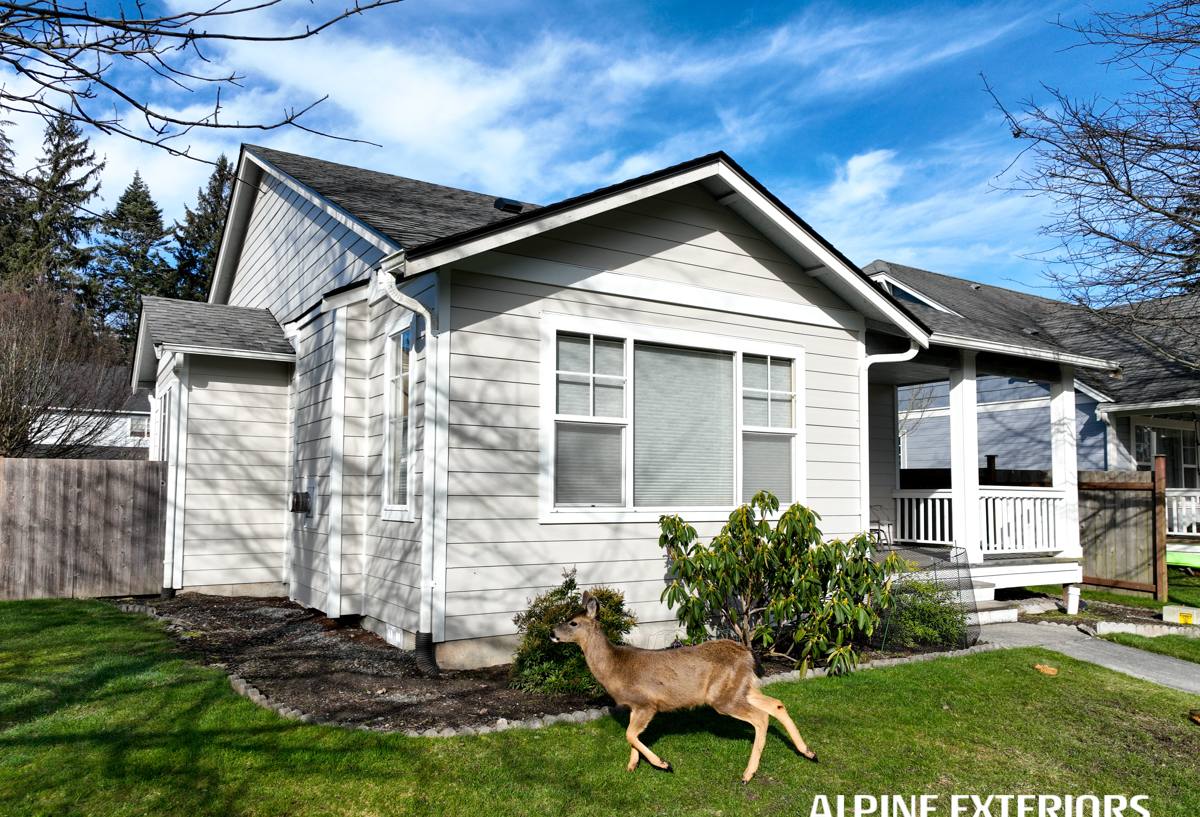
What We See on Island Homes
Working on Guemes Island and the surrounding Anacortes area, the failure patterns we run into are pretty consistent:
- Wood and engineered wood siding that has swollen, delaminated, or gone soft at butt joints and lower courses where moisture collects
- Vinyl siding that has faded, warped, or pulled away from the wall after years of temperature swings and wind loading
- Moss and algae staining on north- and west-facing walls that never get enough sun to dry out fully
- Corroded or failing fasteners and flashing where salt air has been in contact with unprotected metal for years
- Caulk and trim joints that have opened up, giving wind-driven rain a path behind the siding
These aren't signs of bad luck — they're what happens when a material or an installation detail wasn't matched to a marine climate. It's a big part of why we've narrowed what we install down to one product system.
Why We Only Install James Hardie Fiber Cement
We don't install LP SmartSide, vinyl, Cemplank, Allura, primed spruce, or cedar. That's a deliberate standard, not a marketing line, and it's worth explaining honestly.
Engineered wood products like LP SmartSide perform well in a lot of the country, but they rely on an intact factory coating and careful field sealing of every cut edge to keep moisture out. On a site with constant salt air and long damp stretches, that margin for error gets thinner. Vinyl siding is affordable and low-maintenance in the sense that it doesn't need painting, but it's also a thin plastic product that can warp in temperature swings, crack in cold snaps, and fade unevenly under UV exposure over the years — and it doesn't offer the same fire resistance as fiber cement. Cedar and primed spruce are beautiful materials, but real wood siding demands ongoing maintenance — recoating, caulking, and moisture monitoring — to hold up in a wet marine environment, and skipping a maintenance cycle can cost you years of service life. Other fiber cement brands, like Cemplank and Allura, are legitimate products, but we've standardized on one manufacturer so our crews install to one spec, our warranty conversations are consistent, and our supply chain doesn't vary job to job.
James Hardie fiber cement is non-combustible, engineered specifically for different climate zones (their HZ5 line is built for the kind of wet, temperate exposure we get in Western Washington), and finished at the factory with ColorPlus technology — a baked-on finish that resists fading and chipping far better than field-applied paint. It comes with a strong transferable warranty when installed to Hardie's specifications, which matters if you ever sell the home. We stand behind one product because we can install it correctly every time and back it with a warranty that means something.
What "Correct Installation" Actually Means Here
Fiber cement is only as good as the installation behind it. On Guemes Island specifically, that means:
- Proper rain-screen or drainage gap behind the siding so any moisture that gets past the surface can drain and dry instead of sitting against the wall
- Stainless or coated fasteners rated for coastal exposure, not standard galvanized fasteners that corrode faster in salt air
- Correct flashing at every window, door, and roof-to-wall transition — the places wind-driven rain actually finds its way in
- Manufacturer-specified nailing patterns and clearances, including gaps at grade and roof lines so the material isn't sitting in standing water
- Factory-cut and pre-primed edges wherever possible, since a raw cut edge is the one place fiber cement can absorb moisture if left unsealed
Getting the Job Done on an Island
Working on Guemes Island adds a logistics layer that mainland jobs don't have. Materials, equipment, and crews move by ferry, which means a job has to be planned around sailing schedules rather than just a drive-time estimate. We account for that in scheduling and material staging so a project isn't held up waiting on a missed ferry or a late delivery. It also means we try to get material counts right the first time — a forgotten box of fasteners is a bigger deal when getting back to the island takes an hour instead of ten minutes. A crew that's done island work before plans differently than one that hasn't, and that experience shows up in how smoothly the job runs.
More Than Siding: Roofing, Windows, and Decks
Siding is one piece of an exterior envelope, and on a marine site like Guemes Island, the pieces around it matter just as much. We also handle:
- Roofing — the first line of defense against driving rain and the source of a lot of moss growth if it's not maintained or ventilated properly
- Windows — a major source of air and water leaks when flashing and seals age out, and a natural project to pair with siding replacement since the wall is already open
- Decks — exposed to the same salt air and moisture cycles as siding, with their own set of material and fastener considerations
Bundling these into one project, when it makes sense for your home, means fewer separate contractors, one consistent set of flashing and waterproofing details across the whole envelope, and one crew accountable for how it all ties together.
Cost Factors for a Guemes Island Siding Project
Every home is different, but these are the variables that tend to move the price on island projects specifically:
| Factor | Why It Matters Here |
|---|---|
| Ferry and transport logistics | Material staging and crew scheduling around sailing times affects project timeline, not just cost |
| Existing siding condition | Moss, rot, or hidden moisture damage found during tear-off can add repair scope |
| Home exposure | Waterfront or bluff-facing walls with direct wind exposure may need additional flashing detail |
| Siding profile and trim complexity | Lap width, shingle-style panels, and trim detail affect labor time more than material cost |
| Access | Steep driveways, limited staging area, or septic/well locations common on island lots can affect setup |
We walk every one of these with you before giving a number, so the estimate reflects your actual house and lot, not a generic per-square-foot guess.
What to Look for in an Island Contractor
Not every contractor wants to take on island logistics, and that's a fair business decision on their part — but it means it's worth asking a few direct questions before you hire one for a Guemes Island job:
- Have they completed projects on Guemes Island or similar ferry-access communities before?
- Do they carry proper licensing and insurance in Washington State, and will they show you proof?
- Can they explain, specifically, how they'll handle flashing and moisture management for your home's exposure?
- Do they install one warrantied product system they stand behind, or are they willing to install whatever's cheapest that week?
- Will they give you a written estimate that accounts for ferry scheduling rather than a vague timeline?
A contractor who's done island work before will have straightforward answers to all of these without hesitation.
What to Expect Working With Us
We start with an on-site walkthrough of your home, looking at current siding condition, trouble spots, and exposure. From there we put together a written estimate that accounts for material, labor, and the realities of getting a crew and supplies to the island. If moss, water staining, or soft spots show up during that walkthrough, we'll tell you plainly what we're seeing and what it likely means — we're not going to sell you a cosmetic fix over a real moisture problem, and we're not going to oversell work your home doesn't need either.
Once a project starts, we manage the flashing, drainage, and fastening details that make the difference between siding that lasts decades and siding that fails early in a place like this. That's the same standard whether the job is a full re-side, a roof, new windows, or a deck.
If you own a home on Guemes Island and want an honest look at what your siding, roof, windows, or deck are dealing with, we're happy to come out for a free, no-pressure estimate — no obligation, just a straight assessment from a crew that knows this stretch of Skagit County. Use the form below to get started.