 Anacortes Siding
 An Honest Conversation Before You Choose a Siding Material
Homeowners in Anacortes ask us about vinyl siding more than almost any other product. It's the material most of Skagit County grew up seeing on new construction through the 1990s and 2000s, it's inexpensive, and it's still widely sold. We're not going to tell you vinyl siding is a scam or that every vinyl job fails. It doesn't, and it isn't. But we made a business decision years ago to install only James Hardie fiber cement siding, and we think you deserve a straight explanation of why, especially if you're comparing bids and one of them includes vinyl.
This isn't a sales pitch dressed up as an article. It's the same conversation we have with homeowners standing in their driveway, looking at their existing siding and asking what we'd actually put on our own house on Fidalgo Island.
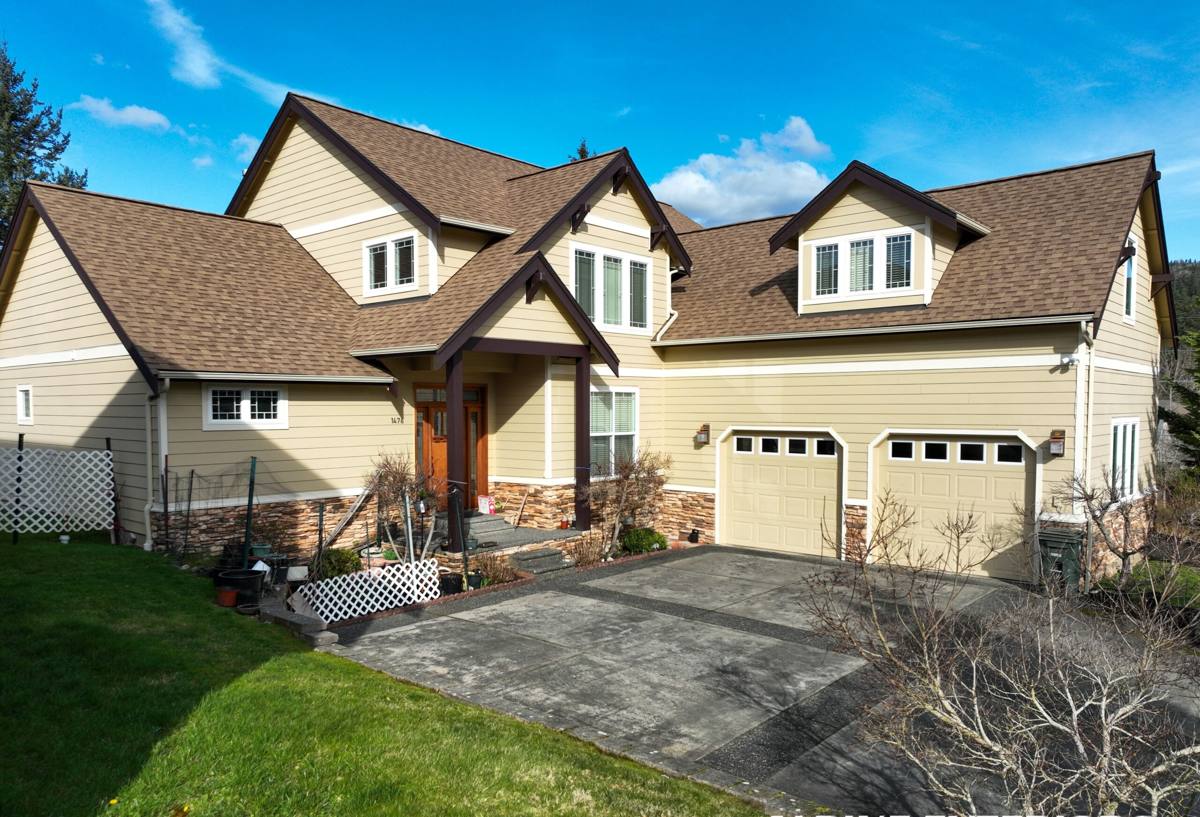
What Vinyl Siding Actually Gets Right
Vinyl earned its market share honestly. It's worth naming what it does well before explaining why we walked away from installing it:
- Low material cost. Vinyl is consistently the cheapest siding option per square foot, materials and labor combined.
- No painting. The color runs through the panel, so there's no paint film to fail on the surface — at least not for a while.
- Fast installation. Panels snap together quickly, which keeps labor costs down on straightforward walls.
- Doesn't rot. Vinyl itself is a plastic product (PVC) and won't rot the way untreated wood will.
If budget is the single deciding factor and the house is a short-term hold, vinyl isn't an irrational choice. Our objection isn't that it's a bad product in the abstract — it's that we don't think it's the right long-term product for homes in this part of Washington, and we don't want to sell something we wouldn't stand behind for twenty or thirty years.
Skagit County's Climate Is Harder on Siding Than People Expect
Anacortes sits on Fidalgo Island, surrounded by salt water on nearly every side, with Rosario Strait and the Guemes Channel funneling wind-driven rain straight into exterior walls for much of the year. That combination — salt air, near-constant moisture, and a moss season that can run from October through May — is a tougher environment than most siding marketing accounts for.
Salt Air and UV Together
Salt-laden air accelerates the breakdown of plastics and coatings faster than it does inland. Vinyl siding is engineered with UV inhibitors, but those inhibitors deplete over time, and coastal UV exposure combined with salt air speeds that clock up. The result homeowners see after a decade or so on the water side of Anacortes is chalking, brittleness, and color fade that's noticeably worse than what the same product shows forty miles inland.
Driving Rain and Wind Load
Wind off the water doesn't just bring rain — it drives it sideways, forcing water up under laps and into seams that are designed to shed water falling straight down, not water being pushed horizontally under pressure. Vinyl siding relies on overlapping panels and weep holes rather than sealed seams, which works fine in calm rain and struggles more in the kind of sideways weather Anacortes gets several months a year.
Moss, Mildew, and a Long Damp Season
Skagit County's moss season is long because the conditions moss needs — shade, moisture, and mild temperatures — persist here longer than in drier parts of the state. Vinyl's slightly textured, low-gloss surface and the narrow gap behind each panel give moss and mildew a place to establish, and because vinyl can't be pressure washed at close range or high pressure without risking cracked or dislodged panels, cleaning it safely is more limited than most homeowners assume.
Installation Sensitivity: Vinyl Has to Move, and That's the Whole Problem
Vinyl siding expands and contracts significantly with temperature — more than almost any other cladding material. Every panel has to be installed with a specific amount of slack, nailed in the center of the nail slot (never tight to the wall), so the panel can slide as it expands and contracts through the seasons. Get that installation detail wrong — and it's an easy detail to get wrong, since a tightly nailed panel looks "more finished" — and you get buckling, waviness, or panels that pop off their locks in a hard wind.
We've been called out to inspect vinyl jobs elsewhere in Skagit County where the siding looked fine for two or three years and then began rippling as the installation errors caught up with it. That's not a defect in the vinyl — it's a mismatch between a material that demands precise, disciplined installation and an industry where vinyl is often treated as the "fast, easy" siding and installed by crews moving quickly to hit a price point.
Impact Resistance and Physical Durability
Vinyl is a thin plastic shell, typically around .040 to .046 inches thick for standard grades. It handles everyday weather fine, but it's genuinely vulnerable to impact — a ladder set carelessly against a wall, a thrown rock, a wind-blown branch, or hail can crack or punch through a panel. Once a panel cracks, replacement means finding a color match, which gets harder every year as manufacturers update their color lines and older runs go out of production. A wall that's fifteen years old may simply not have a replacement panel available in the exact original shade.
What's Actually Happening Behind the Panel
This is the trade-off that matters most and gets talked about least. Vinyl siding is not a water barrier — it's a rain screen that's designed to let some moisture through to a water-resistive barrier (housewrap) behind it, which then has to manage and drain that moisture. That's a legitimate building science approach, but it puts the entire burden of moisture management on the housewrap, flashing, and drainage plane behind the siding rather than on the cladding itself.
In a climate like Anacortes's, where the wall assembly is dealing with moisture load for a large share of the year, we'd rather the cladding material itself be doing real work to shed water, not just passing the job downstream to a housewrap that's harder to inspect and harder to fix once the siding is up. Fiber cement doesn't solve every moisture-management question either — flashing and installation still matter enormously — but it's a denser, more dimensionally stable material behind which we're more comfortable building that assembly.
The Warranty Question
Vinyl siding warranties look generous on paper — many are advertised as "lifetime." In practice, most vinyl warranties are prorated after a set number of years, meaning the manufacturer's payout shrinks the longer you own the house, and they typically cover material replacement only, not the labor to remove and reinstall siding. Fading and color warranties are usually separate and shorter than the structural warranty, often 10-15 years, which matters given how UV and salt air affect color retention here specifically.
| Factor | Standard Vinyl Siding | James Hardie Fiber Cement |
|---|---|---|
| Material composition | PVC plastic | Cement, sand, cellulose fiber |
| Combustibility | Combustible, can melt/deform near heat sources | Non-combustible |
| Typical thickness | ~.040-.046 in | ~5/16 in |
| Expansion/contraction | High — requires slack installation | Low — dimensionally stable |
| Color | Through-body color, fades with UV/salt exposure | Factory-baked ColorPlus finish |
| Impact resistance | Cracks/punctures under impact | Resists impact; engineered for climate |
| Warranty structure | Often prorated after early years | Non-prorated transferable warranty (per Hardie terms) |
| Repainting needed | No (but color fades, can't repaint easily) | No factory finish repaint typically needed for years; can be painted if desired |
Why We Standardized on James Hardie
We stopped installing vinyl, LP SmartSide, and other engineered wood and plastic sidings for the same underlying reason: we wanted one product line we could fully stand behind on every job, in every microclimate around Anacortes, from the exposed waterfront to the more sheltered inland neighborhoods. James Hardie fiber cement is non-combustible, dimensionally stable (it doesn't need the expansion slack vinyl requires), and its HZ5 product line is engineered specifically for climates with significant moisture exposure — which describes Skagit County well.
The ColorPlus finish is baked on at the factory under conditions a job-site paint crew can't replicate, and it's backed by a substantially stronger fade warranty than typical vinyl color guarantees. It's a heavier, denser material to install correctly, which is exactly why installation quality matters — but that's a standard we control by specializing in one product rather than a limitation of the material.
What Correct Installation Looks Like
Because we only install one system, our crews aren't switching between vinyl's slack-nailing technique one week and fiber cement's fastening schedule the next. Consistency in installation technique is a real, if underappreciated, driver of how well any siding performs ten and twenty years out.
Questions Worth Asking Before You Decide
- How is this material rated to perform in wind-driven rain and coastal salt exposure specifically?
- Is the warranty prorated, and does it cover labor or just materials?
- What's the manufacturer's stated performance in high-moisture, low-sun climates like ours?
- How sensitive is the installation to crew experience, and what happens if it's installed slightly wrong?
- If a section is damaged in ten years, can it realistically be color-matched and replaced?
- Is the material combustible, and does that affect insurance or fire-zone considerations for your property?
It's Your House and Your Decision
We're not going to tell you vinyl siding will fail on your house — plenty of it is still standing and performing acceptably around Anacortes and the rest of Skagit County. What we will tell you is that after years of doing this work in a marine climate, we decided we'd rather install one product exceptionally well than several products adequately, and the product we chose is the one engineered for exactly the conditions this peninsula throws at a house: salt air, driving rain, and a long moss season that doesn't let up until late spring.
If you'd like to talk through your specific house, its exposure, and what siding actually makes sense for your situation and budget, we're happy to walk the property with you and give you a straightforward, no-pressure estimate — no obligation, no pushy follow-up calls.