 Anacortes Siding
 A Standard We Set, Not a Brand We Push
Homeowners in Anacortes sometimes ask why we don't offer siding options the way a lot of contractors do — vinyl, LP SmartSide, primed spruce, cedar, or one of the other fiber cement brands. The honest answer is that we used to install more than one product, and after years of tear-offs, warranty claims, and callbacks in Skagit County's coastal climate, we narrowed our lineup to one: James Hardie fiber cement. This isn't a marketing angle. It's a standard we hold ourselves to because it's the material that consistently holds up to what this region does to a house.
This page explains what that climate does, what makes the Hardie system different at a material and installation level, and why we'd rather turn away a job than install something we don't trust to last here.
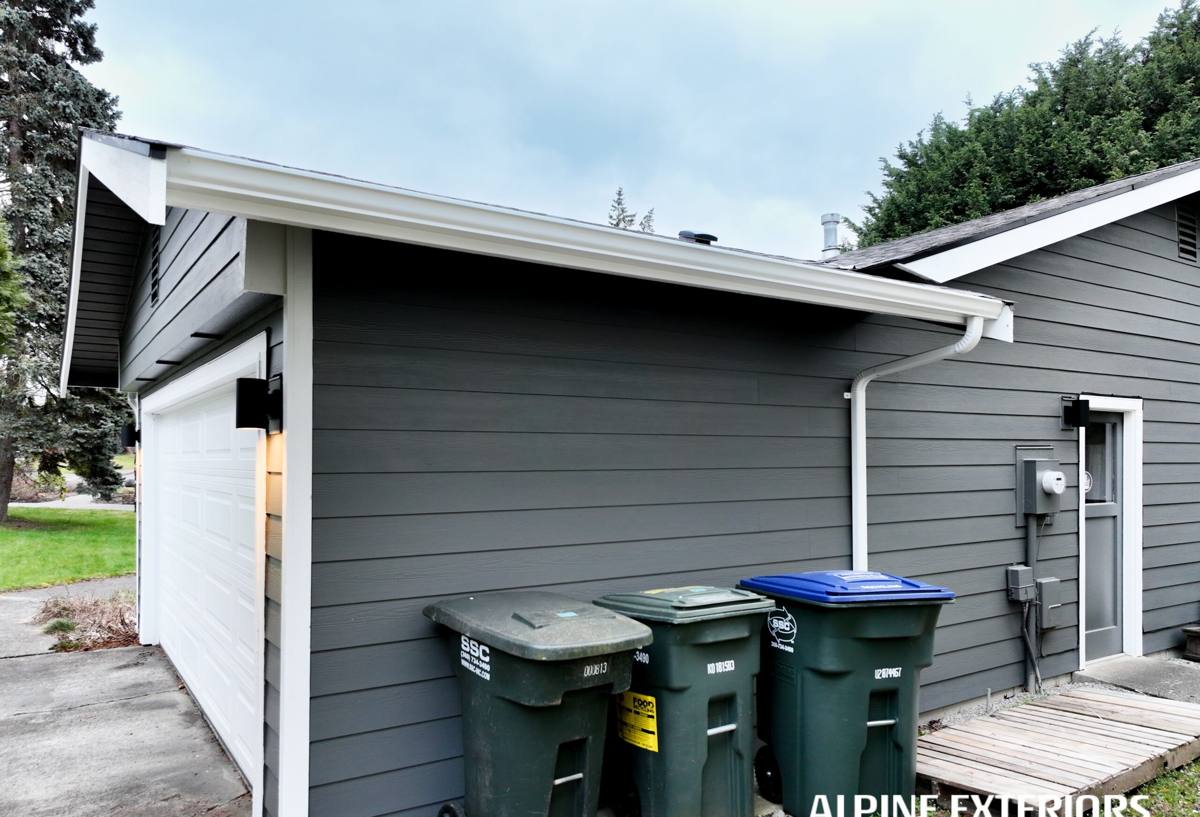
What Anacortes and Skagit County Do to Exterior Siding
Anacortes sits right on the water, and that proximity matters more for siding than most homeowners realize. Salt-laden air off Fidalgo Bay and the Guemes Channel accelerates corrosion on fasteners and finishes, and it degrades certain paints and coatings faster than manufacturers' published ratings assume. Add in driving, wind-blown rain that hits walls at an angle rather than falling straight down, and siding here spends more time actually wet — not just rained on — than siding in a drier inland climate.
Then there's the moss and algae season, which in this part of Western Washington runs long. North-facing walls, shaded elevations, and anything under tree cover stay damp for weeks at a stretch during fall, winter, and spring. Organic growth isn't just cosmetic — it holds moisture against the wall assembly, and moisture held against the wrong material is where siding problems start.
Any siding product can be marketed as weather-resistant. Not every siding product behaves the same way after five winters of salt air, driving rain, and moss on a wall in Skagit County. That gap between the brochure and the real-world performance is what pushed us toward one material.
Why This Matters More Here Than Elsewhere
A siding product that performs fine in a dry inland climate can struggle on the water. Materials that rely on paint film integrity to keep moisture out are only as good as that paint film, and salt air combined with constant damp cycles is a tough environment for any coating to hold up in without maintenance most homeowners don't keep up with.
Why We Stopped Installing the Alternatives
We're not going to tell you a competing product is junk — most of the materials on the market are engineered reasonably well for what they're designed to do. Our issue isn't that these products are bad in the abstract. It's that, installed on homes in this specific climate, they created trade-offs we weren't willing to keep signing our name to.
- Vinyl siding is affordable and low-maintenance in the sense that it doesn't need painting, but it's a thin, flexible material that can warp in temperature swings, crack on impact in cold weather, and it's not fire-resistant. It also fades over time with no way to refinish it — replacement is the only fix.
- LP SmartSide and other engineered wood products use a wood-strand core, which means the entire product depends on caulking, flashing, and paint maintenance staying perfect at every cut edge and seam. In a climate with this much sustained moisture, a wood-based core is a harder product to keep failure-proof over decades.
- Primed spruce and cedar are traditional and can look great, but real wood siding needs a repaint or restain cycle far more often here than in a dry climate, and it's the most vulnerable of all these options to rot, insect damage, and moss holding moisture against the boards.
- Other fiber cement brands (Cemplank, Allura) are chemically similar to Hardie in the broad sense — cement, sand, and cellulose fiber — but we don't have the same manufacturer support, factory-finish track record, or climate-specific engineering behind them that we get from Hardie in this region.
None of that means these products are wrong for every home in every climate. It means that after weighing what this coastline does to a wall assembly, we decided we'd rather install one product exceptionally well than several products adequately.
Inside the James Hardie System
James Hardie is fiber cement siding — a mix of Portland cement, sand, and cellulose fiber, cured into a rigid, dimensionally stable board. It doesn't expand and contract with humidity the way wood does, it doesn't soften or warp the way vinyl can in heat, and it's non-combustible, which matters increasingly for insurance underwriting as well as basic safety.
Product Lines We Use
Hardie makes several product profiles, and which one goes on a given home depends on the architecture and the elevation's exposure:
- HardiePlank lap siding — the traditional horizontal lap look, the most common choice for full re-sides in this area.
- HardiePanel vertical siding — used for board-and-batten style or modern vertical designs, often paired with lap siding as an accent.
- HardieShingle siding — a shingle profile for homes wanting a Craftsman or coastal cottage look without real cedar shingles' maintenance burden.
- HardieTrim — matching trim boards so fascia, corners, and window surrounds age and perform the same way as the field siding.
Built for This Climate Zone
Hardie engineers its products by climate zone, and the Pacific Northwest falls into their HZ5 category — formulated for regions with sustained moisture exposure. That's not a marketing label; it affects the product's moisture management characteristics at the manufacturing level, which is a meaningfully different starting point than a generic siding product sold the same way in every state.
ColorPlus Factory Finish vs. Field-Applied Paint
One of the biggest practical differences between Hardie and most alternatives is where the paint goes on. Most siding products get primed or painted on-site, after installation, exposed to whatever weather shows up that week. Hardie's ColorPlus Technology finish is baked on in a factory-controlled process, cured before the boards ever leave the plant.
That matters for two reasons. First, a factory-cured finish is simply more consistent and durable than field-applied paint, which is at the mercy of temperature, humidity, and application quality on the day it goes on. Second, in a climate with as much rain as Anacortes gets, being able to install pre-finished siding means we're not racing weather windows to get primer and topcoat on before the next system rolls in off the Sound.
ColorPlus finishes also come with their own finish warranty, separate from the substrate warranty, which is a level of coverage field-applied paint jobs don't carry.
The Warranty Structure — and Why It Transfers
Warranty language is where a lot of siding decisions get made or unmade, because the coverage on paper doesn't always match what a homeowner can actually collect on later.
| Factor | James Hardie | Typical Alternatives |
|---|---|---|
| Substrate warranty | Non-prorated, long-term coverage on the board itself | Often prorated after early years |
| Finish warranty | Separate ColorPlus finish coverage | Field-applied paint typically has no manufacturer finish warranty |
| Transferability | Transfers to a new owner if home is sold, within program terms | Varies widely; some are non-transferable |
| Installer requirement | Full coverage generally requires certified/approved installation practices | Often no installer certification tied to warranty |
That transferability piece is worth pausing on. Most homeowners aren't going to own a house for the entire life of its siding, and a warranty that dies the moment the home sells isn't worth much to a buyer weighing resale value. A siding warranty that survives a sale is a real asset when it's time to list the house.
What Correct Installation Actually Involves
Fiber cement siding is only as good as the installation behind it. A great product installed wrong will fail early, and a lot of the siding problems we get called out to inspect in Skagit County trace back to installation shortcuts, not the material itself. Proper Hardie installation isn't complicated, but it has to be done in order, every time.
- Correct water-resistive barrier and flashing detail behind the siding, especially at windows, doors, and roof-to-wall transitions
- Proper starter strip and clearance at the foundation line to keep the bottom edge out of standing water
- Fastener pattern, type, and spacing per Hardie's published installation guide — not generic siding nailing patterns
- Correct minimum overlap on lap siding courses
- Field-cut edges sealed and back-primed where required, since factory finish only covers the factory edges
- Proper gapping and caulking at butt joints and trim intersections to allow for material movement without letting water in
- Adequate clearance where siding meets decks, patios, and roof lines so water sheds away from the wall assembly
Every one of those details matters more on a coastal, high-rainfall property than it would in a dry climate, because there's simply more water hitting the wall, more often, for more of the year.
Comparing the Real Cost Picture
Upfront price isn't the whole cost of a siding decision — maintenance and replacement timeline factor in over the life of the house.
| Material | Upfront Cost | Ongoing Maintenance | Typical Service Life Here |
|---|---|---|---|
| Vinyl | Lowest | Low, but not repairable/refinishable | Shorter in coastal exposure |
| Wood (cedar/spruce) | Mid to high | High — regular repaint/restain | Shortest without diligent upkeep |
| Engineered wood (LP SmartSide) | Mid | Moderate — edge and seam maintenance | Moderate, edge-sensitive |
| James Hardie fiber cement | Mid to high | Low — factory finish, no repainting cycle for years | Longest of the group when installed to spec |
The honest way to read that table: Hardie usually isn't the cheapest option on install day, but it's rarely the most expensive either, and it tends to be the material that costs the least to own over a couple of decades once you factor in what the other options need to stay looking and performing well in this climate.
Is Hardie Right for Every Home?
We're not going to pretend fiber cement is the answer for literally every project. It's heavier than vinyl, so it's not the right retrofit for every existing structure without an engineering check. It costs more upfront than vinyl. And if a homeowner's priority is matching an exact historic wood profile for a preservation requirement, that's a narrower conversation. For the vast majority of homes in and around Anacortes, though, weighing salt air, driving rain, and moss season against decades of ownership, we think the case is straightforward — which is why it's the only material we put our name behind.
If you're weighing a siding replacement or new build in Anacortes or elsewhere in Skagit County, we're happy to walk your home, look at your specific exposures, and give you a straight answer on what it'll take — no pressure, no obligation. Reach out for a free estimate using the form below.