 Anacortes Siding
 Living on the Water: What Oak Harbor Exteriors Are Up Against
Oak Harbor sits close enough to the water that "coastal" isn't a marketing word here, it's a maintenance schedule. Homes in this part of the region deal with a mix of salt-laden air off the Sound, wind-driven rain that hits siding sideways instead of straight down, and long stretches of gray, damp weather where surfaces never fully dry out between storms. That combination is harder on a house than inland weather, even a short drive away. We work throughout the wider Anacortes and Skagit Valley area, and Oak Harbor is one of the communities where we see, consistently, which siding and exterior choices held up and which ones didn't.
None of this is dramatic. It's slow. A house doesn't fail overnight out here, it wears down a little at a time, season after season, until a homeowner finally notices soft trim, peeling paint, or a green film creeping across the north side of the siding. Understanding that slow wear is the whole reason our approach to exteriors looks the way it does.
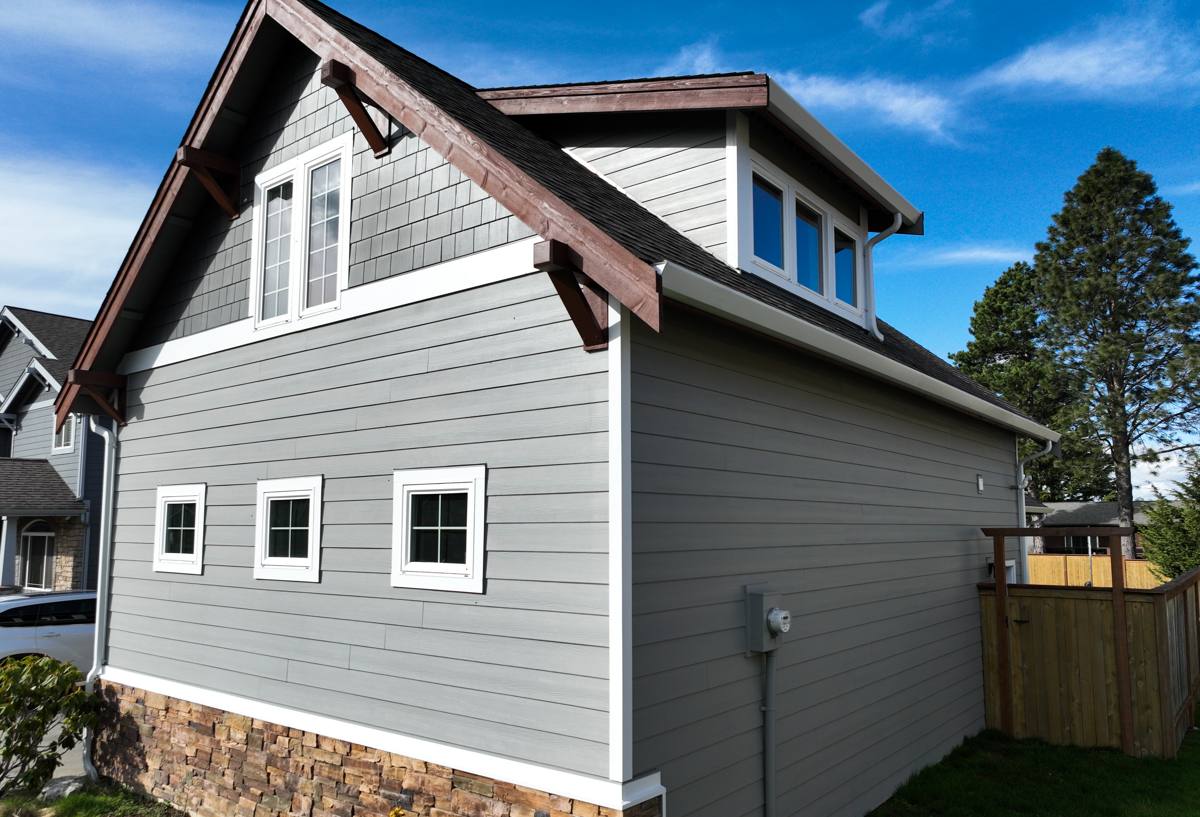
Salt Air, Rain, and Moss: The Three Things That Wear Down a House Here
Salt Air
Airborne salt is corrosive and it's persistent. It settles on fasteners, flashing, and any exposed metal, and it accelerates the breakdown of paint films and caulking. Materials that aren't dimensionally stable, or that rely on a factory finish not designed for marine exposure, tend to show fading, chalking, or corrosion around fasteners years before an inland home would.
Driving Rain
Wind off the water doesn't just drop rain, it drives it into every horizontal seam, window head, and butt joint on a wall. Any siding system that depends on perfect field-applied caulking to stay watertight is fighting a losing battle here, because caulk is the first thing that fails under repeated wetting and drying cycles. The materials and details that matter most are the ones that manage water even when a joint isn't perfectly sealed.
Moss and Sustained Moisture
The long moss season isn't just a roof problem. Moss and algae growth on siding, especially on shaded north- and west-facing walls, holds moisture against the surface for extended periods. Wood-based products are especially vulnerable here, since sustained dampness is exactly what leads to rot, delamination, and swelling at cut edges and fastener holes.
Why We Only Install James Hardie Fiber Cement
We made a decision a while back to standardize on James Hardie fiber cement siding for every siding job we do, full stop. That's not a sales pitch, it's a practical response to what we see on homes in this exact climate. Fiber cement is non-combustible, dimensionally stable in wet and dry cycles, and doesn't absorb moisture the way wood-based or wood-adjacent products do. For a marine environment with salt air and heavy rain, that stability matters more than almost any other property.
Hardie's ColorPlus finish is factory-applied and baked on under controlled conditions, which gives it better adhesion and UV resistance than field-applied paint. That matters in a place where a fresh coat of paint on the south side of a house can start showing wear years sooner than the same paint would inland. Hardie also engineers its products by climate zone, and the HZ5 product line used in this region is formulated for the specific moisture and temperature swings the Pacific Northwest sees, rather than a one-size-fits-all formula.
None of that means Hardie is maintenance-free. It still needs to be installed correctly, caulked at the right joints, and painted eventually if the factory finish isn't chosen or wears past its service life. But it starts from a much stronger baseline against the specific stresses this area produces.
What We Won't Put On Your House, and Why
We don't install vinyl siding, LP SmartSide, Cemplank, Allura, primed spruce, or cedar. That's a deliberate line, and homeowners deserve the honest reasoning, not just a rule.
- Vinyl siding is inexpensive and low-maintenance in mild climates, but it expands and contracts significantly with temperature swings, and driven rain can work behind panels at seams and corners over time. It also isn't a strong performer in wind-driven coastal conditions compared to a mechanically fastened cement board system.
- LP SmartSide and other engineered wood products use treated wood strand technology that resists moisture better than raw lumber, but it is still wood-based at its core. In a climate with a long moss season and sustained dampness, any wood-based product carries more long-term swelling and edge-deterioration risk than fiber cement, especially at cut ends if they aren't field-sealed exactly to spec every time.
- Cemplank and Allura are also fiber cement products, and reasonable alternatives in general terms. We simply standardized on one manufacturer, one warranty structure, and one factory finish system so our crews install to a single spec they know inside and out, and homeowners get one consistent, well-documented transferable warranty rather than comparing fine print between brands.
- Primed spruce and cedar are traditional, attractive, and can look great, but they demand real ongoing maintenance, refinishing on a schedule, and vigilant caulk and paint upkeep to hold up against salt air and driving rain. For homeowners who want that look and are prepared for the upkeep, that's a legitimate choice, just not one we install.
We'd rather turn down a job than install something we don't think will perform well on a house exposed to this kind of weather for the next 30 years.
Beyond Siding: Roofing, Windows, and Decks Built for the Same Conditions
Siding doesn't work in isolation. The same salt air, rain, and moss that wear down siding attack the rest of the exterior too, so we look at the whole envelope, not just one component.
Roofing
Roofs in this area deal with the same moss pressure as siding, plus wind uplift risk during storms. Proper underlayment, flashing at every penetration, and ventilation that keeps moisture from building up in the attic all matter as much as the roofing material itself.
Windows
Window flashing and integration with the siding plane is one of the most common failure points on coastal homes. A window that isn't flashed correctly will leak eventually, regardless of how good the siding around it is. We treat window replacement and siding work as connected, not separate jobs.
Decks
Decks take the most direct beating from rain and standing moisture of any exterior surface, since they're horizontal. Proper spacing, fastening, and material choice for ledger boards and framing matter as much as the decking surface itself, especially where a deck sits close to grade or under tree cover.
What Correct Installation Looks Like
Material choice only gets you part of the way. Most siding failures we're called out to inspect, on any brand, trace back to installation details rather than the product itself: missing or wrong-length fasteners, insufficient clearance at grade, unsealed butt joints, or flashing that was skipped to save time. Getting those details right matters more in a driving-rain climate than in a mild one, because there's less margin for error.
| Factor | James Hardie Fiber Cement | Vinyl | Engineered Wood (LP-type) | Cedar / Primed Spruce |
|---|---|---|---|---|
| Moisture absorption | Very low | None, but seams leak | Low if sealed correctly, higher if not | Moderate to high |
| Salt air resistance | Strong, factory finish | Moderate, can chalk/fade | Moderate | Requires frequent refinishing |
| Fire resistance | Non-combustible | Combustible | Combustible | Combustible |
| Typical repaint interval | 15+ years (ColorPlus) | N/A (can fade/warp) | 7-10 years | 3-7 years |
| Ongoing maintenance | Low | Low, but seam/edge issues over time | Moderate | High |
That table is a general guide, not a guarantee for any individual product line, since specific formulations and installation quality vary. It's meant to show the reasoning behind our standardization, not to replace an on-site look at your specific house.
A Homeowner's Maintenance Checklist
Even the right materials, installed correctly, benefit from basic seasonal attention. This is a reasonable checklist for a coastal Puget Sound home:
- Walk the exterior once or twice a year and look for caulk that's cracked, shrunk, or pulled away from joints, especially around windows and doors.
- Check for moss or algae buildup on shaded siding and roof surfaces, particularly on north-facing walls, and address it before it spreads.
- Keep gutters and downspouts clear so water isn't overflowing onto siding below the roofline.
- Look at grade clearance around the foundation, siding should have adequate clearance from soil, mulch, and hardscaping to avoid wicking moisture.
- Inspect deck ledger boards and fastener points annually, since they're a common spot for hidden moisture damage.
- Note any soft spots, discoloration, or bubbling paint and have them looked at promptly, since small issues are cheap to fix and expensive to ignore.
Why a Local, Skagit-Based Crew Matters
We're based in the region, not dispatched from somewhere else for a one-off job. That matters for a few practical reasons. A local crew knows what this climate actually does to a house over years, not just what a manufacturer's brochure claims. We're around after the job is done if a question comes up, and we're not guessing at wind exposure or moisture patterns because we see the same conditions on homes across Oak Harbor and the surrounding area regularly. Warranty support and follow-up service also mean more when the company doing the work is still local next year, and the year after that.
If you're weighing a siding, roofing, window, or deck project for a home in Oak Harbor, we're happy to take a look and give you a straightforward, no-pressure estimate. There's a form below to get that conversation started.