 Anacortes Siding
 Skyline sits up on the bluff on the west side of Anacortes, with a clear shot at the wind and weather coming off the Salish Sea. That view is the whole reason people buy up there, but it comes with a trade-off: homes on that bluff take more direct exposure than almost anywhere else in Skagit County. Wind-driven rain hits harder, salt air moves through faster, and the moss season runs longer under the mature evergreens that shade a lot of these lots. We do exterior work across Anacortes and greater Skagit County, and Skyline is consistently one of the neighborhoods where climate, not style preference, ends up dictating what actually holds up on a house.
What Skyline Homes Are Up Against
Elevation and open water exposure mean Skyline properties see more sustained wind-driven rain than homes tucked farther into town or shielded by terrain. That kind of rain doesn't just fall straight down and run off a roof the way it does on a calm day — it gets pushed sideways into siding laps, window and door trim, and any gap in flashing that wasn't detailed correctly the first time. Add in salt-laden air that accelerates corrosion on fasteners and metal flashing, and you have conditions that punish shortcuts faster than a sheltered inland lot would.
Then there's shade. Many Skyline lots have mature trees that block direct sun for large parts of the day, which is great for comfort in summer but means roofs and north- or east-facing siding stay damp longer after every rain. That's exactly the environment moss and algae need to establish themselves, and once they do, they hold moisture against the surface underneath, which accelerates whatever decay process is already underway.
None of these conditions are unique to this one neighborhood — they show up in varying degrees all over western Skagit County. What sets Skyline apart is the combination and the intensity: a bluff lot with water exposure sees more of all three factors — wind, salt, and shade-driven moisture — than most other addresses in Anacortes.
Common Issues We Find on Exterior Inspections in This Area
- Moss and algae buildup on shaded roof slopes and on north- or east-facing siding that rarely gets direct sun
- Caulking and trim joints that have opened up from repeated wet-dry cycling over multiple seasons
- Corroded or failing fasteners and flashing on older installations, especially anything not rated for coastal exposure
- Paint or coating failure on wood trim and siding — chalking, peeling, or fading from UV and salt exposure
- Water staining or soft spots near window and door trim where flashing details were never quite right to begin with
- Deck framing and ledger connections showing early corrosion where standard fasteners were used instead of coastal-rated hardware
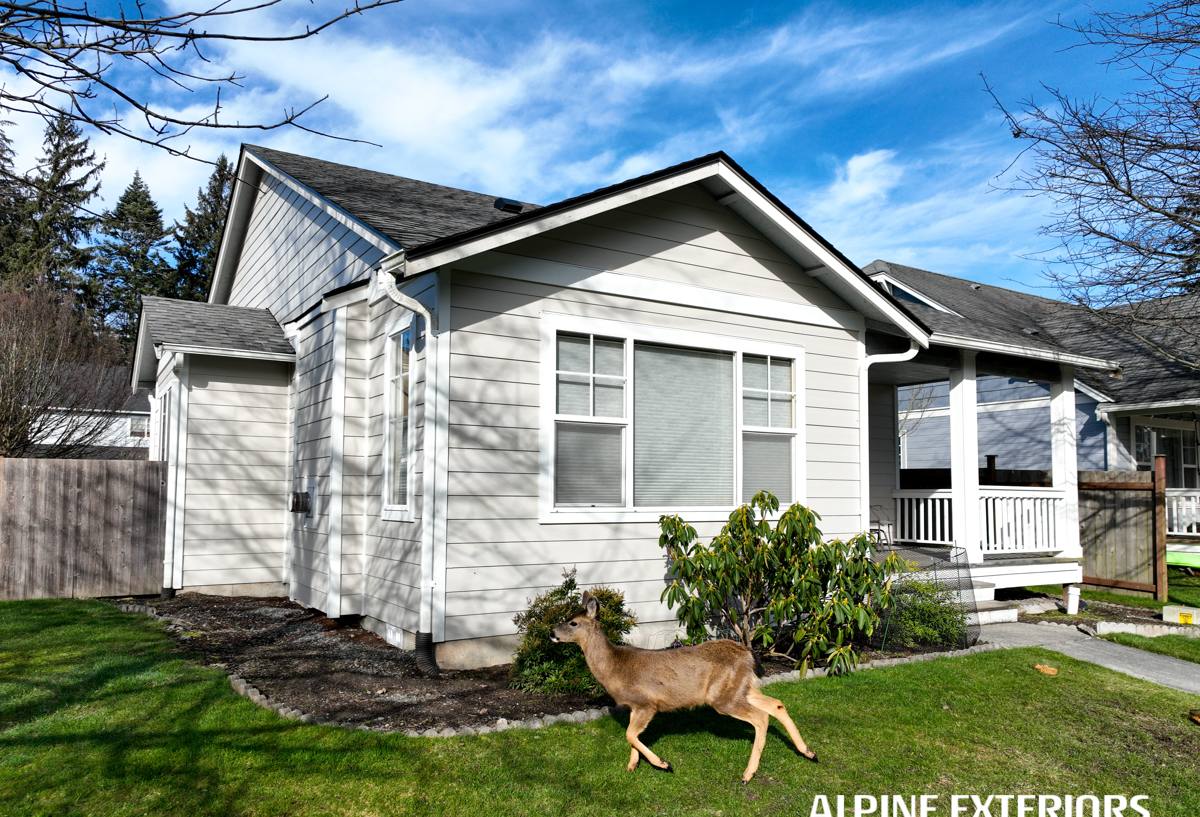
Why Siding Choice Matters More on a Bluff Lot
We install James Hardie fiber cement siding exclusively. We don't offer vinyl, LP SmartSide, Cemplank, Allura, primed spruce, or cedar as options, and that's a deliberate standard, not a supply limitation. We've watched how different siding materials actually perform in this specific climate over time, and a Skyline lot is about as demanding a test as this area offers.
Vinyl siding becomes more brittle with age and UV exposure, and it isn't a water barrier by itself — its performance depends entirely on the weather-resistive barrier and flashing behind it. On a wall that takes direct wind-driven rain, that's a real liability, because any gap in the assembly behind the vinyl becomes a path for water. Wood siding products, and engineered wood products like LP SmartSide, need a consistent repainting and sealing schedule to stay ahead of moisture, and if that maintenance slips even for a season or two on an exposed bluff home, rot can start at seams and cut edges before it's ever visible from the ground.
Fiber cement alternatives to Hardie exist, and some of them are reasonable products. Our decision to standardize on Hardie specifically comes down to the factory-applied ColorPlus finish, the depth of the climate-engineered product lines built for wetter regions, and the strength of the transferable warranty when the product is installed to spec. Hardie's fiber cement is also non-combustible, which matters everywhere but carries extra weight for homeowners thinking about wildfire-season smoke and ember exposure even in a coastal county like this one.
Hardie Product Lines We Work With
| Product Line | Best For | Notes |
|---|---|---|
| HardiePlank Lap Siding | Most Skyline homes, traditional and modern styles | Smooth or cedar-textured finishes, wide color range |
| HardiePanel Vertical Siding | Accent walls, modern designs, gable ends | Clean vertical lines, pairs well with lap siding |
| HardieTrim Boards | Window and door surrounds, corners, fascia | Matches siding profile, resists the swelling and rot that plague wood trim |
| HardieShingle Siding | Accent gables, coastal or craftsman styling | Staggered or straight-edge panels for a shingle look without the maintenance |
| HZ10 Climate Engineered | Homes with direct water or wind exposure, like Skyline | Formulated for wetter, harsher climate zones rather than a generic national spec |
What Correct Installation Actually Involves
Fiber cement siding is only as good as the installation behind it, and this is where a lot of the real-world performance difference between a Hardie job that lasts decades and one that fails early actually comes from. Hardie publishes specific fastening patterns, clearances, and flashing requirements, and on an exposed lot like Skyline we don't treat those as suggestions.
Key details we hold to on every job:
- Correct water-resistive barrier and drainage plane behind the siding, lapped and taped so water that gets past the cladding has somewhere to go besides the wall sheathing
- Proper flashing at every horizontal siding joint, and at every window, door, and roof-to-wall intersection — the places wind-driven rain actually finds a way in
- Manufacturer-specified fastener spacing and type, chosen for coastal exposure rather than a generic interior-grade fastener
- Minimum clearance between the bottom edge of siding and roofing, decks, and grade, so splash-back and standing water don't sit against the material
- Caulking only where Hardie's installation guide calls for it — over-caulking traps moisture just as often as under-caulking lets it in
None of this is exotic. It's the difference between following the manufacturer's actual specification and doing a version of it that looks right from the curb but skips the details that matter once the weather turns.
Roofing on an Exposed Lot
Roofs on bluff-facing homes take a different beating than roofs a mile inland — more wind load, more driving rain working its way under shingles and flashing, and often more moss pressure from shade and moisture that never fully dries out between storms. When we work on a Skyline roof, we pay close attention to flashing at valleys, chimneys, and wall intersections, since that's where wind-driven rain finds its way in if details are cut short. Proper attic and roof ventilation matters too — a roof deck that can't breathe holds moisture longer, and that shortens the life of whatever's installed on top of it, shingles or otherwise.
Moss removal and prevention come up in almost every conversation we have with Skyline homeowners. We can treat and remove existing moss and talk through options like zinc or copper strips that discourage regrowth along the ridge, but the durable fix is usually a combination of routine maintenance and making sure the roofing system itself was installed and ventilated correctly in the first place. A roof that's fighting shade and moisture from day one will always need more attention than one that was designed with this climate in mind.
Windows and Doors: Where Water Intrusion Usually Starts
On an exposed lot like Skyline, windows and doors are one of the most common places we find water problems — not because the window units themselves failed, but because the flashing and sealant around them weren't detailed for the level of wind-driven rain the site actually gets. When we replace windows or doors here, we're not just swapping units for newer ones. We integrate the flashing with the water-resistive barrier and the new Hardie siding around the opening, so water has nowhere to go but back outside, and we check that every sill pan and head flashing detail is doing its job before the trim goes back on.
Energy performance is worth a serious look at the same time. Older single-pane or early dual-pane windows lose a lot of heat in a climate that's damp and cool for much of the year, and upgrading them alongside a siding project is often the most efficient time to do it, since the trim and flashing work already overlaps. Doing windows and siding together also avoids paying for the same trim and flashing labor twice.
Decks in a Wet, Shaded Climate
A lot of Skyline properties have decks positioned to take advantage of the view, which often means west- or north-facing exposure with limited direct sun for drying out after rain. That combination of shade, persistent moisture, and salt air is hard on untreated wood and on any fastener or connector that isn't rated for coastal exposure. We build and repair decks with materials and hardware chosen for that reality, and we pay close attention to drainage and ledger flashing, since a poorly flashed ledger board is one of the more common places we find hidden rot tracking back into the house structure.
Deck Material Trade-Offs for a Bluff Setting
| Material | Upfront Cost | Maintenance | Fit for Skyline |
|---|---|---|---|
| Pressure-treated wood | Lower | Regular sealing or staining needed | Workable but needs consistent upkeep in a shaded, damp spot |
| Cedar | Mid-range | Sealing or staining to prevent graying and rot | Attractive but demanding under constant moisture and shade |
| Composite decking | Higher | Occasional cleaning, no staining | Strong option for shaded, wet lots — resists moisture and moss staining |
What Drives Cost on an Exterior Project Here
Every Skyline home is different, so we don't quote sight unseen, but a few factors consistently move the number more than others on this kind of lot:
| Factor | Why It Matters on a Bluff Lot |
|---|---|
| Extent of hidden moisture damage | Rot behind old siding or trim isn't visible until removal, and it changes the scope once we're into the wall |
| Access and staging | Narrow driveways, tree cover, and steep or terraced lots common in Skyline can affect scaffolding and material staging |
| Flashing and detail work required | A high-exposure site needs more careful, more labor-intensive flashing at every penetration and joint |
| Scope bundling | Combining siding with window, trim, or deck work in one project usually costs less than doing each separately over time |
Maintaining a Hardie Exterior in This Climate
One of the practical advantages of fiber cement over wood or vinyl in this environment is how little ongoing maintenance it needs when it's installed correctly. That doesn't mean zero maintenance, especially on a lot with Skyline's moss and salt exposure.
- Rinse siding annually to clear salt residue and organic buildup, especially on shaded, north-facing walls
- Inspect caulking at trim and window joints yearly and re-caulk any joints that have opened up
- Keep gutters and downspouts clear so water isn't overflowing directly onto siding or trim below
- Trim back vegetation that's keeping any section of the wall in constant shade and moisture
- Address any moss or algae on siding promptly with a gentle wash rather than pressure that can damage the ColorPlus finish
Why a Local Crew Matters Here
Skagit County's coastal microclimates aren't uniform, and Skyline's particular mix of elevation, water exposure, and tree shade is something you learn by working on homes here repeatedly, not by reading a spec sheet written for the whole region. We know which corners of a Skyline lot are going to take the brunt of a winter storm, where moss keeps coming back no matter what's done, and which flashing details actually matter versus which ones are just building-code minimums that don't account for this specific exposure. That local knowledge shapes how we scope a job before we ever pick up a tool.
It also means we're not guessing about permitting requirements or working around the practical realities of bluff-lot access, narrow driveways, or tree cover that affects scaffolding and material staging — all things that come up more often on Skyline properties than on a flat, open lot elsewhere in Anacortes.
What to Expect From an Estimate
- A walk-around inspection of siding, trim, roofing, windows, and any decks, noting current condition and problem areas
- An honest read on what's failing due to age versus what's failing due to exposure or a past installation shortcut
- A clear explanation of why we recommend James Hardie fiber cement over other siding products for a site with this level of exposure
- A written scope and estimate with no pressure to sign on the spot
If you own a home in Skyline and you're noticing moss buildup, fading or cracked siding, water staining near windows, or a deck that's showing its age, we're happy to take a look. Reach out for a free, no-pressure estimate — we'll give you a straight answer about what your home actually needs and why.