 Anacortes Siding
 Why Skyline Homes Take a Different Kind of Weather Beating
Skyline sits close to the water on Fidalgo Island, and that changes what siding has to survive here compared to a more sheltered lot elsewhere in Anacortes. Homes on open, elevated, or waterfront exposure catch wind-driven rain at angles that never touch a sheltered house, and they sit in a steady drift of salt-laden marine air that settles on every exterior surface, day after day. Add Skagit County's long, wet moss season on top of that, and you have three separate stressors — moisture, salt, and organic growth — working on the same wall assembly at the same time.
None of that means Skyline siding fails faster because it's poorly built. It means Skyline siding gets tested harder, and repairs that would hold up fine on a calmer street can fail again within a season or two if they don't account for the exposure. When we go out to a Skyline property, we're not doing a generic patch job — we're accounting for how this particular stretch of the island actually behaves.
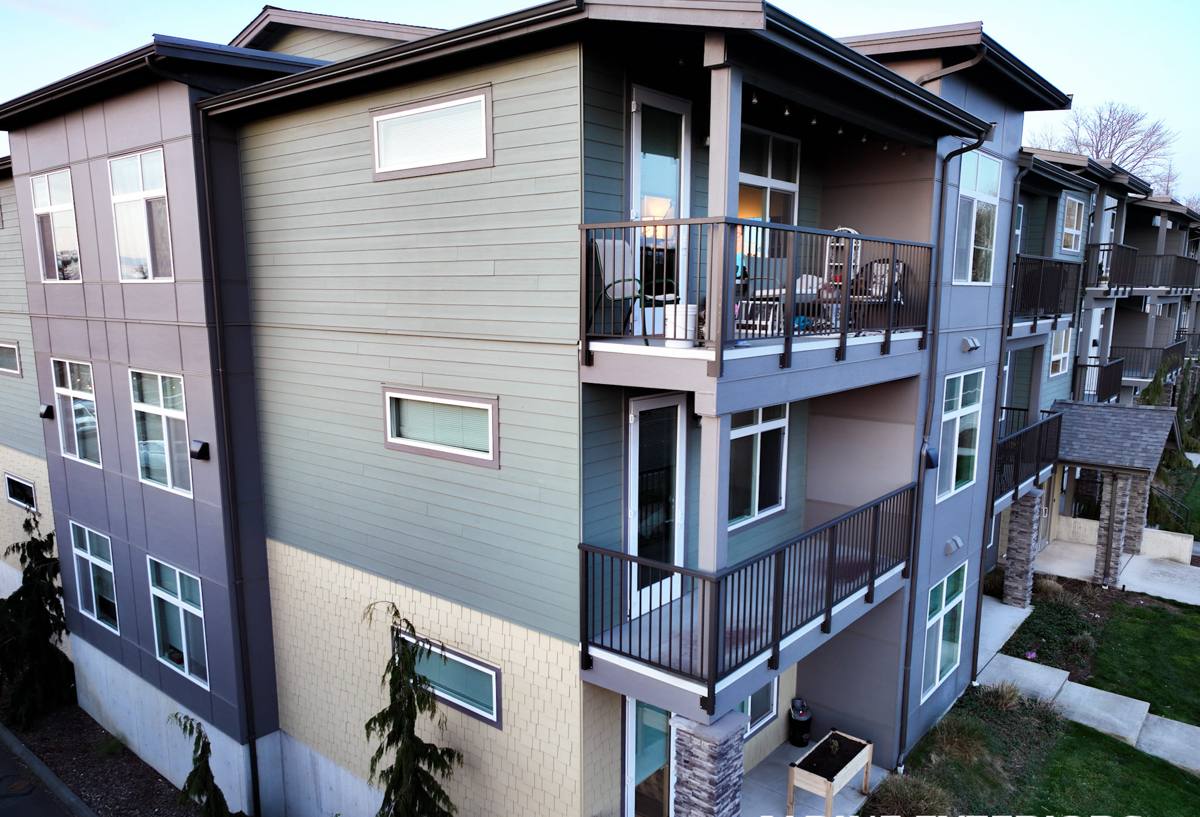
What Salt Air and Driving Rain Actually Do to Siding
It helps to understand the mechanism, not just the symptom. Salt air doesn't rot wood or fiber cement directly the way standing water does — its damage shows up mostly in the metal: nail heads, flashing, trim fasteners, and hardware corrode faster in a marine environment than they do a few miles inland. Once a fastener starts to corrode, it loses its grip, siding panels work loose, and the small gap that opens up becomes an entry point for water. From there, ordinary rain finishes the job that salt air started.
Driving rain is the second half of the problem. On exposed or elevated lots, wind pushes rain sideways and even slightly upward into laps, seams, and trim joints that were designed to shed water falling straight down. A siding system that's watertight in calm weather can still leak during a windstorm if the flashing details and caulked joints weren't built for lateral water pressure. This is why we see more moisture-related siding failures — not necessarily more cosmetic wear — on the higher-exposure lots around Skyline than on comparable homes tucked behind trees or hills elsewhere in town.
Where This Shows Up First
- Fastener heads and trim hardware — rust streaks and loosened panels near the coast-facing walls
- Butt joints and lap seams — where wind-driven rain gets pushed past the overlap
- Window and door flashing — a common leak point on any home, worse under sustained wind exposure
- Inside and outside corners — high-movement areas where caulk and trim fail first
Moss, Algae, and the Shaded North Side Problem
Skagit County's moss season runs long — the region stays damp enough, for enough months of the year, that anything shaded and slow to dry becomes a growth surface. On Skyline properties with mature evergreens or homes oriented so one wall rarely sees direct sun, that's exactly what happens to siding: moss, algae, and mildew take hold in the texture and seams, hold moisture against the surface, and keep that section of wall wetter, longer, than the rest of the house.
This matters for repair work specifically because moss and algae growth is often a symptom, not the actual problem. Homeowners call about green or black staining, but what we're usually finding underneath is a section of siding that's staying wet too long because of a drainage or clearance issue — gutters dumping water onto a wall, vegetation growing too close, or a grade that doesn't let water get away from the foundation. Cleaning the growth off without fixing why that wall stays wet just buys a season or two before it comes back.
Common Signs Skyline Homeowners Should Watch For
Most siding damage in this area starts small and stays hidden behind the surface for a while. Catching it early is the difference between a repair and a much bigger job. Walk your exterior a couple of times a year, especially after a hard windstorm, and look for:
- Soft or spongy spots when you press on the siding, especially near the bottom courses and around windows
- Visible gaps opening up at seams, corners, or where trim meets siding
- Rust streaking below nail heads or metal trim pieces
- Persistent moss, algae, or black staining that returns quickly after cleaning
- Paint or finish that's peeling, bubbling, or chalking unevenly in patches rather than uniformly with age
- Warping, cupping, or panels that no longer sit flat against the wall
- Musty smell or visible staining on interior walls that back up to an exterior wall — a sign water has already gotten past the siding
What a Correct Repair Actually Involves
A siding repair that's just cosmetic — cut out the bad piece, nail in a new one, caulk the edges — is the fastest way to end up doing the same repair again in a year or two, especially in this climate. A repair done right on a Skyline home goes a few layers deeper than the visible panel.
Step One: Find Out How Far the Damage Actually Goes
Damaged siding is often a symptom of something underneath — a compromised weather-resistive barrier, failed flashing, or a fastening pattern that was never right to begin with. We pull back far enough to see what's behind the panel before deciding on a repair plan, not just the section that looks bad from the outside.
Step Two: Fix the Water Path, Not Just the Panel
If flashing is corroded, the house wrap is torn, or a seam was never properly lapped, replacing the siding without correcting that underlying detail just resets the clock on the same failure. Given the wind-driven rain this area sees, we pay particular attention to how water is meant to shed at every joint we open up.
Step Three: Match the Material and the Fastening
Mismatched siding profiles, thicknesses, or fastener types create the next weak point. On James Hardie siding, that means matching plank profile, exposure, and factory finish so the repair blends in and performs the same as the surrounding wall — and using fasteners rated for the coastal exposure, not whatever happens to be on hand.
Step Four: Reseal and Finish to the Same Standard as New Construction
The caulking, flashing tape, and touch-up finish work at the edges of a repair matter as much as the panel itself. A repair that's finished carefully at the seams will hold up to the next windstorm the same way the rest of the wall does.
Repair vs. Replace: How We Make the Call
Not every siding problem on a Skyline home needs a full re-side, and not every problem should be patched. The honest answer depends on how much of the wall is affected and what's driving the damage.
| Situation | Repair usually makes sense | Replacement is usually the better call |
|---|---|---|
| Extent of damage | Isolated to one or two sections, corners, or courses | Damage is spread across multiple walls or the whole exposed elevation |
| Underlying cause | A single failure point — one bad flashing detail, one impact area | A systemic issue — original installation wasn't built for this exposure |
| Age and condition of remaining siding | Rest of the siding is sound and has years of service life left | Remaining siding is near end of life or was a lower-durability product to begin with |
| Material match | Matching product is available or the difference will be minor and low-visibility | Discontinued product, no reasonable match, or patchwork would be visually obvious |
| Water intrusion history | First occurrence, caught early | Repeat leaks or rot findings in more than one area over time |
We'll tell you plainly which side of that table your house falls on. If a repair is the right call, we do the repair. If what we find points to a bigger, recurring issue, we'll say so — and explain why — rather than sending you back out on the same wall again next winter.
Why We Repair With James Hardie Materials
Our company installs only James Hardie fiber cement siding, and that standard carries through to repair work. When we're patching into an existing Hardie wall, we use Hardie panels and trim so the fix matches the original material's density, texture, and factory ColorPlus finish rather than introducing a different product into the wall system. Fiber cement also holds up to this area's conditions in a way that matters for repairs specifically — it's non-combustible, it doesn't provide the organic material that moss and algae feed on the way wood products can, and it doesn't swell or rot from repeated wetting the way some engineered wood siding does under sustained marine moisture exposure.
If your existing siding is a wood-based product, vinyl, or another fiber cement brand, we'll still assess and repair what's there when a targeted fix is the right call. But if the damage points toward a larger replacement, we'll walk you through why James Hardie is what we recommend putting back up — not because the old product was necessarily a bad choice at the time, but because of how it's held up to this specific climate versus how Hardie performs in it.
Our Process When We Come Out to a Skyline Property
- Walk the exterior with you. We look at every elevation, not just the spot you called about — problems on a coastal-exposure home often show up in more than one place at once.
- Open up the damaged area. We pull back siding far enough to see the flashing, house wrap, and framing underneath before quoting anything.
- Give you a straight repair-or-replace recommendation. Based on what we find, using the same factors in the table above, with the reasoning explained, not just a number.
- Match materials and installation details to the exposure. Correct fasteners, correct flashing laps, correct sealants for this climate — not a generic patch.
- Finish and clean up. Touch-up work is done to blend with the surrounding siding as closely as the product allows.
Why a Crew That Already Works This Neighborhood Matters
Siding repair isn't a one-size-fits-all trade. A crew that mostly works sheltered, inland properties may not think to check flashing laps for lateral wind-driven rain, or may not recognize that recurring moss on one wall is a drainage issue rather than just a cleaning problem. A crew that's spent time on Skyline and other exposed Anacortes properties already knows where the damage tends to start, what the wind does on this stretch of the island, and how long moss season really runs in Skagit County — so the diagnosis is faster and the repair is built for the conditions it actually has to survive, not generic conditions.
That local familiarity also means a more honest estimate. We're not guessing at how this climate affects a repair — we've seen what holds up here and what doesn't, and we'll tell you which category your siding falls into.
If you're seeing damage, staining, or soft spots on your Skyline home's siding, we're happy to take a look and give you a straight assessment — no pressure, no upsell, just what we find and what we'd recommend. Fill out the form below to schedule a free estimate.