 Anacortes Siding
 Oak Harbor's Climate Is Rough on Siding — Here's Why
Homes in and around Oak Harbor sit close to the water, and that comes with a specific set of punishments most siding products were never designed to handle. Salt-laden air drifts off the Sound and settles on exterior walls day after day, slowly working into seams, fastener heads, and any spot where paint has thinned. Add in driving, wind-blown rain that hits siding sideways rather than straight down, and you've got moisture finding its way into places a drier inland home would never see it.
Then there's moss. The long, wet stretch of fall through spring here means anything organic — wood trim, cedar, primed spruce, even some vinyl trim caps — stays damp long enough for moss and algae to take hold. On wood-based products, that moisture retention is what eventually leads to soft spots, delamination, and paint failure. It's not a defect in any one product; it's just what happens when a material that isn't built for sustained dampness sits in a place that's damp for months at a stretch.
Any siding installed on an Oak Harbor home needs to handle three things well: constant moisture exposure, salt air, and long dry-out cycles that never quite finish before the next rain arrives. That's the lens we use for every job we bid in this area.
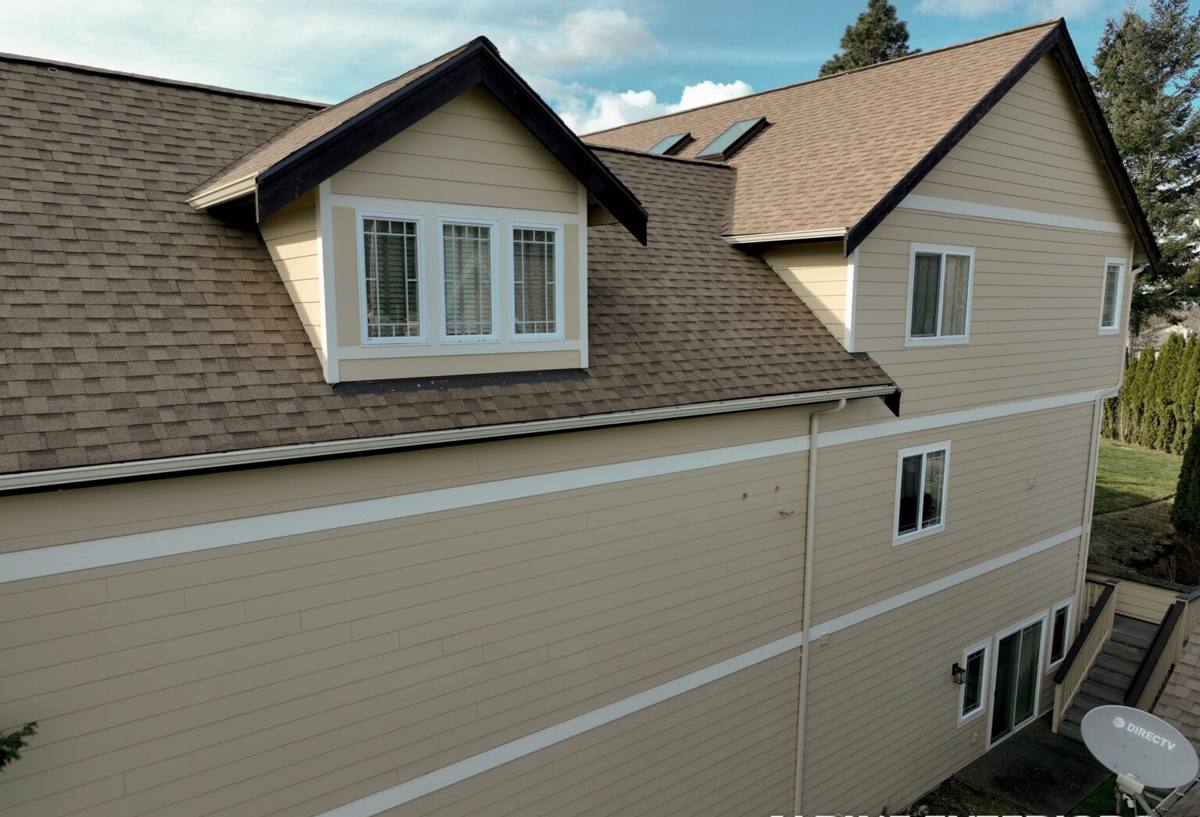
What a Correct Fiber Cement Installation Actually Involves
It Starts Before the Siding Goes Up
Most siding failures we get called out to inspect aren't a failure of the siding material — they're a failure of what's underneath it. A weather-resistive barrier that's lapped wrong, house wrap that's torn during installation, or flashing that was skipped around windows and doors will let water behind the siding no matter how good the surface material is. On a coastal property, that mistake shows up faster and does more damage, because there's simply more water trying to get in.
Clearances and Fastening Matter More Here
Fiber cement has to be installed with the correct ground clearance, proper gapping at butt joints, and fasteners driven to manufacturer spec — not overdriven, not underdriven. In a high-moisture, high-salt environment, sloppy fastening is where corrosion and water intrusion start. We use fasteners rated for the exposure and follow the manufacturer's nailing pattern exactly, because on this coastline there's no margin for shortcuts.
Caulking and Sealant Placement
Where fiber cement should be caulked and where it shouldn't be is a real point of technical detail that gets skipped by unfamiliar crews. Sealing joints that are designed to be sealed, and leaving weep points open where they're designed to drain, is the difference between siding that breathes correctly and siding that traps water.
Why We Only Install James Hardie
We made a decision a while back to standardize on James Hardie fiber cement and stop installing everything else — no vinyl, no LP SmartSide, no Cemplank, no Allura, no primed spruce or cedar. That's not a marketing position, it's a practical one. Once you've spent enough years pulling failed siding off houses in this climate, you start to see which products hold up and which ones create callbacks.
Hardie's fiber cement is non-combustible, dimensionally stable in wet-dry cycling, and comes with a factory-applied ColorPlus finish that's baked on under controlled conditions rather than field-painted. That matters directly here: field paint applied in a marine climate has a much harder time curing and bonding than a factory finish applied in a controlled plant. Hardie also builds region-specific HZ (HardieZone) formulations engineered for moisture exposure, which is exactly the variable that defines Oak Harbor's climate.
We're not saying every other product is unusable everywhere — we're saying that for the specific conditions we build in, Hardie is the one we're willing to put our name behind and back with our own workmanship warranty.
HZ5 and Product Lines We Use in This Area
James Hardie's HZ5 formulation is engineered for the wetter, cooler climate zones of the Pacific Northwest, which is the version we spec for Oak Harbor projects. Depending on the home's style, we typically work with:
- HardiePlank lap siding — the most common choice, available in smooth or cedarmill textures
- HardiePanel vertical siding — used for board-and-batten looks or accent sections
- HardieTrim boards — for corners, fascia, and window/door trim so the whole envelope matches in material and warranty
- HardieShingle siding — for homes wanting a shingle-style look without the maintenance of real cedar shingle
All of these carry ColorPlus factory finish options, which cuts down on the repainting cycle that coastal homes otherwise demand.
Cost Factors for an Oak Harbor Project
Every home is different, but the line items that actually move the price on a coastal fiber cement job are fairly consistent. We won't quote numbers we can't stand behind sight-unseen, but here's what drives the estimate up or down:
| Factor | Why It Matters Here |
|---|---|
| Condition of existing sheathing/WRB | Water-damaged sheathing found during tear-off is common on older waterfront homes and must be replaced before new siding goes on |
| Home exposure to prevailing wind/rain | Elevations facing open water or unobstructed wind often need more careful flashing detail and sometimes different fastening |
| Existing siding type | Removing old cedar or vinyl is a different scope than working over an already-stripped wall |
| Trim and architectural detail | Homes with lots of corners, gables, and window trim take more labor per square foot than a simple rectangular wall |
| Color/finish selection | Factory ColorPlus finishes cost more up front than primed board but eliminate a repaint cycle |
How Our Process Works
1. On-Site Walkthrough
We look at the whole exterior envelope, not just the siding — trim, flashing, window sills, and anywhere we see evidence of past moisture intrusion, which is common on older homes in this area.
2. Tear-Off and Sheathing Check
Once old siding is off, we inspect the sheathing and framing underneath. Any rot or water damage gets addressed before anything new goes up — installing new siding over a compromised wall just hides the problem.
3. Weather Barrier and Flashing
We install or verify a continuous weather-resistive barrier, with proper flashing at every penetration, window, and door. This is the step that determines whether the siding actually performs in driving rain.
4. Hardie Installation to Spec
Correct clearances, correct fastener type and spacing, correct gapping — installed to the manufacturer's published instructions, which is also what keeps the product warranty valid.
5. Final Walkthrough
We go over the finished work with the homeowner before calling the job done.
Signs Oak Harbor Homeowners Should Watch For
- Moss or algae buildup that keeps returning to the same section of wall, even after cleaning
- Paint that's bubbling, peeling, or chalking faster on one elevation than the others (usually the side facing prevailing wind and rain)
- Soft or spongy siding near ground level or under windows
- Visible gaps or separation at butt joints and corner boards
- Rust staining around fastener heads
- Interior signs — musty smell, staining, or soft drywall near exterior walls
Any one of these is worth having looked at before it becomes a sheathing or framing problem.
Maintenance in a Marine Climate
Fiber cement with a factory finish is low-maintenance, not no-maintenance. In this climate we recommend an annual rinse-down to clear salt residue and moss spores before they take hold, keeping gutters clear so water isn't sheeting down the wall face, and a visual check of caulking at trim joints every year or two. None of this compares to the sanding, scraping, and repainting cycle that wood siding demands out here, but a five-minute annual look prevents almost everything on the list above.
Why Hiring a Crew That Already Works Oak Harbor Matters
Coastal installation isn't the same job as installation twenty miles inland, even though the material is identical. A crew that regularly works this shoreline knows where water actually travels on these homes, which elevations take the worst weather, and how much margin to build into flashing details that a drier-climate installer might treat as optional. That local pattern recognition is exactly what prevents callbacks.
If you're weighing a siding replacement in Oak Harbor, we're happy to walk the property, look at what's there now, and give you a straight assessment of what it needs — no pressure, no upsell to a product we don't actually install. Request a free estimate through the form below and we'll get a time on the calendar.