 Anacortes Siding
 Guemes Island Siding: A Different Repair Job Than the Mainland
Guemes Island sits just across the ferry channel from Anacortes, but its siding takes a beating that mainland Skagit County homes are spared to some degree. Every house on the island is exposed to open water on at least one side, wind has nowhere to slow down before it hits a wall, and getting a crew and materials over means planning around a ferry schedule instead of just loading a truck. Repairing siding here isn't just a smaller version of a mainland job — it's a job that has to account for salt exposure, wind-driven rain, and a longer stretch of shaded, damp months than most people expect from a Pacific Northwest island this size.
We work on Guemes Island regularly enough to know what fails first, where it fails, and why patch jobs that look fine in July often come apart by the following winter if they're not done right. This page is about siding repair specifically — not full replacement, not new construction — and what a correct repair actually requires out here.
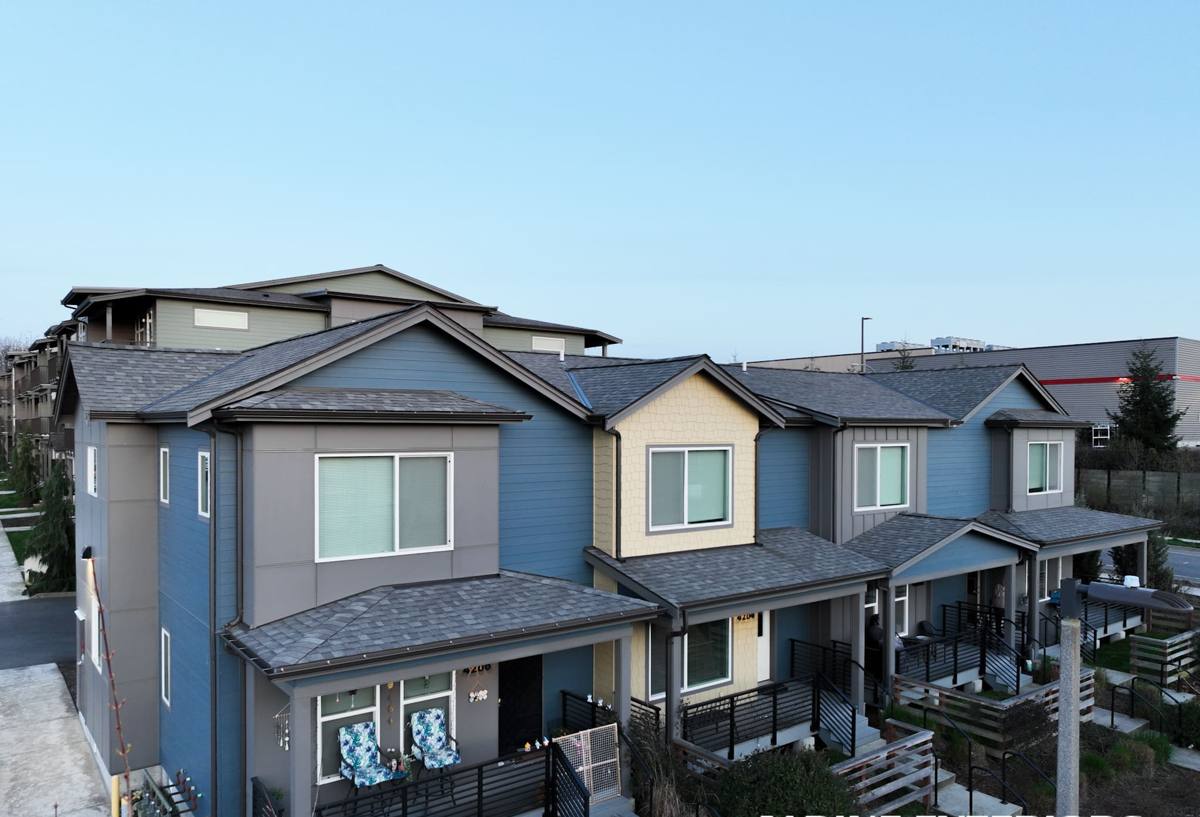
What Salt Air, Driving Rain, and Moss Actually Do to Siding
These three factors show up on almost every repair call we take on the island, and they interact with each other in ways that make problems worse over time.
Salt Air
Airborne salt from the surrounding water settles on siding, trim, and especially fasteners. On homes with wood or older composite siding, salt exposure accelerates surface breakdown and pulls moisture into the material through hairline cracks and open grain. On fasteners and flashing, it drives corrosion faster than an equivalent inland home would ever see. A repair that reuses corroded fasteners or ignores salt-affected trim is a repair that fails again within a couple of seasons.
Driving Rain
Rain on Guemes Island rarely falls straight down — wind off the water pushes it sideways into walls, which means water finds its way into laps, joints, and butt seams that would stay dry in a calmer setting. Siding systems that rely on gravity alone to shed water, or that weren't caulked and flashed with wind-driven rain in mind, are the ones we get called out to repair most.
Moss Season
Between the marine humidity and the shade from mature trees on much of the island, moss and algae have a long growing window here — often close to eight or nine months of the year with the right conditions. Moss holds moisture directly against the siding surface. On the north and west-facing walls especially, that constant dampness is what turns a small paint or coating issue into actual substrate damage.
Signs Your Guemes Island Siding Needs Repair, Not Just Cleaning
Not every stain or soft spot means a major repair, but a few signs consistently point to something beyond a surface wash:
- Soft or spongy spots when you press on the siding, especially near the bottom courses or around window and door trim
- Visible gaps or separation at butt joints, corners, or where siding meets trim
- Persistent dark streaking or moss growth that returns within weeks of cleaning
- Paint or coating that's bubbling, peeling, or chalking heavily on one side of the house more than others
- Cracked or missing caulk at seams, especially on the water-facing or prevailing-wind side
- Fastener heads that are rusted, popped, or leaving rust streaks down the siding
- Warping, cupping, or visible swelling along panel edges
If you're seeing more than one of these on the same wall, that's usually a sign water has been getting behind the siding for a while, not just sitting on top of it.
The Repair Problems We See Most Often on Guemes Island
A few patterns come up repeatedly on island homes, more than we'd typically see on a comparable Anacortes mainland property:
Moisture damage at the base of walls. Splash-back from driving rain, combined with grade and drainage issues common on wooded or sloped island lots, tends to concentrate damage in the bottom one to two feet of siding.
Failed caulk and sealant at trim joints. UV exposure plus salt air breaks down sealants faster here. Once a joint opens up, wind-driven rain gets pushed directly into it rather than running past it.
Moss-driven surface degradation on shaded elevations. North and east walls under tree cover often show more wear than the water-facing side, because they simply never fully dry out between rain events.
Impact and storm damage. Falling branches and wind-thrown debris are more common on tree-lined island properties, and repairs often involve matching an existing siding profile and finish rather than replacing a whole wall.
Corroded fasteners causing loose or rattling panels. This is a slower-developing problem but a common one on homes that are 15+ years old and haven't had the fastening reviewed.
What a Correct Siding Repair Involves
A repair that actually holds up out here isn't just "replace the bad board and caulk the edges." We treat every repair call as a chance to check the surrounding area, not just the obvious damage:
- Diagnose the source, not just the symptom. Damaged siding is often a downstream effect of a flashing gap, a grading issue, or a failed seal somewhere else. We identify why the damage happened before we fix it.
- Check what's behind the siding. Where damage suggests water intrusion, we look at the water-resistive barrier and sheathing underneath, not just the visible siding face. Patching over hidden rot doesn't solve anything.
- Match material and profile. Repairs should be close to invisible once painted — matching plank width, reveal, and texture rather than leaving an obvious patch.
- Use corrosion-resistant fasteners. Given the salt exposure, we don't cut corners on fastener spec here — it's one of the cheapest parts of the job and one of the most consequential if done wrong.
- Reseal and flash properly. Every trim joint, corner, and penetration gets sealed with wind-driven rain in mind, not just a bead of caulk for appearance.
- Prime and finish cut edges. Any field-cut siding edge gets properly sealed before install — an exposed cut edge is one of the fastest paths for moisture to get into fiber cement.
Patch, Section Replacement, or Full Re-Side?
Not every repair calls for the same scope of work. Part of an honest assessment is telling you which category your siding actually falls into.
| Approach | When It Makes Sense | What to Expect |
|---|---|---|
| Localized patch | Isolated impact damage, a single failed board, or a small area of moisture damage with no hidden rot | Fastest turnaround, lowest cost, minimal disruption to the rest of the wall |
| Section or elevation replacement | Damage concentrated on one wall or corner, often the water-facing or shaded side | More labor and material than a patch, but avoids re-siding the whole house when the rest is sound |
| Full re-side | Widespread failure across multiple walls, siding at or past its service life, or repeated repair calls on the same home | Highest upfront cost, but resets the whole envelope with current materials and proper detailing |
We'll always recommend the smallest scope that actually solves the problem. If a full re-side isn't necessary, we won't push for one.
Why We Repair With James Hardie Fiber Cement Only
When a repair requires new material — whether it's a single board or a full elevation — we use James Hardie fiber cement, and only James Hardie. We don't install or repair with LP SmartSide, vinyl, Cemplank, Allura, or unfinished wood siding, and on a site like Guemes Island, the reasoning matters more than usual.
Fiber cement is non-combustible and doesn't feed moisture into its core the way wood-based products can when a seal fails. Hardie's ColorPlus factory finish is baked on rather than field-applied, which means better UV and salt-air resistance than a job-site paint coat, and it holds up better against the moss and algae growth that's nearly constant here for much of the year. Hardie's HZ5 product line in particular is engineered for exactly this kind of coastal, high-moisture climate. It also means that when we patch a section of siding on an island home, the replacement material is dimensionally consistent with what's likely already on the house if it was installed with Hardie originally — and if it wasn't, it's a durable upgrade over whatever's failing now.
Matching material isn't about brand loyalty. It's about not repairing a moisture problem with a product that has the same vulnerabilities that caused it in the first place.
Getting a Crew and Materials to Guemes Island
Working on the island means building the ferry schedule into the job, not treating it as an afterthought. We plan material deliveries and crew trips around ferry availability so a repair doesn't stretch out over extra days waiting on a missed sailing. For larger repairs, we bring what we need in as few trips as possible — extra fasteners, matching material, sealants, and flashing stock — so we're not stuck mid-repair waiting on a supply run back to Anacortes. Homes on the island also tend to have more variable access — driveways, tree cover, and lot grading that differ from a standard mainland lot — so we walk the site and plan logistics before committing to a repair timeline, not after.
After the Repair: Keeping It Looking Right
A correct repair should hold up for years, but Guemes Island's climate means siding here benefits from more attention than a comparable inland home. A yearly rinse-down to knock back moss and salt buildup, especially on shaded or water-facing walls, goes a long way. Keeping gutters clear so water isn't sheeting down onto siding below, and trimming back vegetation that keeps a wall shaded and damp, both reduce the odds of needing another repair call in a few years. If you notice a new soft spot, a caulk joint opening back up, or moss returning heavily in one spot, catching it early is almost always a smaller job than waiting.
If you're seeing signs of trouble on your Guemes Island home, or just want an honest read on whether it's a patch job or something bigger, we're happy to come take a look. We offer free, no-pressure estimates and will tell you plainly what we see and what we'd recommend.