 Anacortes Siding
 Windows Built for Conway's Weather, Not Just Its Openings
Conway sits in the Skagit River delta, low and flat, with open exposure to weather moving in off Skagit Bay and the Sound. That means wind-driven rain that doesn't just fall straight down but gets pushed sideways into wall assemblies, humid air off the surrounding farmland and wetlands, and long stretches of gray, damp months where moss and algae get a real foothold on anything north-facing or shaded. Windows here take a beating that windows in a drier inland climate simply don't. A window that's merely "installed" isn't enough. It has to be sized right, flashed right, and sealed right for this specific environment, or it becomes the first place water finds its way into the wall.
"Custom" in this context doesn't mean fancy shapes or high-end finishes for their own sake — though we do those too. Most often it means building or ordering a window to fit an opening that doesn't match a modern standard size, which is common in Conway's older farmhouses and outbuildings-turned-homes. It also means adapting the installation detailing to the specific wall assembly and siding material on your house, rather than forcing a one-size-fits-all approach.
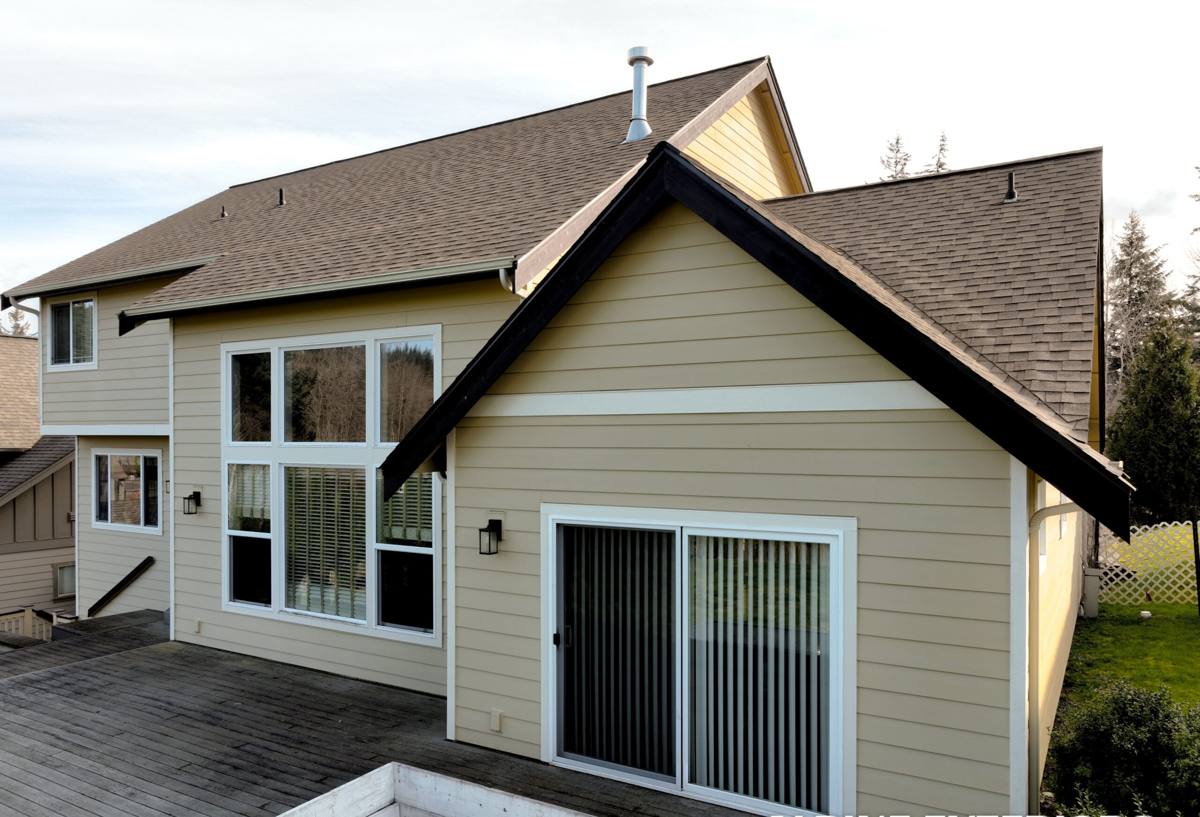
What Makes a Window Job "Custom" in a Place Like This
Non-Standard Openings
Skagit County has a lot of older homes — farmhouses, converted barns, additions built in different decades by different hands. Window openings in these houses frequently don't match today's standard sizes. Off-the-shelf replacement windows either won't fit or will fit poorly, leaving gaps that get packed with foam and hoped for. A custom window is built or special-ordered to the actual rough opening, or the opening is modified correctly to accept a standard unit — both are legitimate approaches, and which one makes sense depends on the house.
Matching the House
Grid patterns, trim profiles, and sightlines matter more on some homes than others. On an older Conway farmhouse, mismatched window styles from room to room stand out. Custom sizing and styling lets us keep sightlines consistent across additions and original construction, which matters both for how the house looks and for how it reads to a future buyer.
Integration With Siding and Trim
A window is only as good as what happens around its edges. Flashing, house wrap integration, and trim detailing determine whether water sheds away from the opening or gets trapped behind the siding. This is where a lot of window problems actually start — not in the window unit itself, but in how it was tied into the wall.
Material Choices, Honestly Compared
We install a range of window materials, and none of them is right for every situation. Here's how the common options actually perform in a wet, salt-influenced climate like Conway's:
| Material | Moisture Behavior | Maintenance | Best Fit |
|---|---|---|---|
| Vinyl | Won't rot or corrode; expands/contracts with temperature swings | Low — occasional cleaning | Most replacement and budget-conscious custom jobs |
| Fiberglass | Very stable dimensionally, handles moisture and temperature swings well | Low | Larger custom openings, higher-exposure walls |
| Wood-clad | Interior wood needs protection from condensation and interior humidity | Moderate to high — finish upkeep matters | Historic-style homes where interior wood look is a priority |
| Aluminum | Conducts cold, prone to condensation in our damp winters | Low, but performance trade-offs | Limited use; we typically steer clients away from it here |
We don't push one material on every homeowner. If you want the warmth of wood on the interior, we'll talk through what that means for upkeep given how much moisture this area sees. If low maintenance is the priority, vinyl or fiberglass will usually make more sense. What we won't do is install a product whose moisture behavior fights against the climate it's going into — that's a decision that costs homeowners money down the road, not just at install.
Glass and Energy Performance
Glass package matters as much as frame material. In Conway's climate, the two things worth paying attention to are:
- Low-E coatings — reduce heat loss in winter and glare in summer, and help manage condensation risk on the interior glass surface during cold, damp mornings.
- Gas-filled, multi-pane units — improve insulation value, which matters given how many overcast, heating-load days this area gets through fall and winter.
Condensation between panes is a sign of a failed seal, not a fixable problem — it means the insulating gas has escaped and the unit needs replacing. We'll point this out if we see it on your current windows during an estimate, since it's one of the clearer signs a window has reached the end of its useful life.
How We Handle a Custom Window Job
- On-site measurement. We measure every opening individually — we don't assume symmetry between openings that look alike, especially in older construction.
- Assessment of the wall assembly. We check what's behind the existing trim: house wrap condition, sheathing condition, any signs of past water intrusion.
- Ordering or building to fit. Depending on the opening and your goals, that means a special-order custom unit or a standard unit with the opening corrected to fit it properly.
- Careful removal. Old windows come out without tearing up more siding or trim than necessary, and we protect the opening from weather during the swap.
- Flashing and sealing. This is the step that determines long-term performance. Proper flashing tape, correct lap sequencing (so upper layers overlap lower ones, shedding water down and out), and sealing at the right points — not everywhere, since trapping moisture behind the wrong seal causes its own problems.
- Trim and siding tie-in. We match trim profiles and make sure the siding integration doesn't leave gaps or unsupported edges.
- Final check. Operation, seal, and sightline check before we call it done.
Signs It's Time to Look at Your Windows
- Visible fogging or moisture between panes (failed seal, not repairable)
- Drafts you can feel near the frame on windy days
- Wood trim that's soft, discolored, or shows moss/algae growth at the sill
- Windows that are hard to open, close, or lock — often a sign of frame warping
- Visible daylight or gaps around the frame from outside
- Rising heating bills without another clear explanation
- Paint or finish failing repeatedly at the same window despite touch-ups
What Affects Cost on a Custom Window Project
| Factor | Why It Matters |
|---|---|
| Opening size and shape | Non-standard sizes require special ordering or opening modification |
| Material | Vinyl typically costs less upfront than fiberglass or wood-clad |
| Glass package | Low-E coatings and multi-pane units add cost but improve performance |
| Condition behind the wall | Water damage or rot discovered during removal adds repair scope |
| Number of windows | Batching a full house typically has better per-window economics than one-offs |
| Trim and siding matching | Custom trim profiles or siding tie-ins take more labor than a straight swap |
We give straightforward, honest ranges during an on-site estimate rather than guessing over the phone — too much depends on what we find once we're actually looking at the opening and the wall behind it.
Why a Crew That Already Works Conway Matters
Conway is a small community, and its housing stock has a personality — older farmhouses, additions built over time, homes sited close to wet, low-lying ground. A crew that regularly works this part of Skagit County has already seen the common issues: openings that were framed slightly out of square decades ago, siding materials layered over each other in past remodels, drainage patterns that push water toward certain walls more than others. That experience shows up in fewer surprises mid-project and fewer callbacks after.
It also matters for something less obvious: knowing how this area's weather actually behaves through the seasons, not in the abstract. Moss season here isn't a one-time event — it's a recurring condition that any exterior work has to be built to withstand, year after year. Salt-tinged air off the Sound and the bay accelerates corrosion on the wrong hardware and finishes. A crew unfamiliar with the area might install a technically correct window that still underperforms here simply because the detailing wasn't adapted to local conditions.
Maintenance That Actually Extends Window Life
- Rinse frames and sills periodically to clear salt residue, especially on wind-exposed walls
- Keep gutters and downspouts clear so water isn't sheeting down past window heads
- Check caulking and sealant at trim joints annually — this is inexpensive to maintain and expensive to ignore
- Address moss or algae growth on sills and trim promptly, before it holds moisture against wood or finish
- Operate windows periodically even in winter to keep weatherstripping and hardware from sticking or seizing
If you're weighing replacement, remodeling an older Conway home, or dealing with an opening that just doesn't fit anything off the shelf, we're happy to take a look and talk through honest options. Reach out for a free, no-pressure estimate using the form below.