 Anacortes Siding
 Siding Built for Flounder Bay's Waterfront Exposure
Flounder Bay sits close enough to the water that homes here deal with a different set of stresses than a house a few miles inland in Skagit County. Salt-laden air moves off the bay and settles on every exterior surface, wind-driven rain comes in sideways during winter storms, and the shaded, damp stretches of the year give moss and algae plenty of time to take hold before summer dries things out. Any siding installed here has to hold up to all three at once, year after year, without constant upkeep from the homeowner.
We install James Hardie fiber cement siding exclusively, and we do it because it's the one product system we trust to perform in exactly these conditions. This page walks through what a correct installation looks like for a Flounder Bay home, what the local climate actually does to siding over time, and why the crew doing the work matters as much as the material itself.
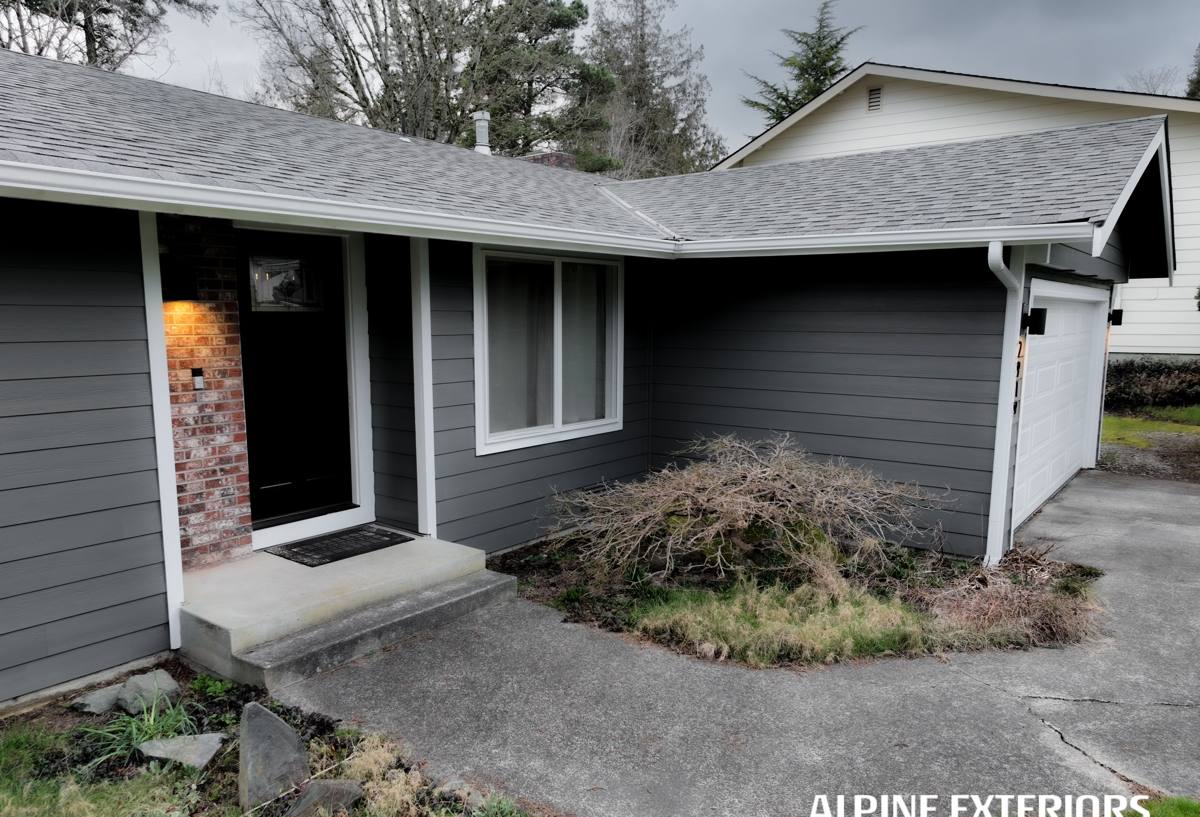
What Salt Air, Rain, and Moss Actually Do to Siding
Salt Air and Corrosion
Airborne salt is corrosive to metal components — fasteners, flashing, trim connectors — and it can accelerate the breakdown of finishes that aren't formulated to resist it. Over years, a home near the bay sees faster fade and chalking on lower-grade paint jobs than the same siding would show a few miles inland. This is one of the reasons factory-applied, baked-on finishes matter more here than in drier, inland parts of the county.
Driving Rain and Water Intrusion
Flounder Bay's exposure means rain doesn't just fall straight down — it gets pushed sideways into wall assemblies during winter fronts. Siding that isn't installed with proper clearances, flashing, and drainage behind it will eventually let moisture past the surface layer, and once water gets into the wall cavity, the damage is often hidden until it's expensive. Correct installation is a bigger factor in long-term performance than the siding material itself.
Moss and Algae Growth
Western Washington's long wet season, combined with the shade many Flounder Bay lots get from mature trees, creates ideal conditions for moss and algae to colonize a wall surface. Porous or absorbent siding materials give these organisms something to grip and grow into. Dense, factory-finished fiber cement gives them far less to hold onto, which matters over a 20- or 30-year ownership horizon.
Why We Only Install James Hardie Here
James Hardie fiber cement is engineered specifically to resist the combination of moisture, UV, and biological growth that defines a Pacific Northwest coastal climate. It's non-combustible, it doesn't rot or delaminate the way wood-based products can, and Hardie's ColorPlus finish is baked on in a factory-controlled process rather than field-applied — which means better adhesion and more consistent fade resistance than a job-site paint coat, especially in a salt-air environment like Flounder Bay.
Hardie also builds region-specific product lines (HZ5, HZ10) engineered for different climate zones, which lets us match the product to the actual exposure conditions of a given home rather than installing a one-size-fits-all board. For a waterfront-adjacent property, that distinction is worth taking seriously.
| Factor | James Hardie Fiber Cement | Vinyl / LP SmartSide / Cedar |
|---|---|---|
| Moisture resistance | Engineered for wet climates, doesn't absorb water like wood-based composites | Vinyl can warp; wood-based products absorb moisture at cut edges and fastener points |
| Salt air performance | Factory finish resists chalking and fade near water | Field-applied or lower-grade finishes fade faster in salt exposure |
| Moss/algae resistance | Dense material with less surface for growth to establish | More porous surfaces give moss and algae more to grip |
| Fire performance | Non-combustible | Vinyl melts/deforms; wood-based products are combustible |
| Long-term maintenance | Low — periodic wash, minimal repainting over the product's life | Vinyl can crack/fade; cedar needs regular refinishing; LP needs edge sealing diligence |
We're upfront that vinyl, LP SmartSide, and cedar all have legitimate uses and loyal followings elsewhere. But given what we've seen happen to lower-tier siding on homes near Fidalgo Island's shoreline, we made a standard for our own crews and stuck with it.
What a Correct Installation Involves
The siding material is maybe half the equation. The other half is installation detail, and this is where most long-term failures actually originate — not in the product, but in shortcuts taken during the install.
- Weather-resistive barrier: A continuous, properly lapped water barrier behind the siding, with no gaps at penetrations.
- Rainscreen gap: A drainage space between the barrier and the siding so any water that gets past the surface can drain and the wall can dry, rather than staying trapped against the sheathing.
- Flashing at every penetration: Windows, doors, vents, hose bibs, and any other wall penetration need properly integrated flashing so water is directed out and down, not into the wall.
- Correct fastener pattern and depth: Hardie specifies fastener placement and embedment for a reason — over- or under-driven fasteners are one of the most common causes of premature siding failure.
- Proper clearances: Siding held off decks, patios, and grade by the manufacturer-specified minimum, so splashback and standing moisture don't sit against the bottom edge.
- Factory-cut edges sealed where field-cut: Any cut edge exposed on site gets treated according to Hardie's specifications to maintain the product's moisture resistance.
Skip any one of these and the siding can look fine for a few years while a moisture problem builds behind it undetected — which is exactly the failure mode that's hardest and most expensive to fix later.
Our Process for a Flounder Bay Project
1. On-Site Assessment
We look at your home's specific exposure — how close to the water, how much shade, which walls take the worst of the winter storms — and use that to inform product selection and detailing, not just a generic spec sheet.
2. Removal and Substrate Check
Old siding comes off and we inspect the sheathing and framing underneath for any moisture damage before anything new goes on. This step catches problems that are invisible from the outside and is the whole reason a full re-side is a better long-term fix than siding-over-siding.
3. Water Management Installation
Weather-resistive barrier, rainscreen, and flashing go in first, with extra attention at every window, door, and penetration — this is the step that determines whether the wall stays dry for the next 30 years.
4. Hardie Panel Installation
Panels or lap siding go up to Hardie's fastening and clearance specifications, with trim and corner details finished to match.
5. Final Walkthrough
We walk the finished job with you, covering care and maintenance expectations specific to a bay-adjacent property.
Maintenance Realities for a Bay-Adjacent Home
Even the right product benefits from basic upkeep in this environment. Homes near Flounder Bay should expect to occasionally rinse salt residue and organic buildup off exterior walls, especially on north- and west-facing sides that stay shaded and damp longer. Gutters and downspouts need to stay clear so roof runoff isn't dumping extra water down a wall face. None of this is heavy maintenance — it's the kind of periodic attention that keeps a well-installed Hardie system performing at its best for decades, rather than the constant repainting or patching that lower-grade siding often demands in this same location.
Why Local Experience in This Exact Area Matters
A crew that has worked waterfront and near-waterfront properties around Anacortes and Skagit County knows where the problem spots typically show up — which wall orientations take the worst weather, how much clearance a given lot's drainage actually needs, and how the local moss season behaves on shaded elevations. That's knowledge you don't get from a spec sheet, and it shows up in fewer callbacks and a longer-lasting result. It also means we're not learning your neighborhood's climate on your project.
Choosing a Contractor for Flounder Bay Siding Work
- Ask what water-resistive barrier and rainscreen system they use, and why.
- Ask how they handle flashing at windows and penetrations — get specifics, not a general reassurance.
- Confirm they're a factory-trained Hardie installer, not just someone who occasionally orders the material.
- Ask what happens if they find moisture damage in the sheathing once old siding comes off.
- Get the warranty terms in writing — both the manufacturer's product warranty and the contractor's labor warranty.
- Ask for a written scope that specifies clearances, fastener schedule, and flashing details, not just "siding installation" as a line item.
Get a Straight Answer for Your Home
Every property near Flounder Bay has its own exposure, shading, and drainage situation, and the right approach depends on those specifics rather than a generic answer. If you're weighing a re-side or dealing with siding that's already showing wear from salt air, rain, or moss, we're happy to take a look and give you a straightforward assessment. Reach out for a free, no-pressure estimate using the form below.