 Anacortes Siding
 Ship Harbor sits at the exposed western edge of Fidalgo Island, where the ferry terminal and the open water of Rosario Strait meet the shoreline. Homes here take a beating that houses a mile inland in Anacortes simply don't see in the same combination: salt-laden wind off the water, driving rain that comes in sideways during winter storms, and long stretches of shaded, damp weather that keep moss and algae established on north- and west-facing walls for most of the year. Siding that would hold up fine in a more sheltered Skagit County neighborhood can start showing problems within a few years out here if it isn't matched to the exposure and installed correctly.
Why Ship Harbor Wears Out Siding Faster Than Most of Anacortes
Three things define this stretch of shoreline, and all three work against ordinary siding at the same time. First is direct wind exposure — there's little in the way of terrain or dense tree cover between the water and many of the homes here, so wind-driven rain hits walls with real force during fall and winter systems instead of just running down them. Second is salt aerosol. Even without a direct waterfront lot, homes close to Rosario Strait pick up airborne salt that settles on siding, trim, and fasteners, accelerating corrosion and breaking down finishes that aren't built to shed it. Third is the region's long moss season — mild, wet winters and shaded exposures mean some walls stay damp for weeks at a stretch, which is exactly the environment moss, algae, and mildew need to take hold.
None of these are exotic problems. They're the same three forces that affect siding all over coastal Skagit County — but Ship Harbor gets a concentrated version of all three at once, which is why we treat it as its own case rather than applying a generic siding spec.
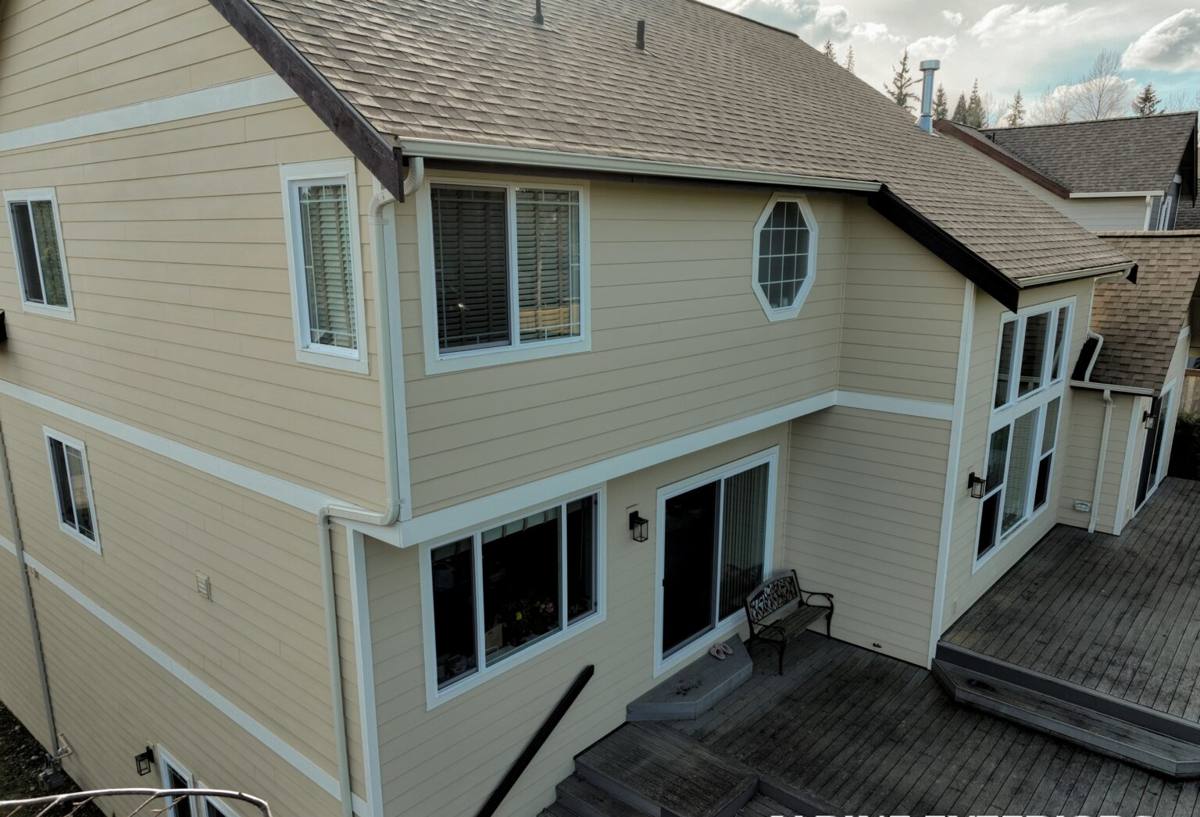
What Salt Air, Wind-Driven Rain, and Moss Season Actually Do to a Home's Exterior
Salt aerosol and fastener corrosion
Airborne salt doesn't just dull a painted finish — it accelerates corrosion on exposed metal: nail heads, flashing seams, and trim fasteners. Once corrosion starts at a fastener, water tracks in around it, and a small metal problem becomes a siding problem. This is why fastener choice and flashing detail matter more here than they would on a sheltered inland lot.
Wind-driven rain and wall assembly moisture
On an exposed wall, rain isn't just falling past the siding — it's being pushed into every lap, seam, and penetration. If the water-resistive barrier behind the siding, the flashing at windows and doors, and the lap spacing aren't done to spec, wind-driven rain finds its way behind the cladding. Once moisture gets trapped behind siding on a wall that doesn't get much sun or airflow to dry it back out, the sheathing underneath is at risk, not just the siding face.
Moss, algae, and prolonged dampness
Moss and algae need three things: moisture, shade, and time. Ship Harbor's shaded, damp walls provide all three for much of the year. Beyond the cosmetic issue, sustained growth holds moisture against the siding surface and can work into laps and seams over time, so a wall that looks "just a little green" is often also a wall that's staying wet longer than it should.
Why We Standardized on James Hardie Fiber Cement for This Kind of Exposure
We install James Hardie fiber cement exclusively — not vinyl, not LP SmartSide, not cedar, not other fiber cement brands. That's a deliberate standard, not a default. Fiber cement is non-combustible and dimensionally stable in a way wood-based and polymer sidings aren't: it doesn't expand and contract with moisture and temperature swings the way wood products do, and it doesn't soften, warp, or become fastener-loose the way engineered wood siding can once moisture gets past the surface. In an environment like Ship Harbor, where wind-driven rain and prolonged dampness are routine rather than occasional, that stability is the difference between a wall system that shrugs off the climate and one that's fighting it every winter.
James Hardie's ColorPlus factory-applied finish is also part of the decision. It's baked on under controlled conditions with a finish engineered to resist fading and hold up against UV and moisture exposure, which matters on walls that get a steady coating of salt film and long wet seasons. A field-painted finish — on any siding material — is only as good as the paint job and the maintenance schedule behind it; ColorPlus is built into the product before it ever reaches the site.
Choosing the Right HardieZone Product Line for a Ship Harbor Home
James Hardie engineers its siding by climate zone under the HardieZone system, and the Pacific Northwest — including Skagit County and Anacortes — falls under the HZ5 designation, formulated for wetter, more moisture-exposed climates. That's the baseline we build from for every Ship Harbor project, but the specific product mix still depends on the home:
- HardiePlank lap siding — the standard field siding for most homes, available in several profiles and textures; the workhorse for exposed walls facing the water or prevailing wind.
- HardiePanel vertical siding — often used for accent sections, gables, or a more modern look, with fewer horizontal laps for water to catch on.
- HardieTrim boards — matched trim around windows, doors, and corners, which is where a lot of moisture intrusion problems actually start if the trim and flashing aren't detailed correctly.
- HardieSoffit panels — vented or non-vented options for eaves, relevant on homes where roof overhangs are shallow and walls get more direct rain exposure as a result.
The right combination depends on the home's exposure, its existing wall assembly, and how much overhang protection it already has. That's a walkthrough conversation, not a one-size answer — a west-facing wall with minimal eave overhang needs a different level of flashing and clearance attention than a sheltered side wall on the same house.
What a Correct Installation Involves
Fiber cement siding is only as good as the installation underneath it. Most of the problems we get called out to diagnose on other contractors' work trace back to shortcuts in a handful of specific steps — not the material itself. On a Ship Harbor home, we treat each of these as non-negotiable:
- Water-resistive barrier and drainage plane — a continuous, correctly lapped barrier behind the siding, with a drainage gap where the wall assembly calls for one, so any water that does get past the cladding has somewhere to go besides the sheathing.
- Flashing at every penetration — windows, doors, hose bibs, light fixtures, and vents all get proper head flashing and sealant details, since these are the highest-risk points for wind-driven rain intrusion.
- Correct fastening — fastener type, spacing, and depth to Hardie's specifications, using corrosion-resistant fasteners appropriate for a marine-influenced climate rather than standard-grade hardware.
- Proper lap and clearance — correct overlap on horizontal laps, and correct clearance from grade, roof lines, and decks so water doesn't wick into the bottom edge of the siding.
- Caulking and sealant at seams — using sealants rated for exterior, UV, and moisture exposure, applied only where Hardie's install guide calls for them (over-caulking can trap moisture just as easily as under-caulking).
None of this is unique to Ship Harbor — it's how Hardie siding is supposed to go on anywhere. What changes here is how little margin for error there is. A flashing detail that's "close enough" might go unnoticed for a decade on a sheltered inland wall. On an exposed Ship Harbor wall taking direct wind-driven rain every winter, the same shortcut tends to show up as a problem in a fraction of that time.
ColorPlus Factory Finish vs. Field Painting in a Salt-Air Environment
Homeowners sometimes ask whether a field-painted finish would be cheaper or just as good. In a salt-air, high-moisture environment like this one, we don't recommend it as a first choice. ColorPlus finish is cured onto the board in a factory setting, giving consistent coverage and adhesion that's difficult to match on-site, especially on cut edges and touch-ups after installation. Field-applied paint depends heavily on surface prep, weather conditions during application, and the specific paint product used — variables that are hard to control on an active job site and easy to get wrong. For a wall that's going to be exposed to salt film and long wet seasons for the next several decades, we'd rather start with a finish engineered for exactly that exposure than take on the added maintenance risk of a field-applied coating.
Cost Factors for a Ship Harbor Siding Project
Every home is different, so we don't quote sight-unseen — but the factors that move the price on a project like this are consistent enough to lay out honestly:
| Factor | Why It Matters Here |
|---|---|
| Wall exposure and orientation | West- and south-facing walls facing the water often need more attention to flashing and fastening detail, which affects labor time. |
| Existing wall condition | If old siding removal reveals sheathing damage from past moisture intrusion, repair work adds to the scope before new siding goes on. |
| Product mix | Lap siding, panel siding, trim, and soffit each have different material and labor costs; a home using several product types costs more than a single-product job. |
| Trim and detail complexity | Homes with more windows, dormers, and roof intersections have more flashing points, which adds labor regardless of square footage. |
| Access and site conditions | Waterfront and hillside lots around Ship Harbor can complicate staging and scaffolding, which affects labor time. |
We walk every home before quoting so the number reflects the actual wall conditions and exposure, not a generic per-square-foot estimate.
Maintaining Hardie Siding Near the Water
Fiber cement is low-maintenance compared to wood-based siding, but "low-maintenance" doesn't mean "no maintenance," especially in a salt-air, moss-prone location. A simple annual routine goes a long way:
- Rinse salt film and airborne grime off the siding with a garden hose or soft wash — avoid high-pressure washing, which can force water behind laps and damage the finish.
- Check and clear gutters and downspouts before the fall rains, since overflowing gutters send extra water straight down the wall face.
- Look at caulked joints around windows, doors, and trim once a year for cracking or gaps, and have any failures resealed before winter storms arrive.
- Keep an eye on shaded, north-facing walls for moss or algae growth and address it early rather than letting it establish for another wet season.
- Trim back vegetation and tree limbs that keep a wall section shaded and damp longer than the rest of the house.
Why Hire a Crew That Already Works This Area
Ship Harbor's exposure isn't a theoretical concern — it's a specific combination of wind, salt, and moisture that shows up in how we detail flashing, which fasteners we spec, and where we pay closer attention during installation. A crew that hasn't worked this stretch of shoreline before is learning those lessons on your house. We'd rather bring the experience with us. That's true whether it's a full re-side after old siding has failed, or new construction where getting the wall assembly right from the start avoids problems entirely.
If you're weighing a siding project on a Ship Harbor home — whether you're dealing with moss buildup, moisture damage from a past installation, or just planning ahead for a home that's due — we're happy to walk the property, look at the actual exposure your walls are dealing with, and put together a straightforward, no-pressure estimate. Use the form below to get started.