 Anacortes Siding
 Roof Repair for Conway's Particular Climate Mix
Conway sits in the low, flat stretch of Skagit County between Anacortes and Mount Vernon, close to the Skagit River delta and the open farmland that runs out toward the bay. That geography matters more than most homeowners realize when it comes to roofs. You get the same marine air and driving rain that hits the rest of Skagit County and the San Juan region, but with less tree cover in a lot of spots than you'd find closer to town, which means more direct wind exposure across open fields. On properties that do have mature trees or sit closer to sloughs and wetland edges, you get the opposite problem: shade and standing moisture that never fully dries out between storms.
Either way, a roof out here is working harder than a roof in a drier inland climate. Salt-laced air moving up from the Sound and Skagit Bay accelerates corrosion on exposed metal. Long stretches of damp, low-light weather from fall through spring feed moss and algae. And because rain here tends to come sideways as much as straight down, water finds its way into gaps that would never leak in a calmer climate. Repair work in Conway has to account for all of that, not just patch whatever is visibly broken.
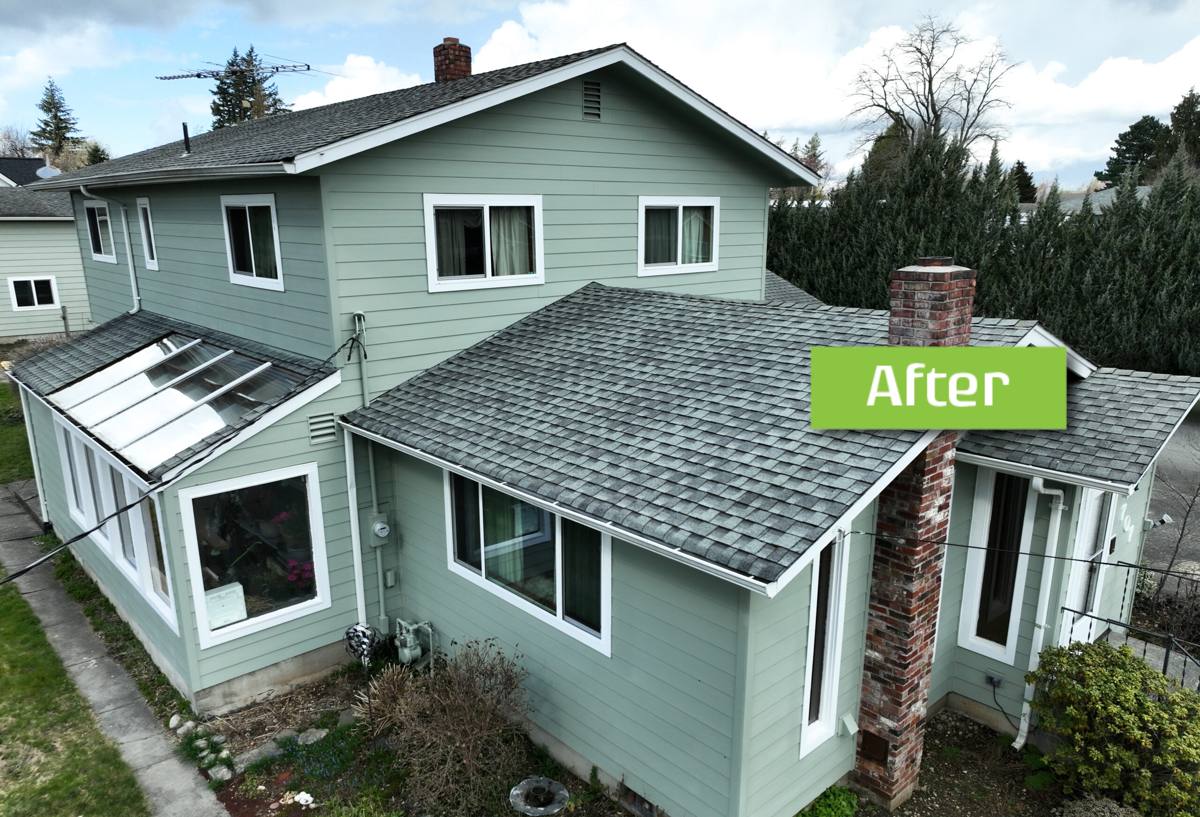
Signs a Conway Roof Needs Repair, Not Replacement
Most roofs don't fail all at once. They fail in specific spots, usually the same spots, because those spots are where water naturally wants to go or where two different materials meet. Catching these early is the difference between a repair bill and a full tear-off.
- Water stains on interior ceilings, especially near chimneys, skylights, or where a roof plane changes direction
- Granules collecting in gutters or at downspout outlets, a sign asphalt shingles are wearing thin
- Moss or thick algae buildup concentrated in shaded valleys or on the north-facing slope
- Lifted, cracked, or missing shingles after a windstorm
- Rust streaking or soft spots around metal flashing at chimneys and sidewalls
- Sagging or spongy feel in a specific section of roof deck, usually near a past leak
- Daylight visible through the attic at roof penetrations or ridge lines
If what you're seeing is limited to one or two of these, in one area of the roof, it's almost always a repair situation. Widespread granule loss across the whole field, or soft decking in multiple places, starts pointing toward replacement instead.
Moss, Algae, and Salt Air: What's Actually Happening
Moss doesn't just sit on top of shingles looking messy. Its root structure lifts shingle edges and holds moisture directly against the roofing material, which is exactly what asphalt and wood shingles don't want. In Conway's damp, low-sun months, moss can take hold in shaded valleys and north slopes within a couple of seasons if it isn't controlled. Left alone, it works granules loose and creates channels for water to track under the shingle course above it.
Algae is a different problem — mostly cosmetic dark streaking — but it signals the same underlying condition: a roof surface that stays wet longer than it should. Salt air compounds things on the metal side of a roof. Nail heads, flashing, and any exposed fasteners corrode faster this close to the water than they would twenty miles inland. We see this most often on older flashing around chimneys and skylights, where a fastener that's rusted through is often the actual source of a leak that looked, from the ceiling stain, like it was coming from somewhere else entirely.
Where Leaks Actually Start
A homeowner's first instinct is usually to blame the shingles themselves, but in our experience the shingle field is rarely the real point of failure. The most common failure points are the transitions — anywhere the roof plane changes, gets interrupted by a penetration, or meets a wall.
| Location | Why It Fails | What a Correct Repair Involves |
|---|---|---|
| Chimney flashing | Step and counter-flashing corrode or pull away from mortar joints over time | Removing old flashing, resealing or re-cutting the reglet, installing new step flashing under the shingle course |
| Roof valleys | Concentrated water flow wears through valley metal or open valleys faster than the field | Replacing valley metal or membrane, re-lacing or re-cutting shingles to proper clearance |
| Vent boots and pipe jacks | Rubber boot collars crack and shrink years before the shingles around them wear out | Swapping the boot, checking deck condition underneath, resealing to code |
| Skylight perimeters | Factory flashing kits degrade or were installed without proper underlayment lap | Removing and reinstalling flashing with correct shingle and underlayment sequencing |
| Sidewall step flashing | Missing or improperly lapped flashing where a roof meets a wall or dormer | Re-flashing each course individually rather than relying on caulk alone |
How We Approach a Conway Repair Call
We don't sell a repair off a photo or a phone description. Water travels before it shows itself, so what looks like a leak over the kitchen might actually be entering ten feet away at a valley or vent. Our process is built around finding the real source, not just the visible symptom.
- On-roof inspection. We walk the roof, not just the ground, checking flashing, fasteners, shingle condition, and deck firmness at and around the suspected problem area.
- Attic check when accessible. Interior water paths often reveal where a leak is actually entering versus where the stain shows up.
- Written scope before work starts. You get a clear explanation of what's failing, why, and what the repair involves — no vague line items.
- Repair matched to cause. We fix the flashing, decking, or ventilation issue causing the failure, not just the shingles sitting on top of it.
- Debris and moss cleared responsibly. Moss and old material removed without pressure-washing the shingle surface, which does more damage than the moss itself.
- Final walk-through. We show you what was done and what to watch for going forward.
Repair vs. Replacement: How to Tell
Nobody wants to pay for a repair on a roof that needs replacing in two years, and nobody wants to pay for a full replacement when a targeted fix would've done the job. Here's the honest breakdown we use when we're standing on a Conway roof making that call.
| Factor | Leans Repair | Leans Replacement |
|---|---|---|
| Age of roof | Under 15-18 years (asphalt) | Approaching or past manufacturer's expected service life |
| Extent of damage | Localized to one flashing point, valley, or section | Multiple leak points or widespread granule loss |
| Decking condition | Firm underfoot, no soft spots found | Soft, spongy, or delaminated decking in more than one area |
| Shingle condition overall | Rest of roof still has consistent color and flexibility | Brittle, curling, or cracking shingles across the field |
| History | First repair call on this roof | Third or fourth repair on the same roof in recent years |
Broadly speaking, most straightforward flashing or valley repairs in this area run in the low hundreds to low thousands of dollars depending on access, material, and how much of the surrounding roofing has to come up to do the work correctly. Anything beyond that scope is worth a real inspection before assuming replacement is necessary — and worth one before assuming it isn't.
Materials That Hold Up Out Here
What we install during a repair matters as much as the workmanship. Given the salt air and moss pressure common around Conway and the wider Anacortes area, we lean toward materials with a track record in this specific climate rather than whatever is cheapest at the yard.
- Flashing metal: we favor corrosion-resistant metals over painted steel in areas with direct salt air exposure, since coated steel can start rusting at cut edges and fastener points within a few seasons here
- Underlayment: synthetic underlayment or self-adhered membrane at valleys and eaves, which handles wind-driven rain better than older felt products
- Shingles: algae-resistant granule shingles where a full course replacement is needed, since standard granules streak faster in this humidity
- Sealants: we treat caulk and roofing cement as a backup, not a primary seal — proper flashing geometry does the real work of keeping water out
We're not tied to one manufacturer, and we'll tell you plainly when a premium product isn't worth the cost difference for a targeted repair versus when it is. The goal is a repair that matches the performance of the surrounding roof, not one that becomes the next weak point.
Why It Matters to Hire a Crew That Already Works This Area
Roofing crews that mostly work drier, inland climates tend to under-detail flashing and skip ventilation checks that matter a lot more here than they do there. A crew that regularly works Anacortes, Conway, and the rest of Skagit County knows which failure points show up repeatedly in this specific weather pattern — the sideways rain, the shaded moss zones, the salt exposure closer to the water — and builds the repair to hold up against that, not against a generic set of building code minimums.
There's also a practical side to it: a local crew can get to a Conway roof quickly when a storm damages it, and can follow up the next season to check that a repair is holding, without a long drive eating into the job.
Ventilation: The Repair Step People Skip
A leak repair that ignores attic ventilation is only half done. Poor airflow traps moisture under the roof deck, which speeds up moss growth from the underside as well as the top, and shortens the life of the shingles you just paid to fix. When we're already up on a Conway roof for a repair, we check ridge and soffit venting as a matter of course. If the attic is trapping heat and moisture, we'll flag it — sometimes the fix is as simple as clearing blocked soffit vents, and sometimes it means adding ventilation as part of the repair scope. Either way, it's better to know before the next repair call, not after.
Get a Straight Answer on Your Conway Roof
If you're seeing a stain, missing shingles after a windstorm, or moss that's gotten out of hand, it's worth having someone look before it turns into a bigger job. We'll give you a free, no-pressure estimate, tell you honestly whether it's a repair or something bigger, and explain exactly what the work involves — use the form below to get started.