 Anacortes Siding
 Bow's Roofs Work Harder Than Most
Bow sits close enough to Samish Bay and the surrounding saltwater shoreline that homes here deal with a combination most inland Washington roofs never see: salt-laden air, wind-driven rain off the water, and long stretches of shade and dampness that keep moss and algae active for most of the year. Add in Skagit County's mix of open farmland exposure and tree-lined properties, and you get roofs that age unevenly — one side battered by wind and salt, the other slowly colonized by moss under overhanging branches.
An asphalt shingle roof that's installed correctly for this environment can handle it for decades. One that's installed to a generic spec, without attention to ventilation, flashing, and moisture management, tends to show its age early — curling shingles, granule loss, soft decking, and moss creeping under the shingle tabs within the first ten years. The difference isn't the shingle bag on the shelf; it's how the whole system is put together.
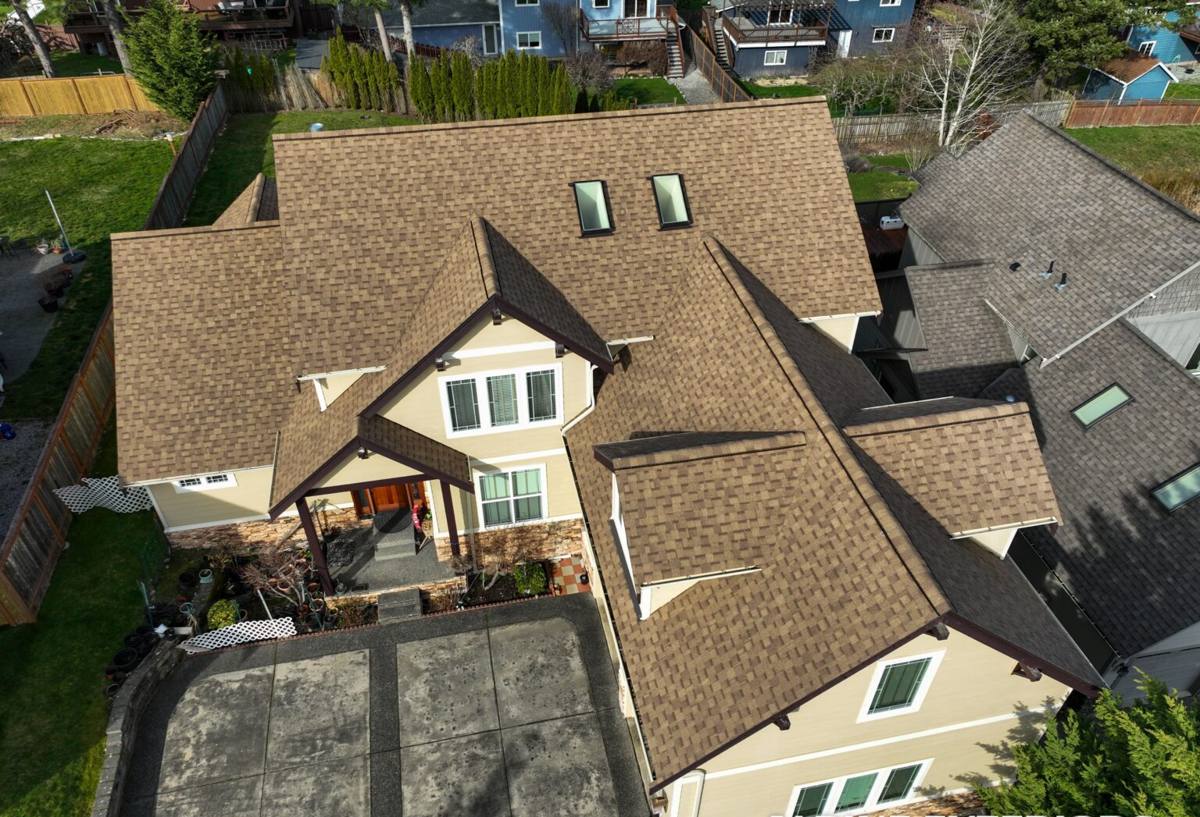
What Bow's Climate Actually Does to a Roof
Salt Air and Metal Components
Salt air accelerates corrosion on exposed fasteners, flashing, and vent components. Cheap or mismatched metal — the wrong nail coating, uncoated flashing, bargain vent caps — starts rusting years before the shingles themselves wear out. Once a fastener or flashing edge corrodes, water finds a path underneath the shingle field even if the shingles look fine from the ground.
Driving Rain
Storms coming off the water don't just fall straight down — they push rain sideways and up under shingle tabs, especially at low-slope sections, valleys, and anywhere the wind gets funneled by trees or terrain. A roof built for a drier, calmer climate often skips extra underlayment protection at these vulnerable points. In Bow, those are exactly the spots that need it most.
Moss and Algae Season
Shade, moisture, and mild temperatures give moss and algae a long growing window here — often most of the year rather than a short summer break. Moss doesn't just look bad; its root structure lifts shingle edges, holds water against the roof deck, and works fasteners loose over time. Left unaddressed, a moss-covered roof section can fail years ahead of a clean one made from the identical shingle.
What a Correctly Installed Shingle Roof Includes
A shingle roof is a layered system, not just a surface product. For Bow homes, every layer matters more than it would in a drier, more sheltered climate.
- Sound, properly fastened roof decking — soft or delaminated plywood gets identified and replaced before anything goes back on, not patched over
- Ice-and-water shield or equivalent self-adhered membrane at eaves, valleys, and around every penetration, not just where code minimums require it
- A quality synthetic or felt underlayment across the full field, lapped correctly for the prevailing wind and rain direction
- Corrosion-resistant flashing and fasteners suited to a salt-air environment, not standard-grade hardware
- Balanced intake and exhaust ventilation so the attic and roof deck can dry out between storms instead of staying damp
- Shingles rated for algae resistance, properly nailed per manufacturer spec (not gun-fast, under-driven, or over-driven)
Skip any one of these and the roof will still look fine on installation day. The failures show up two, five, or ten years later — which is exactly when a shortcut is hardest to trace back to its cause.
Signs a Bow Roof Needs Attention
Because moss and salt-driven wear happen gradually, a lot of homeowners don't notice a problem until it's already inside the attic. Worth checking for, or asking about during an inspection:
- Moss visible at shingle edges, valleys, or the north-facing slope
- Granules collecting in gutters or at downspout outlets
- Shingle tabs that look cupped, curled, or lifted at the corners
- Rust streaking below metal flashing, vents, or fasteners
- Dark streaking across the shingle field (algae, not just dirt)
- Any soft spots, sagging, or daylight visible from inside the attic
- Interior ceiling stains, especially after a windy rainstorm
Any one of these on its own isn't necessarily an emergency. Several together, or anything paired with an interior stain, is worth a look before the next storm season.
How Our Process Works
1. On-Site Assessment
We walk the roof and the attic, not just one or the other. Ground-level photos don't show soft decking or moisture staining on the underside of the sheathing, and attic conditions tell us as much about ventilation problems as the shingles themselves do.
2. Honest Scope — Repair vs. Replace
Not every issue means a full tear-off. If the decking is sound and the problem is isolated — a flashing failure, storm damage to one section, moss buildup that hasn't compromised the shingles yet — we'll say so and price it as a repair. A full re-roof only makes sense when the underlying system is actually failing.
3. Tear-Off and Deck Inspection
Where a replacement is warranted, we remove the old roofing down to the deck and inspect every sheet of plywood underneath. Any soft, delaminated, or water-damaged decking gets replaced before new underlayment goes down — no shortcuts, no reusing questionable sheathing to save time.
4. Underlayment and Flashing First
This is where a roof's long-term performance in Bow's climate actually gets decided. Self-adhered membrane goes at the eaves, valleys, and every penetration; underlayment is lapped correctly for wind direction; flashing is replaced with corrosion-resistant material rather than reused.
5. Shingle Installation
Shingles go down to manufacturer nailing specifications, with attention to exposure and alignment. We check ventilation balance at this stage too — intake at the eaves, exhaust at the ridge — since a shingle roof with poor airflow underneath will fail from the inside regardless of how well the top layer was installed.
6. Final Walkthrough
We walk the finished roof with the homeowner, cover what was done, and explain any maintenance — moss prevention steps in particular — that will keep the new roof performing as long as it should.
Choosing a Shingle for This Environment
Most manufacturers now offer an algae-resistant version of their standard shingle line, and for a Bow home, that upgrade is worth the modest cost difference. Beyond that, the main decision is weight class and wind rating.
| Shingle Type | Typical Lifespan | Best Fit For |
|---|---|---|
| 3-tab standard | 15–20 years | Budget-driven projects; least wind and moss resistance |
| Architectural / dimensional | 25–30 years | Most Bow homes — better wind rating, thicker profile resists granule loss |
| Algae-resistant (AR) upgrade | Same as base line | Any shaded or north-facing roof plane — slows moss and algae regrowth |
| Premium / high-wind rated | 30+ years | Exposed sites near open water or with a history of wind damage |
We don't push homeowners toward the most expensive option by default. We'll tell you plainly which class of shingle makes sense for your specific roof exposure — a shaded, tree-covered lot and an open, wind-exposed one near the water don't need the same product.
What Drives Cost on a Bow Roofing Project
| Factor | Why It Matters |
|---|---|
| Roof size and pitch | Steeper roofs take longer, need more safety setup, and use more material per square |
| Decking condition | Hidden water damage found during tear-off adds material and labor to replace sheathing |
| Number of valleys, penetrations, chimneys | Each one needs additional flashing and underlayment work |
| Shingle class chosen | 3-tab, architectural, and premium wind-rated lines carry different material costs |
| Ventilation upgrades | Adding or correcting intake/exhaust venting is sometimes needed on older homes |
| Access and site conditions | Tree cover, tight lot lines, or difficult staging can add time |
We give a written estimate that breaks these out rather than a single lump number, so you can see exactly what you're paying for and why.
Maintenance That Actually Extends Roof Life Here
A well-installed shingle roof in Bow still benefits from basic seasonal attention, especially given how long moss and algae stay active in this climate.
- Keep gutters and downspouts clear so water doesn't back up under the shingle edge
- Trim back overhanging branches to cut down on shade and debris buildup
- Have moss treated or removed before it spreads under shingle tabs, not after
- Check attic ventilation isn't blocked by insulation or debris
- After major windstorms, do a visual check for lifted or missing shingles
- Schedule a roof inspection every few years, even without visible problems
None of this replaces a correct initial installation — but it does mean the difference between a roof that reaches its full rated lifespan and one that needs early repairs.
Why It Matters That We Already Work in Bow
A roofing crew that regularly works Bow and the surrounding Skagit County area isn't guessing about how this climate treats a roof — we've seen which shingle lines hold up to the salt air, where moss tends to take hold first on local roof designs, and which flashing details actually keep driving rain out during a real winter storm off the water. That local pattern recognition shows up in small decisions throughout a project: where we add extra underlayment even though code doesn't strictly require it, which ventilation setup we recommend for a shaded lot versus an open one, and how we sequence work around the wetter months so a tear-off isn't left exposed longer than necessary.
It also means we're not disappearing after the invoice is paid. A local crew is the one you can actually call if a question comes up two years down the road — about a repair, a warranty item, or just what that new patch of moss on the north slope means.
Get a Straight Answer on Your Roof
Whether you're dealing with visible moss, a suspected leak, or just want an honest read on how much life is left in your current roof, we're happy to take a look. If you'd like a free, no-pressure estimate for asphalt shingle roofing in Bow, fill out the form below and we'll get in touch to schedule a time.