 Anacortes Siding
 Fidalgo Island's Siding Problem Isn't Like Most of Washington's
Fidalgo Island sits where Skagit County meets the Salish Sea, and that location creates a siding environment most inland contractors never have to think about. You've got salt-laden air moving off the water, long stretches of driving rain pushed sideways by wind off Rosario Strait and Guemes Channel, and a wet, mild winter that gives moss, algae, and lichen months to establish themselves on anything that stays damp. None of these are dramatic, single-day threats. They're slow, cumulative ones — the kind that show up as soft trim, chalky paint, or rot behind a wall five or ten years after a siding job that looked fine on installation day.
That combination matters because it's different from what a lot of general siding guidance assumes. A product spec sheet written for a dry inland climate doesn't account for chloride exposure off salt water, or for siding that may not fully dry out between rain events for weeks at a stretch during a Pacific Northwest winter. Homes on Fidalgo Island, whether they're close to the water or set back in a wooded lot, deal with a version of "wet climate" that's more persistent than most of the state sees.
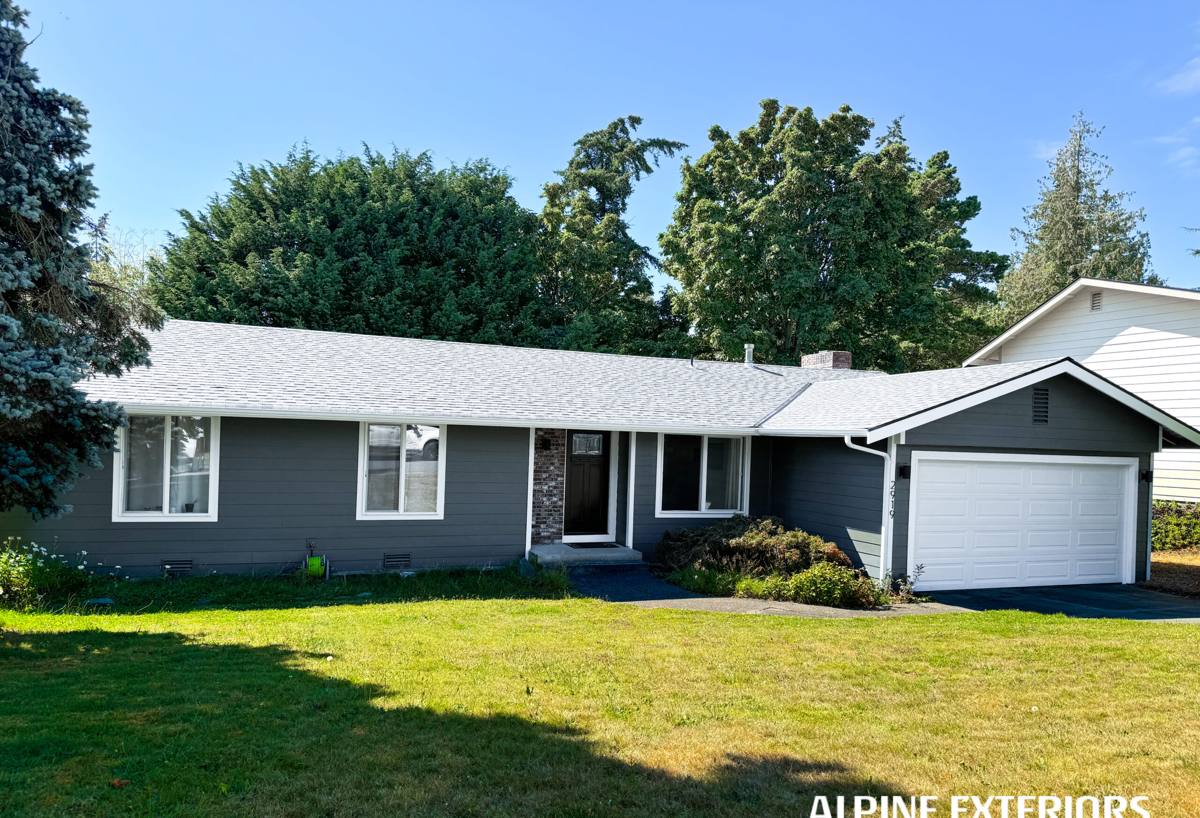
Why Salt Air, Rain, and Moss Change What Siding Needs to Do
Salt Air and Metal Fasteners
Airborne salt accelerates corrosion on exposed metal — fasteners, flashing, and trim accessories. Siding installed with the wrong fastener spec, or with flashing details that trap moisture against metal, ages faster near the water than the same product would inland. This is a detail that shows up in the install, not on the product box.
Driving Rain and Wall Assembly
Wind-driven rain doesn't just hit a wall — it gets pushed sideways and upward into laps, seams, and penetrations that would stay dry in a calmer climate. A siding system that isn't detailed for wind-driven rain can let moisture past the face material and into the wall assembly, where it does damage nobody sees until there's a soft spot or a musty smell.
Moss, Algae, and a Long Wet Season
Skagit County's mild, wet winters are good for moss and bad for siding that holds moisture at the surface. Wood-based products absorb water and stay damp longer, giving moss and algae time to take hold and giving rot fungus the moisture it needs. Anything installed without decent airflow behind it — or too close to grade, or shaded by heavy tree cover, which is common on wooded Fidalgo Island lots — is especially exposed to this slow biological wear.
Why We Only Install James Hardie in This Climate
We install James Hardie fiber cement siding exclusively. We don't install vinyl, LP SmartSide, cedar, primed spruce, or other fiber cement brands like Allura or Cemplank. That's not brand loyalty for its own sake — it's a standard we settled on after weighing how different siding materials actually hold up in a marine, high-moisture climate like this one.
Fiber cement is non-combustible and dimensionally stable, meaning it doesn't expand, contract, warp, or absorb water the way wood-based products do. James Hardie backs its boards with a factory-applied ColorPlus finish, which is baked on under controlled conditions rather than field-painted, and holds color and adhesion better through repeated wet-dry cycles than most site-applied paint systems. James Hardie also engineers separate product formulations for different climate zones — one aimed at regions with heavy freeze-thaw cycling, and another, HZ10, engineered specifically for wetter, milder, moisture-heavy climates like the Pacific Northwest coast. For Fidalgo Island homes, that moisture-focused engineering is the more relevant of the two.
We're not going to tell you every other product is worthless — vinyl is inexpensive and low-maintenance in mild climates, and cedar has a look plenty of homeowners genuinely prefer. But vinyl can warp and fade with sustained sun and temperature swings, wood siding demands a maintenance schedule most homeowners underestimate, and mixing brands or off-spec accessories on a fiber cement job creates warranty gaps. We'd rather install one product system correctly, in the formulation built for this climate, than offer five options and hope one of them holds up.
Comparing Siding Options in a Marine, High-Moisture Climate
| Factor | James Hardie Fiber Cement | Vinyl | Cedar / Wood | LP SmartSide |
|---|---|---|---|---|
| Moisture absorption | Very low | Low, but seams can trap water | High — needs consistent upkeep | Moderate — engineered wood core |
| Salt air / corrosion resistance | Strong; fiber cement itself doesn't corrode | Fair; can chalk and become brittle over time | Weak without regular sealing | Fair; edges vulnerable if seal is broken |
| Moss / algae resistance | Good with proper clearance and airflow | Fair | Poor without regular treatment | Fair |
| Fire resistance | Non-combustible | Melts/deforms under heat | Combustible | Combustible |
| Typical maintenance | Occasional wash, repaint on a long cycle | Low, but limited repair options | Annual sealing/painting | Periodic caulk and paint upkeep |
| Warranty structure | Long, transferable manufacturer warranty | Varies widely by product tier | None beyond installer workmanship | Manufacturer warranty, moisture-sensitive terms |
What a Correct James Hardie Install Looks Like Here
The product only performs as designed if the installation respects Hardie's own specifications — and in a climate like this one, the details that get skipped elsewhere are the ones that matter most.
Water Management Behind the Siding
Correct installation starts with a drainage plane and weather-resistive barrier behind the siding, not just at it. On a wall exposed to wind-driven rain off the strait, we pay close attention to flashing at windows, doors, and any wall penetration, and to how water is directed away from those transitions rather than allowed to pool.
Fastener and Gap Spacing
Hardie specifies exact fastener placement, board overlap, and gapping at butt joints, trim, and any adjoining material. Gaps that are too tight don't allow the board to handle normal moisture-driven movement; gaps that are too wide, or caulked when they shouldn't be, can trap water instead of shedding it. This is a place where a crew unfamiliar with Hardie's spec — or one used to a different product entirely — tends to improvise, and improvising is exactly what causes early failures.
Clearance From Grade, Decks, and Roofs
Siding installed too close to soil, a deck surface, or a lower roofline stays wet longer and is the first place moss and rot take hold. We hold to manufacturer-specified clearances even when it means adjusting trim or flashing details rather than shortcutting.
Caulking Only Where It Belongs
Over-caulking is common and it's a real problem — sealing joints that are designed to breathe traps moisture inside the assembly instead of letting it drain and dry. Correct Hardie installation caulks specific transitions, not everything that looks like a seam.
Our Process for Fidalgo Island Homes
- On-site assessment. We look at wall exposure (windward vs. sheltered sides matter a lot here), existing sheathing condition, tree cover, and any visible moisture or moss damage on the current siding.
- Moisture check where relevant. On older homes, or where the existing siding shows signs of past water intrusion, we check the sheathing underneath before quoting a straightforward re-side, since hidden rot changes the scope of the job.
- Product and color selection. We help you choose the right Hardie board profile and ColorPlus color for your home's style, factoring in how colors read against the island's typical mix of wooded lots and open water views.
- Installation to Hardie's spec. Fastening, flashing, clearances, and gapping done to manufacturer requirements — not shortcuts that save an afternoon but cost you five years down the line.
- Final walkthrough. We go over the finished work with you, including what routine maintenance actually looks like for a Hardie install in this climate.
Maintenance in a Moss-Prone, Salt-Air Environment
James Hardie siding is genuinely low-maintenance compared to wood, but "low-maintenance" doesn't mean "no maintenance" — especially with the moss and algae pressure Skagit County's wet season creates.
- Rinse siding periodically with a garden hose to clear salt residue and organic buildup, especially on walls facing the water or shaded by trees.
- Avoid pressure washing directly into seams and joints — it can force water past details that are meant to shed it, not resist direct pressure.
- Trim back vegetation and tree limbs that keep a wall section shaded and damp longer than the rest of the house.
- Check gutters and downspouts each fall so overflow isn't running down the siding face during heavy rain events.
- Watch for early moss or algae growth in shaded, low-airflow corners and address it before it spreads across a wall section.
- Repaint on the long cycle ColorPlus finishes allow, rather than the shorter cycle field-applied paint typically needs.
Why a Crew That Already Works Fidalgo Island Matters
Siding work on the island isn't identical from one lot to the next. A house facing open water deals with more direct wind-driven rain and salt exposure than one set back in a wooded interior lot, and a crew that's worked across both knows to adjust flashing and clearance details accordingly rather than applying one generic approach everywhere. Familiarity with Anacortes and Skagit County permitting requirements also keeps a project moving instead of stalling on paperwork a contractor unfamiliar with the area might not anticipate.
There's also a practical logistics side to it. Getting materials and crews on and off the island efficiently, working around the realities of an island community's roads and access points, and knowing which neighborhoods have architectural covenants or HOA color/material requirements — these are things a crew that already works here handles without it becoming your problem to manage.
What Affects the Cost of a Fidalgo Island Siding Project
Every home is different, but a few factors tend to move the price of a James Hardie project on the island more than others:
| Cost Factor | Why It Matters |
|---|---|
| Existing sheathing condition | Rot or moisture damage found during tear-off adds repair scope before new siding goes on |
| Board profile and trim complexity | Lap siding, shingle-style panels, and detailed trim packages all install differently |
| Wall exposure and access | Waterfront-facing walls, steep lots, or limited equipment access affect labor time |
| Color and finish selection | Standard ColorPlus colors vs. custom or premium finishes carry different material costs |
| Tear-off vs. install over existing siding | Full tear-off costs more up front but is often the right call when moisture damage is present |
We'll walk through these specifics for your home directly rather than quoting off a generic square-footage number, since the exposure and condition differences between a waterfront lot and a sheltered interior one can genuinely change the right approach.
If you're weighing a siding replacement on Fidalgo Island, we're happy to take a look and give you a straightforward, no-pressure estimate — including an honest read on what your current siding and sheathing condition actually need. Use the form below to get started.