 Anacortes Siding
 Flounder Bay sits on the water side of Fidalgo Island, and homes and cabins in that pocket of Anacortes deal with a version of Skagit County's weather that's more concentrated than most: salt-laden air off the bay, wind-driven rain coming straight in off the water, and a wet season that keeps shaded ground and low-lying structures damp for months at a stretch. A deck built or installed without that in mind tends to show it within a few seasons — soft boards, corroded fasteners, moss creeping into every joint. A deck built for it holds up. This page is about what that actually takes when the material is composite decking and the site is Flounder Bay.
Why Flounder Bay's Climate Is Hard on Decks
A waterfront or near-waterfront lot in Flounder Bay gets more of everything that shortens a deck's life: salt air that accelerates corrosion on any metal hardware, wind that drives rain sideways into end grain and fastener heads, and shade from surrounding trees or the terrain itself that keeps surfaces from drying out between storms. Add in Anacortes's long moss season, and a deck here is fighting moisture, salt, and organic growth almost year-round rather than just during a rainy stretch.
None of that is unique to Flounder Bay in kind — it's the same set of pressures that any Skagit County coastal property deals with. What's different is degree. A deck a mile inland and up out of the marine layer dries faster, sees less salt, and has an easier time of it. A deck close to the bay doesn't get that break, which is exactly why the material and the installation details matter more here than they would on a sheltered inland lot.
What We Look For on a Flounder Bay Deck Inspection
- Soft, spongy, or delaminating boards, especially near the house and in shaded corners that never fully dry
- Corroded fasteners, joist hangers, or ledger bolts — a common failure point once salt air gets into unprotected metal
- Moss and algae buildup between boards and on the north or shaded side of the structure
- Standing water or slow drainage where the deck was never sloped or gapped correctly to begin with
- Ledger board attachment that's trapping moisture against the house rim joist
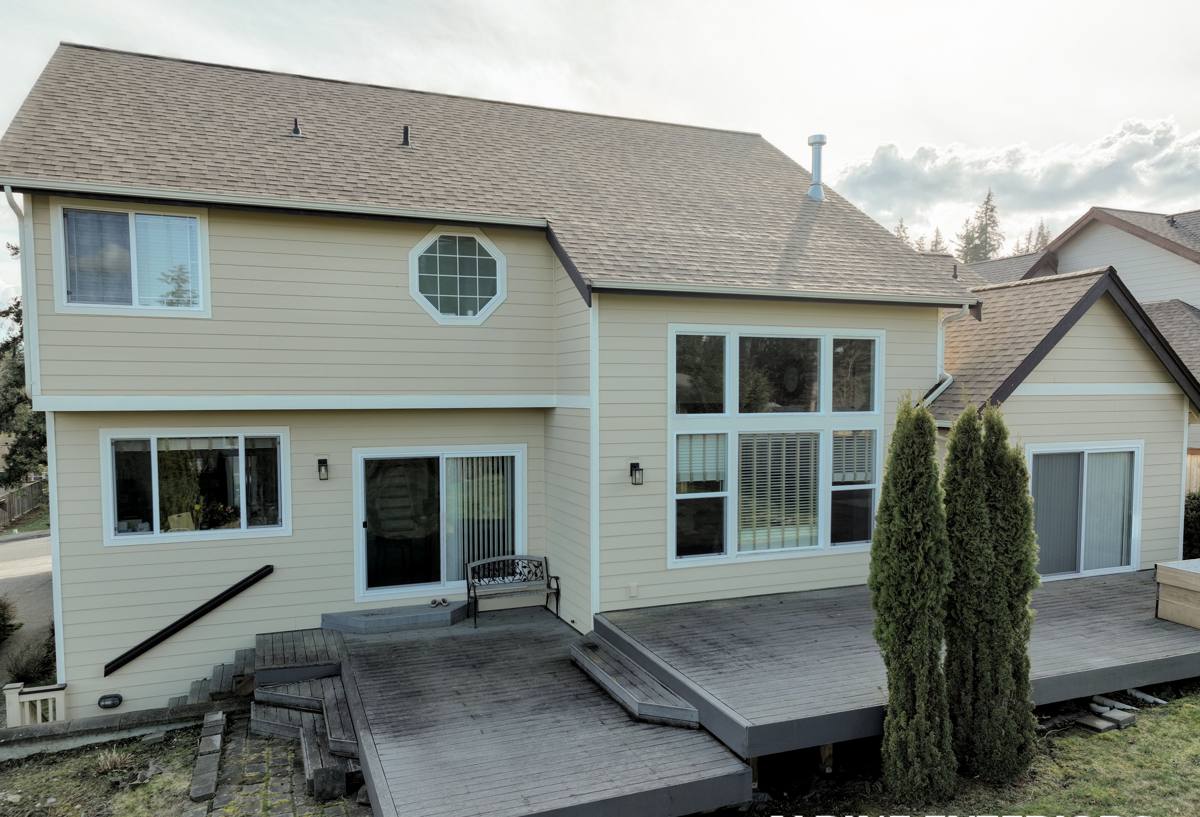
Why Composite Makes Sense for This Site
Composite decking doesn't rot, doesn't need annual staining or sealing, and doesn't absorb water the way solid wood does — all real advantages on a lot that stays damp longer than most. It's not immune to the climate, but it removes the biggest maintenance burden a wet, salty environment puts on a wood deck, and it gives moss and algae a harder surface to grip compared to open wood grain. For a lot of Flounder Bay homeowners, that trade-off — higher upfront cost for dramatically lower upkeep — is the whole reason to consider it in the first place.
That said, composite isn't a material you can install the same way everywhere and expect the same result. The boards themselves resist moisture well, but the structure underneath — framing, fasteners, flashing, and airflow — still has to be built for a marine climate, or the deck will fail from the substructure up even while the surface boards look fine.
What a Correct Composite Install Involves Here
Substructure and Framing
The joists, beams, and ledger board under a composite deck do most of the real work of keeping it dry and stable, and they're the parts most likely to be shorted on a lower-cost install. In a Flounder Bay setting we're looking at joist spacing tight enough for the specific composite board being used — many composite products require closer spacing than dimensional lumber decking, especially on angled or picture-frame layouts — and framing lumber that's rated for ground contact or coastal exposure where it's close to grade or shaded ground.
Fastening and Hardware
Salt air is hard on unprotected metal, so hardware selection isn't optional here — it's the difference between a deck that's solid in fifteen years and one with hidden corrosion problems in five. That means stainless steel or coated fasteners rated for coastal/marine exposure, hidden fastener systems sized correctly for the board profile, and joist hangers and structural connectors that won't quietly corrode where you can't see them.
Flashing, Drainage, and Airflow
Where the deck meets the house is the single most common source of long-term water problems, composite or not. A ledger board needs proper flashing and a water-resistant barrier behind it so moisture can't track into the rim joist or wall assembly. Under the deck, the frame needs enough slope and gap spacing between boards to actually shed water rather than hold it, and enough clearance and airflow underneath to let the structure dry out between the rain events that come through here regularly.
| Detail | Why It Matters in Flounder Bay |
|---|---|
| Hidden fastener spacing per board profile | Wrong spacing shows up as board movement, gapping, or squeaking within a year or two of wet-dry cycling |
| Stainless or marine-rated hardware | Salt air corrodes standard coated fasteners faster here than in an inland install |
| Ledger flashing and WRB integration | Prevents moisture tracking into the house structure — the most expensive failure to fix after the fact |
| Joist tape or capped framing | Protects framing lumber from the moisture composite boards trap against it |
| Slope and drainage gap | Keeps water moving off the deck instead of pooling under shaded, slow-drying boards |
Choosing a Composite Product for a Salt-Air Site
Not all composite decking is built the same, and the differences matter more on an exposed, salty lot than they would somewhere drier. The big split is between capped composite — where a protective polymer shell wraps the board — and older uncapped composite, which is more prone to moisture absorption and surface wear over time. PVC decking is a related but different product: it's fully synthetic rather than wood-plastic composite, and it handles constant moisture exposure differently.
| Option | Moisture Handling | Maintenance | Fit for Flounder Bay |
|---|---|---|---|
| Uncapped composite | Can absorb moisture at cut ends and surface over time | Occasional cleaning; more prone to staining/mold in constant damp | Workable but not our first choice this close to the water |
| Capped composite | Polymer shell resists moisture absorption and staining | Low — periodic washing | Strong fit; the shell holds up well against salt air and shade-driven moisture |
| PVC decking | Fully synthetic, essentially immune to moisture absorption | Low — periodic washing | Excellent moisture performance; runs warmer underfoot and has its own installation requirements |
We talk through these trade-offs with each homeowner rather than defaulting to one product for every job. A shaded, low-airflow deck close to the bay benefits most from a fully capped or PVC product; a sunnier, more open site has a bit more flexibility. What we won't do is put an uncapped, budget composite on a heavily shaded waterfront deck and call it a long-term solution — the maintenance burden and moisture risk just aren't worth the upfront savings in this specific setting.
Moss, Algae, and the Long Wet Season
Even a fully capped composite deck isn't immune to moss and algae — it just resists staining and rot the way wood would. Organic growth still needs somewhere to establish, and gaps between boards, shaded corners, and anywhere debris collects are where it takes hold. Correct board spacing and a drainage plan that actually moves water and debris off the deck go a long way toward keeping growth manageable. Beyond that, it comes down to periodic cleaning — composite doesn't need staining or sealing, but it does benefit from being kept clear of standing organic matter, especially through the wetter months when Anacortes barely dries out between storms.
Our Process for a Flounder Bay Deck Project
- On-site assessment of the existing deck or build site, including sun/shade exposure, drainage patterns, and proximity to the water
- Honest recommendation on composite product tier based on that specific site's exposure — not a one-size answer
- Structural plan covering joist layout, hardware, ledger flashing, and drainage before any boards go down
- Installation to manufacturer spec for fastener spacing, gapping, and ventilation clearance
- Final walkthrough covering what maintenance the specific product does and doesn't need going forward
Cost Factors to Expect
Composite decking costs more upfront than pressure-treated wood, and the range depends on product tier, deck size and layout, substructure condition, and site access. Broadly, capped composite runs a mid-to-upper price range compared to wood, and PVC typically sits at the top of that range. The bigger cost variable on a Flounder Bay project is often the substructure work — if existing framing, ledger flashing, or hardware needs to be brought up to a standard that will actually last in this environment, that's real work worth budgeting for rather than skipping to save money on the visible boards.
| Factor | Why It Moves the Price |
|---|---|
| Composite tier (uncapped vs. capped vs. PVC) | Material cost and moisture performance scale together |
| Substructure condition | Replacing or upgrading framing and hardware for coastal exposure adds labor and material |
| Ledger and flashing detail | Correct integration with the house takes more time than a simple bolt-on ledger |
| Layout complexity | Picture-frame borders, angles, and stairs add labor and sometimes tighter joist spacing |
| Site access | Waterfront lots can mean tighter access or material staging challenges that affect labor time |
Maintenance a Flounder Bay Composite Deck Actually Needs
- Periodic washing to clear debris, pollen, and organic buildup before it becomes moss or algae staining
- Keeping gaps between boards clear so water and debris can drain rather than collect
- Checking under-deck airflow isn't blocked by storage, plantings, or added skirting that traps moisture
- A visual check of visible fasteners and ledger flashing every year or two, especially after a hard winter storm season
- No staining or sealing required on capped composite or PVC — that maintenance step is one of the trade-offs you're paying for upfront
Why a Crew That Already Works Flounder Bay Matters
Composite decking is a forgiving material on the surface, but the substructure decisions underneath it — framing spec, fastener choice, flashing detail, drainage slope — are exactly the things that separate a deck that holds up through Anacortes winters from one that develops hidden problems in five or six years. Those decisions come from having actually built and repaired decks in this kind of exposure, not just from following a generic install guide written for a drier, calmer climate. We do exterior work throughout Skagit County, and waterfront pockets like Flounder Bay are where the difference between a standard install and one detailed for the site actually shows.
If you're planning a new composite deck or replacing an aging one in Flounder Bay, we're glad to take a look at your specific site — sun exposure, drainage, current condition — and give you a straight read on what it needs. Reach out for a free, no-pressure estimate.