 Anacortes Siding
 Why Burlington's Climate Is Harder on Siding Than It Looks
Burlington sits inland from Anacortes but still gets the full package of Skagit County weather: salt-tinged marine air pushed in off the Sound, long stretches of driving rain from fall through spring, and the low light and dampness that keep moss and algae going most of the year. None of that is dramatic weather in the way a hailstorm or hurricane is dramatic — it's slow, steady, cumulative pressure. That's exactly the kind of exposure that wears out the wrong siding material years before it should, because the damage happens quietly behind the surface rather than all at once.
Wood-based products swell and dry out repeatedly with every wet-dry cycle. Vinyl gets brittle and fades under UV even on our gray days, and it can't be repainted when it does. Moss and algae take hold on any surface that stays damp and shaded, which describes a lot of north- and west-facing walls in this area. Siding here isn't just cosmetic — it's the first line of defense against a climate that never really dries out completely.
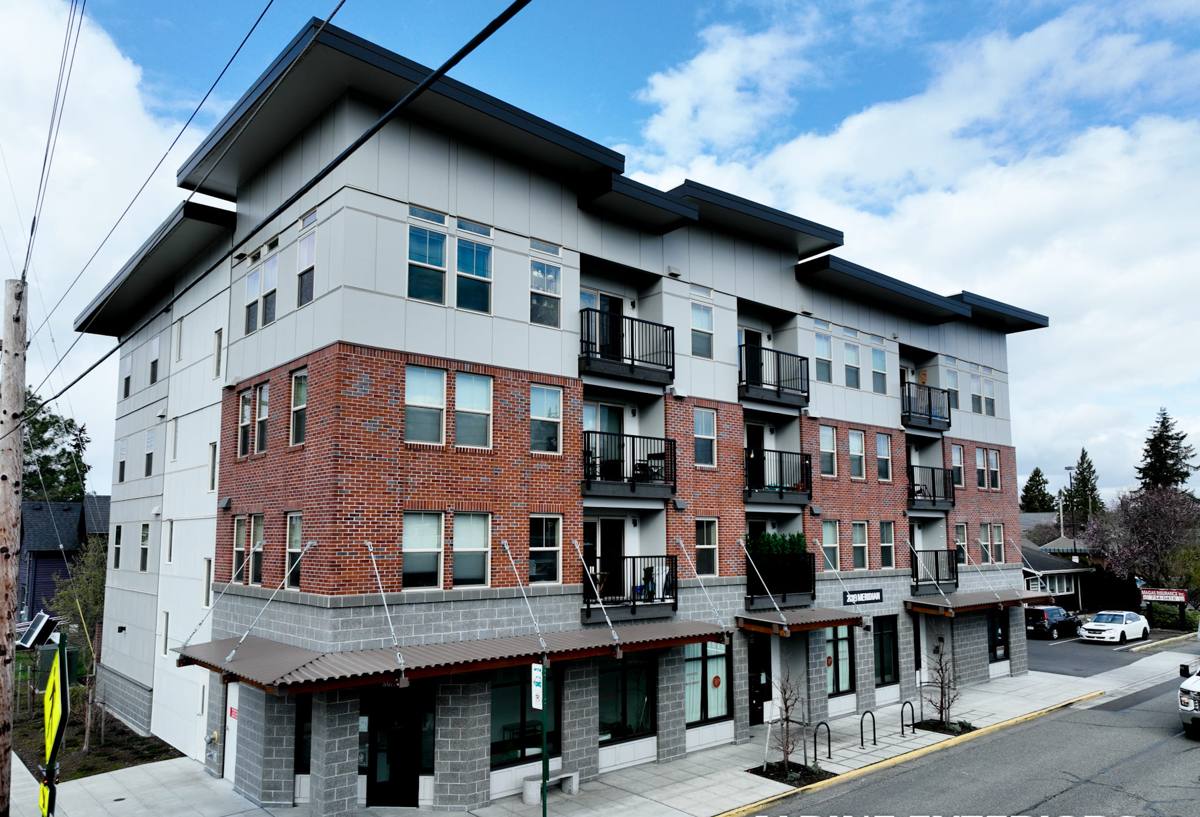
Why We Install James Hardie and Nothing Else
We standardized on James Hardie fiber cement siding for every job we do, including here in Burlington, and we don't install vinyl, LP SmartSide, cedar, or other fiber cement brands. That's not a marketing line — it's a decision based on what actually holds up in this specific climate over decades, not just the first few years.
James Hardie is non-combustible fiber cement, which matters for fire risk during dry summer stretches, but the bigger day-to-day advantage in Burlington is moisture behavior. Fiber cement doesn't absorb water the way wood-based siding does, and it doesn't warp, rot, or delaminate the way engineered wood products can when they take on repeated moisture. It holds paint and factory finish far longer than wood substrates, which matters when a home is getting rained on eight or nine months a year.
Built for This Specific Climate
Hardie's HZ5 product line is engineered specifically for climates with significant moisture exposure — the Pacific Northwest is squarely in that category. It's a different formulation than what gets shipped to dry, hot regions, and it's the version we use on Burlington homes. The point isn't a marketing distinction; it's that the product has been formulated for exactly the wet-dry cycling and humidity this area produces year-round.
ColorPlus Finish and What It Means for Moss and Salt Air
Most of what we install carries Hardie's ColorPlus factory finish rather than field-applied paint. That finish is baked on in a controlled factory environment, which gives it better adhesion and UV resistance than paint applied on-site after installation. In practical terms for a Burlington home, that means the color holds longer against the fading and chalking that constant damp gray weather causes, and the surface resists the kind of finish breakdown that gives moss and algae an easier foothold.
Moss doesn't grow because siding is "bad" — it grows because a surface stays damp, shaded, and rough enough to hold spores. A tight, factory-cured finish sheds water faster and gives moss less to grab onto than a chalky or porous surface. It doesn't make a home moss-proof, but it meaningfully slows how fast growth reestablishes after a cleaning, which matters in a place where the growing season for moss is most of the year.
What a Correct Installation Involves
The siding material is only half the equation. A huge share of siding failures we see on older Burlington homes trace back to installation shortcuts, not the product itself. Fiber cement done wrong will still cause problems — trapped moisture doesn't care what the surface material is.
The Details That Matter Most Here
- A continuous weather-resistant barrier behind the siding, installed and lapped correctly so water is directed out, not trapped against the sheathing
- Proper flashing at every window, door, and penetration — the majority of moisture intrusion starts at these transitions, not through the field of the siding itself
- Correct nail/fastener placement and spacing per Hardie's installation specs, since under- or over-driven fasteners compromise both wind performance and long-term board integrity
- A minimum gap maintained between siding and grade, decks, patios, and roof lines so the board isn't sitting in standing water or splash-back
- Factory-cut and field-cut edges sealed per manufacturer spec, since raw cut edges are the most vulnerable point on any fiber cement board
- Adequate clearance and caulking at butt joints and corners, done in a way that allows for expansion without letting water track in
Skipping any one of these doesn't show up as a problem in year one. It shows up in year five or eight, as a soft spot, a stain, or a section that's failing while the rest of the wall looks fine. That gap between installation shortcuts and visible damage is exactly why hiring based on installation discipline matters more than most homeowners realize.
How Our Process Works for a Burlington Job
We start with a walk-around of the home to assess current siding condition, moisture history, trouble spots around windows and rooflines, and any rot or sheathing damage that needs to be addressed before new siding goes up — covering a problem never fixes it. From there we scope the specific Hardie profile and color that fits the home, whether that's traditional lap siding, a shingle-style panel, or a smooth modern reveal.
Once materials are confirmed, we handle removal of the old siding, inspection and repair of the sheathing and framing underneath, installation of the weather barrier and flashing, and then the Hardie siding itself to manufacturer spec. We do a final walkthrough with the homeowner before calling the job complete. Because we work in Burlington and the surrounding Anacortes area regularly, we're familiar with the wall assemblies and moisture patterns common to homes in this part of Skagit County, which speeds up diagnosis and helps us catch issues before they're buried behind new siding.
Comparing Siding Options for This Climate
| Factor | James Hardie Fiber Cement | Vinyl | Engineered Wood (e.g. LP SmartSide) | Cedar |
|---|---|---|---|---|
| Moisture resistance | Strong — doesn't absorb water like wood-based products | Doesn't absorb water but seams/panels can allow moisture behind them | Vulnerable at cut edges and joints if moisture gets in | Absorbs moisture; needs consistent maintenance to manage swelling |
| Finish longevity | ColorPlus factory finish holds color for years | Color molded in but fades and chalks with UV exposure | Needs field-applied paint/stain, shorter repaint cycle | Needs regular staining/sealing or it grays and weathers |
| Fire resistance | Non-combustible | Combustible, can melt/deform near heat | Combustible | Combustible |
| Moss/algae resistance | Tight factory finish sheds water, slows regrowth | Can trap moisture in seams behind panels | Porous surfaces give moss more to hold onto | Naturally porous, prone to moss and mildew |
| Repainting needed | Rarely, if using ColorPlus | Never repainted but can't be restored once faded | Every several years | Every 2-5 years |
This isn't a claim that other materials are unusable — vinyl and engineered wood are installed all over the country and can perform reasonably in milder climates. Our position is narrower: for the specific combination of salt air, sustained rain, and moss pressure that Burlington and the wider Anacortes area deal with, fiber cement's moisture behavior and finish durability hold up better over a 20-30 year window, and that's the timeframe that actually matters for a siding investment.
Maintenance Expectations After Installation
Hardie siding is lower-maintenance than wood or vinyl, but "lower" isn't "none." In this climate, plan on an occasional gentle wash to keep moss and algae from establishing on shaded or north-facing walls — a soft wash, not high-pressure blasting that can force water behind boards or damage the finish. Inspect caulking at joints, trim, and penetrations every year or two, since caulk is the one component that ages faster than the siding itself and is cheap to maintain proactively. Keep gutters and downspouts clear so water isn't sheeting down a wall section repeatedly, which accelerates both staining and moss growth in exactly the shaded, damp spots this climate already favors.
What to Ask Before Hiring Anyone for Siding Work
- Are they installing to the manufacturer's written spec for fastener placement, gapping, and flashing — not just "how we've always done it"?
- Do they inspect and repair sheathing/framing before covering it, or just install over existing conditions?
- Can they explain their flashing detail at windows and doors specifically, not just describe the siding material?
- Do they carry proper licensing and insurance for exterior work in Washington?
- Have they worked in this specific area enough to recognize local moisture and moss patterns?
Warranty and Long-Term Value
James Hardie backs its products with a strong, transferable limited warranty, which adds real value at resale since a future buyer inherits the coverage, not just the siding. Warranty terms vary by product line and finish, and we'll walk through the specifics that apply to your home during the estimate. The bigger point is that a warranty is only as good as the installation underneath it — improper installation is a common reason warranty claims get denied, which is one more reason installation discipline matters as much as the material choice itself.
If you're weighing siding options for a Burlington home and want a straight answer about condition, scope, and cost, we're happy to walk the property and put together a free, no-pressure estimate — just fill out the form below.