 Anacortes Siding
 Why La Conner Roofs Age Differently Than Inland Homes
La Conner sits right on the Swinomish Channel in Skagit County, and that waterfront location changes how a roof ages. Salt-laden marine air is more corrosive to exposed metal than dry inland air, so fasteners, flashing, and vent components can start showing rust and wear well before a comparable roof further from the water. Add in the long stretch of gray, drizzly months typical of this part of Washington, and you get roofs that stay damp longer, dry out slower, and give moss and algae exactly the conditions they need to take hold.
None of this means a roof in La Conner is doomed to fail early. It means the roof has to be built, and replaced, with those specific conditions in mind. A roof replacement that would hold up fine in a drier eastern Washington town isn't automatically the right approach here. The materials, the underlayment, the flashing details, and the ventilation all need to account for constant moisture exposure and salt air, not just wind and rain in general.
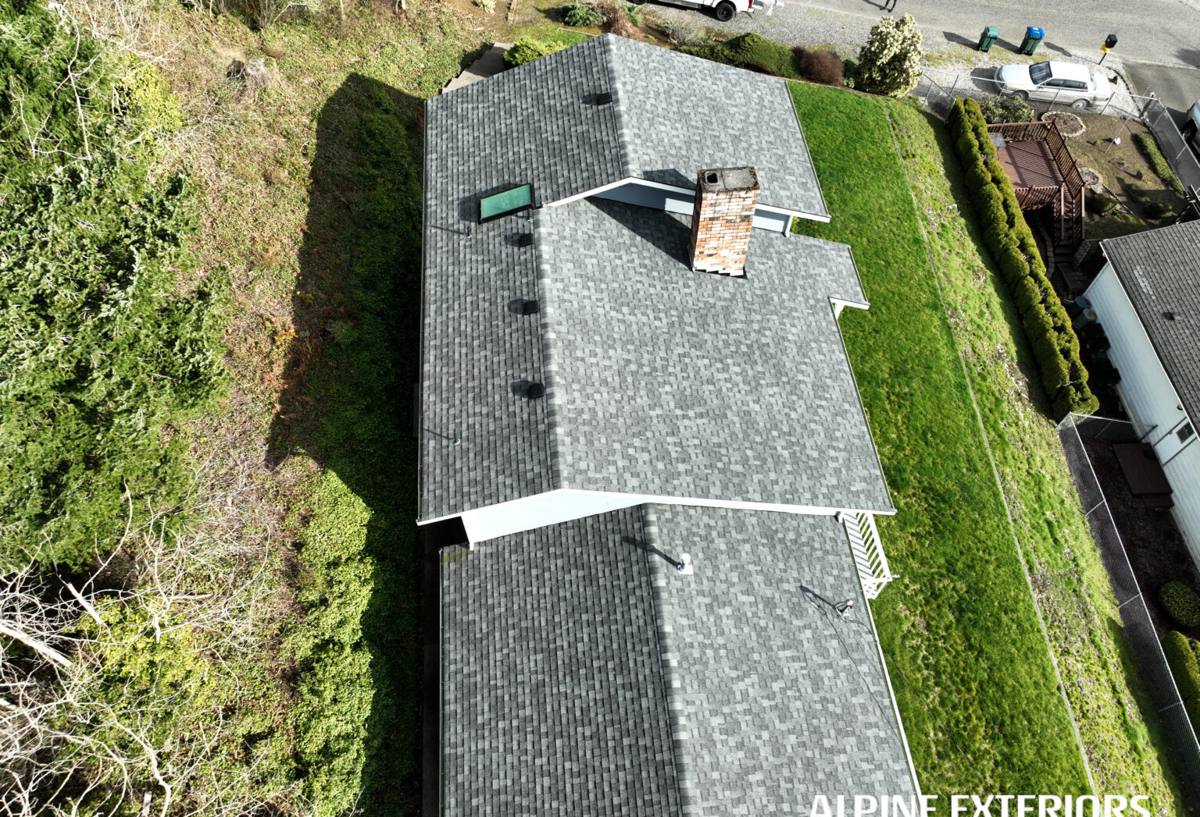
Signs a La Conner Roof Has Reached the End of Its Service Life
Homeowners often ask whether their roof needs a full replacement or just another repair. A few signs tend to show up consistently on roofs in this area once they're past their practical lifespan:
- Moss that keeps coming back within a season or two of cleaning, even on north- and shade-facing slopes
- Heavy granule loss showing up in gutters, or shingles that look bald in patches
- Shingles that are curling, cupping, or lifting at the edges
- Soft or spongy spots when walked or pressed on, which usually means the decking underneath is wet or rotting
- Daylight visible through the roof deck from inside the attic
- Rust streaking around flashing, vents, or metal valleys
- Two or more leak repairs in the same general area within a couple of years
Any one of these on its own might still be a repair. Several together, especially combined with a roof that's already 18-25 years old for asphalt composition, usually mean the smarter money is on replacement rather than continuing to chase individual failures.
Why Repairs Stop Making Sense
Patch repairs on an aging roof buy time, but they don't fix what's actually going wrong underneath. If the decking has absorbed moisture over several seasons, or the underlayment has degraded from years of standing dampness, a new set of shingles on top of that won't hold up. We'll always tell a homeowner honestly when a repair is the better near-term move and when it's just delaying an inevitable full tear-off.
What a Correct Roof Replacement Actually Involves
A roof replacement is more than swapping old shingles for new ones. In a coastal, high-moisture area like La Conner, the details underneath the visible roofing material matter as much as the material itself.
Tear-Off and Deck Inspection
We remove the old roofing down to the deck rather than layering over it. That's the only way to actually see the condition of the plywood or board sheathing underneath. Any soft, delaminated, or water-stained decking gets replaced before anything new goes down — installing new roofing over a compromised deck just guarantees an early failure.
Underlayment Built for a Wet Climate
Underlayment is the roof's backup layer if wind-driven rain gets past the surface material, and in a place that gets sustained driving rain off the water, that backup layer earns its keep more often than it would inland. We pay particular attention to synthetic or self-adhering underlayment at vulnerable areas — eaves, valleys, and around any penetrations — where wind-blown rain is most likely to find a way in.
Flashing That Handles Driving Rain, Not Just Rain
Flashing around chimneys, skylights, walls, and valleys is one of the most common points of roof failure, and it's also one of the most common places we find corner-cutting on older installs. Properly formed, properly lapped flashing — and metal that can hold up to salt air rather than corroding out in a few years — makes a real difference in a channel-side location like La Conner.
Ventilation to Fight Moisture and Moss From the Inside Out
A roof that's damp only from the outside is one problem. A roof that's also trapping moisture from inside the attic is a bigger one. Balanced intake and exhaust ventilation keeps the underside of the deck dry, which reduces rot risk and also keeps the roof surface itself cooler and drier, which in turn slows moss and algae growth. Ventilation gets evaluated as part of every replacement, not treated as an afterthought.
Roofing Material Options for Skagit County's Coastal Climate
There's no single "best" roofing material for every home — it depends on budget, roof pitch, tree cover, and how much long-term maintenance a homeowner wants to take on. Here's how the common options actually perform under La Conner's conditions:
| Material | Moss & Algae Resistance | Salt Air Durability | Typical Lifespan | Maintenance Needs |
|---|---|---|---|---|
| Algae-resistant asphalt composition shingle | Good with treated granules; still needs periodic cleaning | Good, with corrosion-resistant fasteners and flashing | 25-30 years | Low to moderate |
| Standard asphalt composition shingle | Fair; more prone to algae staining over time | Fair; depends on flashing/fastener quality | 20-25 years | Moderate |
| Metal roofing (standing seam) | Very good; sheds moisture quickly, little for moss to grip | Requires coastal-grade coatings/fasteners to avoid corrosion | 40-50+ years | Low |
| Cedar shake | Poor without regular treatment; retains moisture | Fair; needs consistent upkeep near salt air | 20-30 years with upkeep | High |
| Synthetic/composite shingle | Good; resists moisture absorption | Good | 30-50 years | Low |
For most La Conner homes, algae-resistant asphalt shingle or metal roofing end up being the most practical trade-off between upfront cost, longevity, and how much moss and algae maintenance a homeowner is willing to keep up with. We'll walk through the honest pros and cons for your specific roof rather than pushing one product across the board.
Our Roof Replacement Process
Every roof replacement follows the same general sequence, adjusted for the specifics of your home:
- On-site inspection of the current roof, decking condition, ventilation, and flashing details
- A written estimate that lays out material options and what each involves, with no pressure to decide on the spot
- Permitting handled before work begins, since La Conner falls under its own town jurisdiction separate from unincorporated Skagit County
- Protecting landscaping, siding, and gutters before tear-off starts
- Full tear-off to the deck, with old material hauled off-site as it comes down
- Deck repair or replacement wherever the sheathing has been compromised
- Installation of underlayment, flashing, ventilation components, and the new roofing material
- Site cleanup, including a magnetic sweep for stray nails, and a final walkthrough
We keep homeowners informed at each stage, especially if we uncover deck damage during tear-off that wasn't visible during the initial inspection — that's a common surprise on older coastal roofs, and we'd rather flag it and get approval than make assumptions.
Cost Factors in a La Conner Roof Replacement
Every roof is different, so we won't quote a number without seeing the actual home, but the factors that move the price up or down are consistent:
- Total roof size and how steep the pitch is — steep roofs take longer and require more safety setup
- Material choice, from standard asphalt shingle up through metal or synthetic options
- How much decking needs to be replaced once the old roofing comes off
- Number of existing layers that have to be torn off
- Number of penetrations — chimneys, skylights, vents — that each need proper flashing
- Access, particularly on waterfront lots, narrow driveways, or heavily treed properties common around La Conner
- Any permit or inspection requirements specific to the property
An accurate number only comes from an actual on-site look. What we won't do is give a low estimate over the phone and then find "surprise" charges once the crew is on the roof — the inspection is where we find the real scope, before work starts, not after.
Keeping Moss and Salt Air From Shortening Your New Roof's Life
A new roof is only as good as the maintenance it gets afterward, and that matters more in La Conner's climate than in drier parts of the state. A few habits go a long way toward protecting the investment:
- Keep gutters and downspouts clear so water isn't sitting against the roof edge
- Trim back overhanging branches to cut down on shade and debris that feed moss growth
- Have moss treated proactively rather than waiting for visible colonies to spread
- Check attic ventilation isn't blocked by insulation or storage
- Have flashing and fasteners inspected periodically for early signs of salt corrosion
- Address any small leak immediately rather than waiting to see if it gets worse
None of this requires a major annual undertaking, but a roof that gets zero attention between installation and the next problem tends to show its age faster here than it would somewhere drier.
Why Hiring a Crew That Already Works in La Conner Matters
A roofing crew that mostly works inland doesn't always account for how differently a channel-side property behaves. Local experience means knowing which moss species are actually common in this part of Skagit County, understanding how wind off the water hits certain roof orientations, and being familiar with La Conner's own permitting process rather than assuming county rules apply automatically. It also means having handled the access challenges that come with waterfront lots, narrow historic streets, and mature tree cover — logistics that a crew unfamiliar with the area can underestimate when quoting a job.
Local knowledge doesn't replace good workmanship, but it does mean fewer surprises, more accurate estimates, and a roof that's actually built for the conditions it has to survive here rather than a generic install.
Get an Honest Look at Your Roof
If your La Conner roof is showing moss that won't stay gone, granule loss, or you're just not sure whether repair or replacement makes sense, we're happy to take a look and give you a straight answer. Fill out the form below for a free, no-pressure estimate.