 Anacortes Siding
 Mount Vernon's Climate Is Harder on Siding Than It Looks
Homes in and around Mount Vernon sit in one of the more punishing microclimates in Skagit County. The combination of salt-laden air moving in off Puget Sound, long stretches of driving rain through fall and winter, and a moss season that can run nine months out of the year means exterior siding here works harder than it does almost anywhere else in the state. Salt air accelerates corrosion on fasteners and trim metal. Driving rain finds every gap in a wall assembly that isn't detailed correctly. And moss doesn't just look bad — it holds moisture against a wall surface for weeks at a time, which is exactly the condition that rots wood-based siding and breaks down paint film.
None of this means siding is doomed here. It means the material and the installation both have to be matched to the conditions, not just picked off a sample board. That's the entire premise behind this page: what a Mount Vernon home actually needs from its siding, what correct work looks like, and why we install James Hardie fiber cement exclusively rather than offering a menu of products.
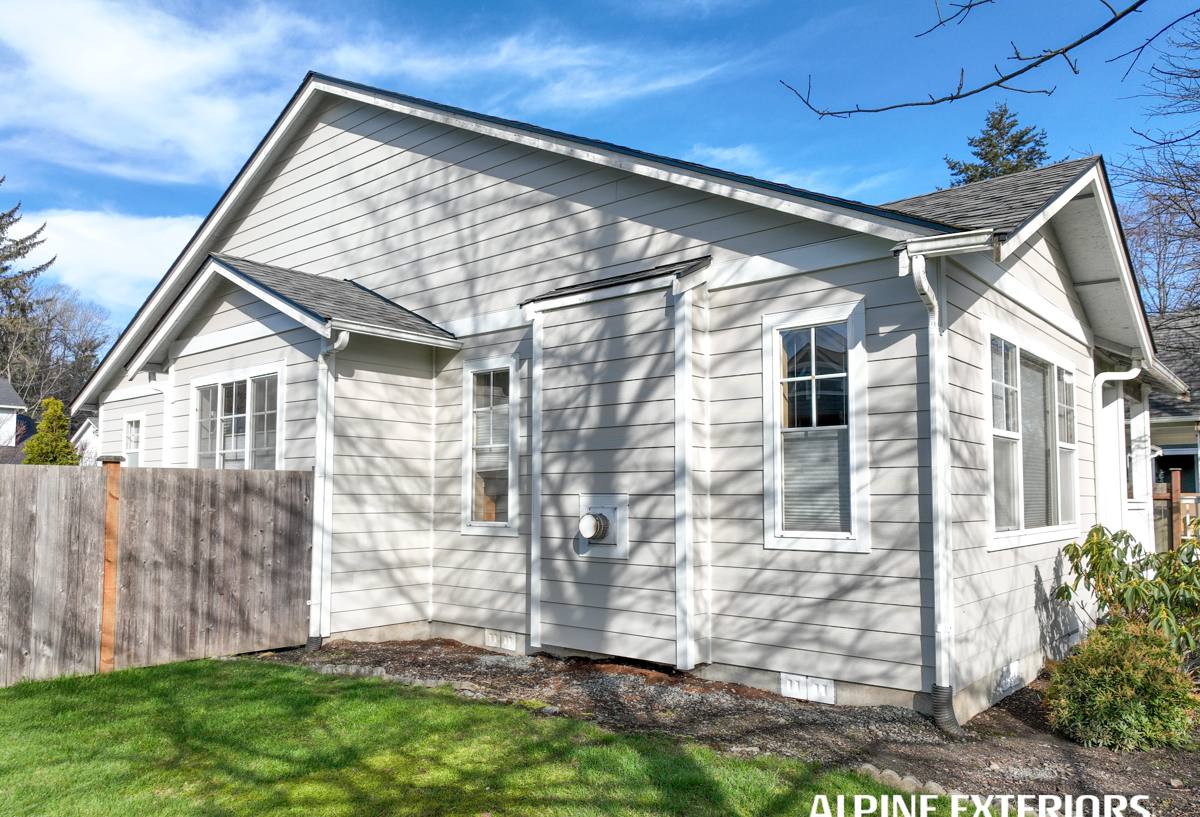
Why We Install Only James Hardie Fiber Cement
We don't carry vinyl, LP SmartSide, Cemplank, Allura, primed spruce, or cedar. That's a deliberate standard, not a lack of options. Each of those products has legitimate uses somewhere, but none of them holds up as consistently to the specific combination of salt exposure, sustained moisture, and moss growth that defines this part of Skagit County. Vinyl can warp and its seams give moisture a path inward. Wood-based products, even engineered ones, depend heavily on paint film integrity and perfect flashing to keep water out — and in a climate where things stay damp for days at a time, that margin for error shrinks fast. Cedar looks excellent on day one but requires an ongoing maintenance commitment most homeowners don't want to sign up for indefinitely.
James Hardie fiber cement is cement, sand, and cellulose fiber — it doesn't rot, it doesn't feed moss the way wood does, and it's non-combustible. The ColorPlus factory finish is baked on under controlled conditions, which gives it better adhesion and color retention than field-applied paint standing up to years of coastal humidity. That's the trade-off calculation behind our standard: we'd rather install one product correctly, every time, than offer five products and hope each one gets detailed right.
The Right Hardie Product Line for This Area
James Hardie engineers its siding by climate zone, and that matters here. The HZ5 formulation is built for wetter, more humid regions and is the appropriate specification for Mount Vernon and the rest of Skagit County — as opposed to the HZ10 line, which is intended for drier, freeze-heavy climates. HZ5 is engineered with moisture and mold resistance as a priority, which lines up directly with the driving rain and prolonged damp conditions this area sees for much of the year.
Board profile matters too. Lap siding, board-and-batten, and shingle-style panels are all available, and the right choice usually comes down to the home's architectural style and how much wall area sits exposed to prevailing wind-driven rain. On more exposed elevations, we pay close attention to lap exposure and fastening pattern, since those are the details that determine how well a wall sheds water over decades, not just in the first few years.
ColorPlus Finish vs. Field-Applied Paint
A factory-applied ColorPlus finish is baked on and cured under controlled conditions, giving it stronger adhesion than paint applied on-site after installation. In a climate with heavy moisture cycling, finish adhesion is one of the first things to fail on lower-quality installations, so this is a meaningful, practical difference — not a cosmetic upgrade.
What a Correct Installation Actually Involves
Fiber cement siding is only as good as the assembly behind it. A huge share of the siding failures we get called out to inspect trace back to installation shortcuts, not the material itself. For Mount Vernon homes, we treat the following as non-negotiable:
- A drainage plane and weather-resistive barrier installed correctly behind the siding, with proper overlap and no shortcuts around penetrations
- Correct starter strip installation so the bottom course sheds water instead of wicking it upward
- Flashing at every window, door, and roof-to-wall transition — the single most common place we find water intrusion on older homes
- Proper fastener type and placement, since the wrong fastener corrodes faster in salt-influenced air and can cause staining or loosening over time
- Correct clearance between the bottom of the siding and grade, decks, or roof lines, so water and moss-holding debris don't sit against the board
- Caulking and sealant only where Hardie's specifications call for it — over-caulking can trap moisture just as easily as under-caulking lets it in
Every one of these is easy to skip and hard to see once the siding is up. That's exactly why they matter — a rushed or unfamiliar crew can produce a wall that looks fine for a year or two before problems show up.
Signs Your Current Siding Is Losing the Fight
If you're evaluating whether it's time to replace siding on a Mount Vernon home, a few warning signs come up consistently in this climate:
- Moss or algae staining that returns within weeks of cleaning, especially on north-facing or shaded walls
- Paint that's peeling, bubbling, or chalking well before the manufacturer's repaint interval
- Soft spots, visible cupping, or delamination on wood-based or engineered wood siding
- Visible rust streaking below fasteners or trim, a sign metal components are corroding
- Gaps opening up at seams, corners, or trim boards that weren't there when the siding was new
Any of these on their own might just need a repair. Several at once, especially combined with soft or spongy sections, usually points to moisture that's already gotten behind the cladding — which is a bigger job than a patch.
How Our Process Works for Mount Vernon Projects
We start with an on-site assessment, not a sales pitch. That means looking at the existing siding and sheathing condition, checking for moisture damage at vulnerable points like window heads and roof transitions, and assessing how exposed each elevation is to prevailing wind and rain. From there we walk through product line, profile, and color, and put together a written scope that spells out what's being removed, what the wall assembly will look like once it's opened up, and how flashing and drainage will be handled.
During installation, we sequence the work so that weather barrier and flashing details go in correctly before a single course of siding goes up — those steps aren't visible once the job is done, so we don't rush them. We do a final walk-through against the original scope before calling a project complete, checking fastening, caulking, and trim details specifically, since those are the spots most likely to get overlooked on a fast timeline.
Comparing Siding Options for This Climate
Homeowners often ask us to explain, plainly, why the material choice matters so much here. This is a general comparison of how common siding materials tend to perform against the specific conditions Mount Vernon deals with — salt-influenced air, sustained rain, and heavy moss pressure — rather than a claim about any single manufacturer's product.
| Material | Moisture & Rot Resistance | Moss/Algae Resistance | Maintenance Burden | Typical Lifespan |
|---|---|---|---|---|
| James Hardie Fiber Cement (HZ5) | High — cement-based, does not rot | Does not feed organic growth like wood | Periodic cleaning; factory finish reduces repainting | Multiple decades with correct install |
| Vinyl | Moderate — can warp; seams are moisture entry points | Surface growth possible, cleans off | Low, but panels can crack or fade over time | Variable, shorter in harsh sun/impact conditions |
| Engineered Wood (e.g. LP SmartSide) | Depends heavily on paint film and flashing integrity | More susceptible if moisture penetrates | Repainting and edge sealing on a regular cycle | Shorter if maintenance lapses |
| Cedar | Natural resistance, but rot risk rises once finish fails | Feeds moss and algae readily in damp shade | High — regular refinishing required | Shorter without consistent upkeep |
This is why we standardized on one product: it lets us guarantee a consistent installation approach instead of adjusting our quality expectations by material.
Maintaining Hardie Siding in a Marine Climate
Fiber cement is low-maintenance, not no-maintenance. In a climate like this, a simple annual routine keeps siding performing the way it's designed to:
- Rinse siding down at least once a year to remove salt residue and organic buildup before it stains or holds moisture
- Trim back vegetation and tree cover that keeps walls shaded and damp longer than necessary
- Inspect caulking at trim, windows, and corners annually and have any cracked or missing sealant redone
- Check gutters and downspouts before the rainy season so water isn't overflowing directly onto siding
- Address any paint chipping or exposed edges quickly, since exposed cut edges are the one place fiber cement is more vulnerable to moisture
Why Local Installation Experience Matters
Correct James Hardie installation depends on matching details to the specific exposure a wall faces, and that judgment comes from having done the work on homes dealing with the same conditions repeatedly — not from a general contracting background. A crew that regularly works Mount Vernon and the rest of Skagit County already knows which elevations tend to take the worst of the wind-driven rain, how moss pressure behaves on shaded north walls, and where salt air causes the earliest fastener and trim wear. That familiarity shows up in the small decisions — flashing details, fastener choice, lap exposure — that determine whether a siding job holds up for decades or starts showing problems in year three.
If you're weighing a siding project on a Mount Vernon home, we're glad to walk the property, look at what's there now, and talk through what correct James Hardie installation would involve for your specific home. There's no cost and no pressure to move forward — just a straightforward look at what your siding needs. Use the form below to request a free estimate.