 Anacortes Siding
 Why Similk Beach Siding Wears Differently
Similk Beach sits along the water on the approach into Anacortes, and that waterfront position changes how siding ages here compared to homes further inland in Skagit County. Salt-laden air off the bay works its way into fasteners, trim joints, and any seam where water can linger. Add the driving, wind-pushed rain that comes through this stretch of Fidalgo Island in the fall and winter, and siding here takes a heavier, more constant beating than siding on a sheltered inland lot just a few miles away.
Then there's moss and mildew season, which in this part of Washington isn't really a season at all — it's most of the year. Shaded north and west walls facing tree lines or the water stay damp longer after every rain, and that persistent moisture is exactly what moss, algae, and mildew need to take hold. Siding that can't shed water quickly or that absorbs moisture into its core is going to show streaking, soft spots, and paint failure sooner here than almost anywhere else in the county.
None of this means Similk Beach is a bad place to own a home — it just means the siding has a harder job to do. Replacing siding here isn't just a cosmetic decision; it's a chance to correct whatever let moisture in the first time and put a product on the wall that's actually built for a wet, salt-exposed marine environment.
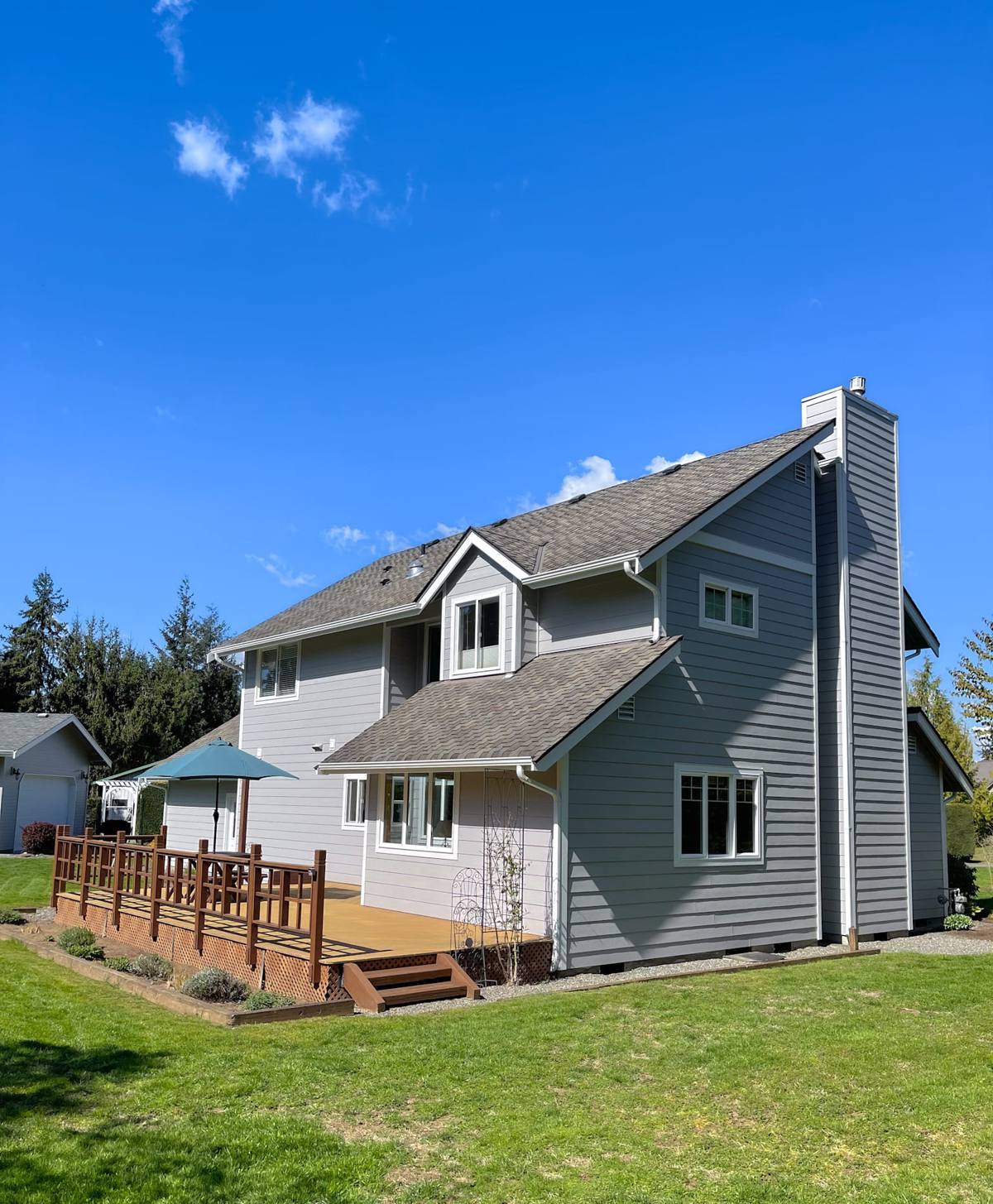
Signs a Similk Beach Home Needs Siding Replacement
Waterfront and near-waterfront homes often show damage in different places than a typical suburban house, because the exposure isn't uniform — one wall can be in rough shape while the rest of the house looks fine. Walk your exterior and look for these before deciding whether you're dealing with a repair or a full replacement:
- Soft, spongy, or crumbling siding when you press on it, especially near the bottom courses and around window and door trim
- Paint that's peeling, bubbling, or chalking faster on one or two walls than the rest of the house — usually the sides facing prevailing wind and rain
- Persistent green or black staining that comes back within weeks of being cleaned
- Visible gaps, warping, or buckling in lap siding, particularly on older wood or engineered wood products
- Rust streaking from fasteners, which signals the fastener coating has failed and water is likely getting behind the panel
- A musty smell or soft drywall on interior walls that back up to exterior siding — a sign moisture has already gotten past the siding layer
- Siding that's more than 20–25 years old, regardless of visible damage, since the water-resistive barrier behind it is likely past its useful life too
If you're only seeing one or two of these on isolated sections, a repair might be enough. If you're seeing several, or if the damage traces back to a water intrusion problem rather than just cosmetic wear, replacement is almost always the more honest answer — patching over a moisture problem just delays the same repair at a higher cost later.
Repair vs. Replace: A Quick Gut Check
| Situation | Repair Usually Fits | Replacement Usually Fits |
|---|---|---|
| Damage location | One board or small isolated area | Whole wall, multiple walls, or spreading pattern |
| Cause | Impact damage, one bad board | Failed water-resistive barrier, systemic moisture intrusion |
| Age of siding | Under 15 years, otherwise sound | 20+ years, or original builder-grade product |
| Underlying sheathing | Confirmed dry and solid | Soft, discolored, or unknown condition |
What a Correct Siding Replacement Involves
A siding replacement in a marine-exposed spot like Similk Beach is only as good as what happens before the new siding goes up. Stripping the old siding off is also your one real chance to inspect and correct everything underneath — sheathing, flashing, and the water-resistive barrier — before it gets covered up for another two decades.
Tear-Off and Inspection
Old siding comes off in sections so the crew can inspect sheathing as they go rather than guessing at what's underneath from the outside. Any soft, delaminated, or water-damaged sheathing gets identified and replaced — this is the step that gets skipped on cut-rate jobs, and it's the one that determines whether the new siding lasts.
Water-Resistive Barrier and Flashing
A new weather-resistive barrier goes over the sheathing, lapped correctly from bottom to top so water always drains outward and down, never sideways into a seam. Flashing gets installed or corrected at every window, door, deck ledger, and roof-to-wall intersection — these transition points are where the overwhelming majority of siding leaks actually originate, not through the field of the siding itself.
Fastening and Clearances
Fasteners are set to the manufacturer's spec for penetration depth and spacing, using coated fasteners rated for the exposure. Siding is held up off decks, patios, and grade with the clearance the manufacturer requires, so splash-back and standing water don't sit against the bottom edge of the material — a common failure point on homes close to the shoreline.
Caulking and Trim
Joints and trim are sealed with the right sealant for the substrate, not just whatever's on the truck. Over-caulking gaps that should be designed to drain, or under-caulking joints that need a seal, are both common mistakes that shorten the life of an otherwise good siding job.
Why We Only Install James Hardie Fiber Cement
We don't install vinyl, LP SmartSide, primed spruce, cedar, or other fiber cement brands like Cemplank or Allura. That's a deliberate standard, not a matter of what happened to be available on a given job. In an environment like Similk Beach — salt air, sustained rain exposure, and near-constant dampness feeding moss and mildew — the material choice matters more than almost anywhere else in the county.
Vinyl expands and contracts significantly with temperature swings and can warp or crack in high-wind, high-exposure locations; it also can't be painted a dramatically different color without risking heat distortion. Engineered wood products like LP SmartSide perform well when installation is flawless, but they're wood-based, and wood-based sidings are more sensitive to the kind of sustained moisture exposure this location sees — any lapse in flashing or caulking gives water an easier path into the material. Cedar and primed spruce look great initially but require far more repainting and moisture vigilance than most homeowners want to sign up for on a waterfront-adjacent property.
James Hardie fiber cement is non-combustible, dimensionally stable, and engineered specifically for the Pacific Northwest's wet marine climate through its HZ5 product line. The factory-applied ColorPlus finish is baked on under controlled conditions, resists fading and chipping far better than field-applied paint, and comes with its own finish warranty on top of Hardie's product warranty. It doesn't rot, it doesn't feed insects, and it holds up to repeated wet-dry cycling — which is exactly what Similk Beach siding goes through, week after week, most of the year.
Material Comparison for Marine-Exposed Homes
| Factor | James Hardie Fiber Cement | Vinyl | Engineered Wood / Cedar |
|---|---|---|---|
| Moisture resistance | Excellent — cement-based, won't rot | Good, but seams can trap moisture | Fair — wood-based, sensitive to lapses in sealing |
| Salt air / coastal durability | Engineered for it (HZ5 line) | Can become brittle over time | Requires more frequent maintenance |
| Finish longevity | Factory ColorPlus finish, long warranty | Color molded in, but can fade/chalk | Field-applied paint, needs repainting cycles |
| Fire resistance | Non-combustible | Melts/deforms under heat | Combustible |
| Typical lifespan when installed to spec | 30+ years | 20–30 years | 15–25 years, maintenance-dependent |
Our Process for Similk Beach Projects
The steps don't change from house to house, but how we apply them shifts based on a property's exposure — a home facing open water gets more attention on flashing and fastener spec than a home tucked back from the shoreline.
- On-site assessment. We walk the exterior, check for soft sheathing, evaluate current flashing and drainage, and note which walls are taking the heaviest weather exposure.
- Written estimate. You get a clear scope — what's being replaced, what Hardie product line and profile we're recommending, and a real cost range, not a vague ballpark.
- Tear-off and sheathing repair. Old siding comes off in workable sections; any compromised sheathing is documented and replaced before anything new goes up.
- Water-resistive barrier and flashing. Installed and lapped correctly at every penetration, window, door, and roofline intersection.
- Hardie installation. Panels or lap siding installed to manufacturer fastening spec, with correct clearances from grade, decks, and roofing.
- Trim, caulking, and final inspection. Joints sealed appropriately, trim finished, and a walk-through so you know exactly what was done and why.
Cost Factors for Similk Beach Siding Replacement
Every home is different, so we don't quote a number until we've actually looked at your walls — but these are the factors that most often move the price up or down:
| Factor | Effect on Cost |
|---|---|
| Sheathing condition underneath old siding | Hidden rot or water damage adds repair scope once uncovered |
| Home size and wall complexity | More corners, gables, and trim detail means more labor |
| Siding profile chosen | Lap siding, panel siding, and shingle-style Hardie products vary in material and install cost |
| Story height and access | Two-story or waterfront-facing walls with limited staging access take longer |
| Trim and accessory work | New trim boards, soffit, or fascia repair alongside siding adds to scope |
We'd rather walk a property and give you real numbers than throw out a range that doesn't match what's actually behind your siding. A lot of Similk Beach homes look fine from the curb and have sheathing issues you'd never guess at until the old siding comes off — which is exactly why the estimate visit matters.
Maintenance After Installation
Hardie siding is low-maintenance, not no-maintenance, and a little attention keeps it performing at its best in this climate:
- Rinse the exterior once or twice a year to keep salt residue and organic buildup from accumulating, especially on walls facing the water
- Keep gutters clear so overflow doesn't run down the siding face repeatedly in one spot
- Trim back vegetation and tree cover that keeps a wall shaded and damp longer than the rest of the house
- Check caulking at trim joints every couple of years and have any cracked or missing sealant redone
- Address any moss or algae growth promptly with a gentle wash rather than pressure-washing directly into seams
Why Local Experience in This Area Matters
Similk Beach isn't a typical suburban neighborhood — it's a shoreline community where wind direction, tree cover, and proximity to the water change block by block, sometimes house by house. A crew that's worked this stretch of Skagit County knows which walls on a waterfront lot need extra flashing attention before they even get up on a ladder, and they know how Anacortes' weather patterns actually behave through fall and winter, not just what a general Pacific Northwest siding guide says. That local pattern recognition is the difference between a siding job that looks right on install day and one that's still performing correctly in year fifteen.
If your siding is showing wear, or you're just not sure whether you're looking at a repair or a full replacement, we're happy to come out, take an honest look, and give you a straightforward assessment. The estimate is free, there's no pressure, and you'll get a clear answer either way — use the form below to get started.