 Anacortes Siding
 Why West Anacortes Decks Wear Faster Than Decks Inland
West Anacortes sits close to the water, and that proximity changes what a deck has to survive. Homes here catch salt-laden air off the Rosario Strait and Guemes Channel, take driving rain straight off Pacific storm systems, and sit under enough shade and moisture for moss to get a foothold on almost any horizontal surface. None of that is unique to any one yard — it's a Skagit County reality for anything built outdoors near the water. But it means a deck built with generic, big-box assumptions about lumber and hardware will show its age faster here than the same deck would in a drier, inland part of Washington.
We don't treat that as a reason to over-build or upsell unnecessary materials. We treat it as a design and construction problem with known solutions: the right decking material for the exposure, fasteners that won't corrode, framing that sheds water instead of trapping it, and a maintenance plan the homeowner can actually keep up with. That's the difference between a deck that looks good for two summers and one that holds up for decades.
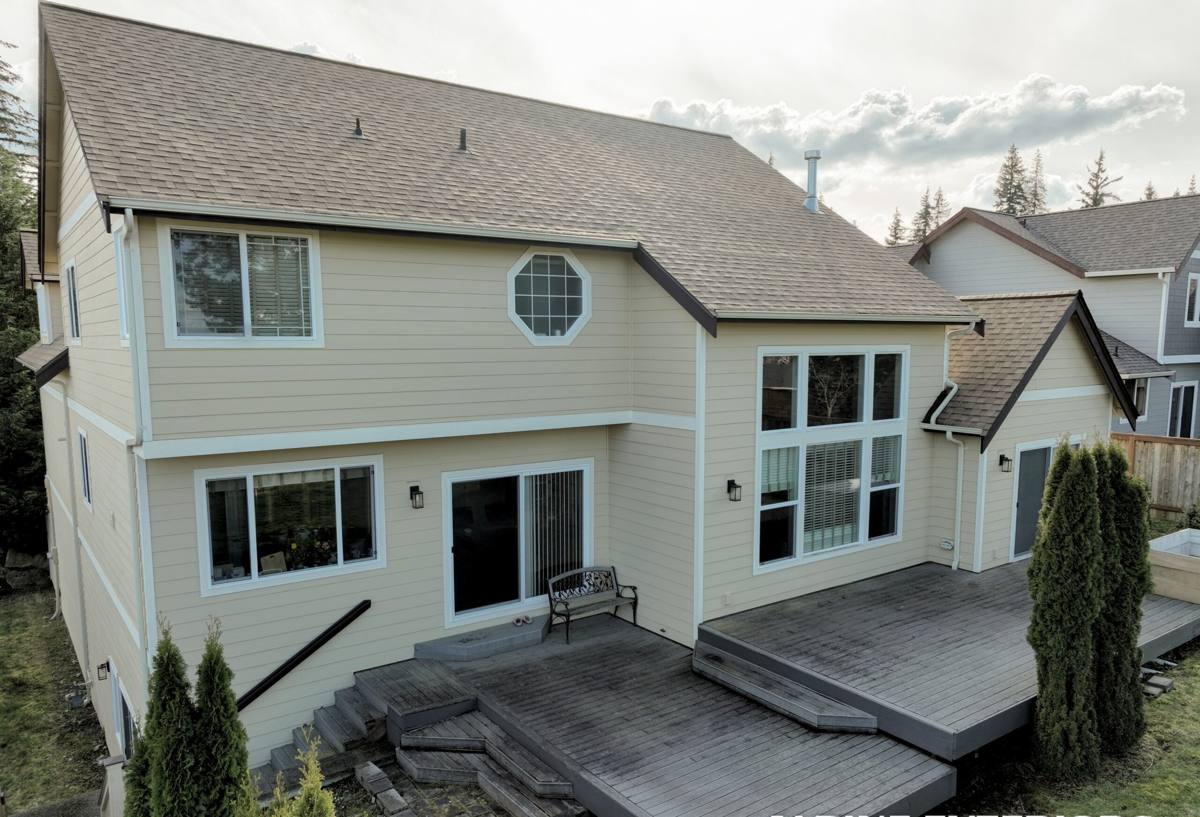
What Salt Air and Moss Season Actually Do to a Deck
It helps to understand the specific failure points, because they're not always where homeowners expect.
Salt Air and Metal Hardware
Airborne salt accelerates corrosion on anything metal — screws, joist hangers, bolts, railing brackets. Standard electro-galvanized fasteners can start showing rust streaks within a season or two this close to the water. Once a fastener corrodes, it loses holding strength long before it looks obviously bad, which is why fastener choice matters more here than almost anywhere else in the build.
Driving Rain and Water Intrusion
Wind-driven rain doesn't fall straight down — it gets pushed sideways and up under boards, around ledger connections, and into any gap that isn't properly flashed. A deck that would stay dry in a calm rain can still take on water at the ledger board or stair stringers during a real Pacific storm if those details weren't built correctly the first time.
Moss, Algae, and Shaded Surfaces
Moss needs moisture and shade to establish, and West Anacortes has plenty of both for much of the year. On decking, moss holds water against the surface, feeds mildew growth, and on wood decking in particular, accelerates rot in the areas it colonizes. It also makes boards slick — a real safety issue on stairs and near doorways.
Framing and Structure: Getting the Bones Right
Everything visible on a deck sits on top of a structural frame, and that frame is where corners get cut on decks that fail early. For West Anacortes homes, we pay particular attention to a few things:
- Ledger board flashing — the connection where the deck attaches to the house is the single most common source of hidden water damage. It needs proper flashing, not just fasteners and caulk.
- Footings sized for the soil and slope — many West Anacortes lots have grade changes or bluff-adjacent terrain, and footing depth and bearing need to match actual soil conditions, not a generic assumption.
- Joist spacing matched to the decking material — composite and PVC boards often require tighter joist spacing than wood to avoid flexing over time, so the framing plan changes depending on what decking goes on top.
- Airflow underneath the deck — trapped, stagnant air under a low-clearance deck is exactly the environment moss and mildew like. Where clearance allows, we build in ventilation rather than sealing the underside off.
Choosing Decking Material for This Climate
There's no single "correct" decking material — it depends on budget, how much upkeep the homeowner wants to do, and how exposed the deck is to weather. Here's how the common options actually compare for a marine, moss-prone environment like West Anacortes:
| Material | Upfront Cost | Maintenance Needed | Moss/Moisture Resistance |
|---|---|---|---|
| Pressure-treated wood | Lowest | Annual cleaning and re-sealing | Fair — needs consistent upkeep to resist rot and moss |
| Cedar | Moderate | Regular sealing to hold color and resist checking | Naturally rot-resistant but still needs cleaning to prevent moss buildup |
| Capped composite | Higher | Occasional washing, no sealing or staining | Good — dense cap resists moisture absorption and moss adhesion |
| PVC decking | Highest | Occasional washing, no sealing | Best — fully synthetic, no organic material for rot or insects |
We install all of these depending on what a homeowner is after. Pressure-treated and cedar cost less up front but ask for real annual maintenance to keep moss and moisture from getting a grip — skip a year or two of upkeep and you're playing catch-up. Capped composite and PVC cost more initially but trade ongoing labor for material cost, which is worth it for homeowners who want a deck they're not sealing every spring.
A Word on Composite Brands
Composite and PVC decking brands vary in board density, cap thickness, and how they handle the freeze-thaw and moisture cycling common on the west side of Fidalgo Island. We don't push a single brand — our standard is choosing products with warranties and installation specs that match this climate, and installing them exactly to the manufacturer's fastening and spacing requirements. Composite decking that's installed loose or off-spec is where most of the complaints about the material actually come from, not the material itself.
Railings, Fasteners, and Hardware
Railings and hardware take the most direct exposure to salt air and rain, and they're often the first thing to show wear on an otherwise sound deck. For West Anacortes builds, we default to stainless steel or high-grade coated fasteners rather than standard galvanized hardware, and we spec structural connectors rated for exterior, coastal-adjacent use. On railing systems, we look at how the material handles both moisture and UV — some cable and aluminum rail systems that look great inland can pit or dull faster with regular salt exposure if the coating isn't rated for it.
Guardrails, baluster spacing, and stair railings also need to meet current residential building code, which sets minimum heights and spacing regardless of material choice. We build to code as a baseline, not a ceiling.
Our Process, Start to Finish
- On-site consultation — we walk the actual lot, check grade, sun/shade exposure, and how exposed the location is to prevailing wind and rain.
- Design and material selection — we talk through decking material, railing style, and layout based on the home, the budget, and how much maintenance the homeowner wants to take on long-term.
- Permitting — decks generally require a permit through the City of Anacortes or Skagit County depending on the property's location; we handle that process rather than leaving it to the homeowner.
- Framing and structural build — footings, ledger flashing, and joist framing go in first, inspected before decking goes on.
- Decking, railing, and stairs — installed to manufacturer spec, with fastening and spacing appropriate to the material and this climate.
- Final walkthrough — we go over the finished deck with the homeowner, including what maintenance (if any) the chosen material needs going forward.
Keeping a Deck Ahead of Moss Season
Whatever material a deck is built from, a little seasonal attention goes a long way in this climate. We give homeowners a straightforward maintenance rhythm rather than a vague "keep it clean" instruction:
- Sweep debris and organic buildup off the deck surface regularly, especially in shaded corners where moss establishes first.
- Rinse or wash the deck at least once or twice a year to remove airborne salt residue and early moss growth before it spreads.
- Check and clear gaps between boards where debris and moisture collect — this is where rot and moss both start on wood decking.
- Inspect railings and visible fasteners annually for rust streaks or corrosion, especially on wood and lower-grade metal hardware.
- Re-seal or stain wood decking on the schedule the product calls for — skipping years is what shortens a wood deck's life the most.
- Keep nearby vegetation trimmed back where it shades the deck and holds moisture against the surface.
Why It Matters That We Already Work West Anacortes
A deck built by a crew that hasn't accounted for salt exposure, driving rain, and moss season will often look fine for the first year or two — the problems show up later, in loosening fasteners, softening ledger connections, or decking that never quite sheds water the way it should. Building here regularly means we're not guessing at how a given material or fastener holds up in this specific environment; we've seen it. That shows up in the small decisions — flashing details, fastener grade, joist spacing, drainage — that don't show up on a materials list but decide how the deck ages over the next fifteen or twenty years.
If you're planning a new deck or replacing one that hasn't held up to the weather here, we're happy to take a look and talk through what makes sense for your home. Reach out for a free, no-pressure estimate using the form below — there's no obligation, just a straight answer on what your project would involve.