 Anacortes Siding
 New-Construction Windows Are a Different Job Than Replacement
New-construction windows aren't the same product or the same install as a replacement window dropped into an existing opening. A new-construction window has a nailing flange around its perimeter that gets integrated directly into the wall's weather-resistive barrier before siding goes on. That flange, and how it's flashed, is what keeps water out of the wall for the next several decades. Get it right during framing and it's invisible forever. Get it wrong, and the mistake is buried behind siding and trim where nobody sees it until there's rot in the sheathing.
On a Flounder Bay build, that first-time-right requirement matters more than in a lot of inland neighborhoods. Homes here sit close to the water on Fidalgo Island, exposed to conditions that push ordinary window details past what they're built to handle. We treat every new-construction window opening as a system — sill pan, flashing, flange, fasteners, and sealant working together — not just a box set into a hole in the wall.
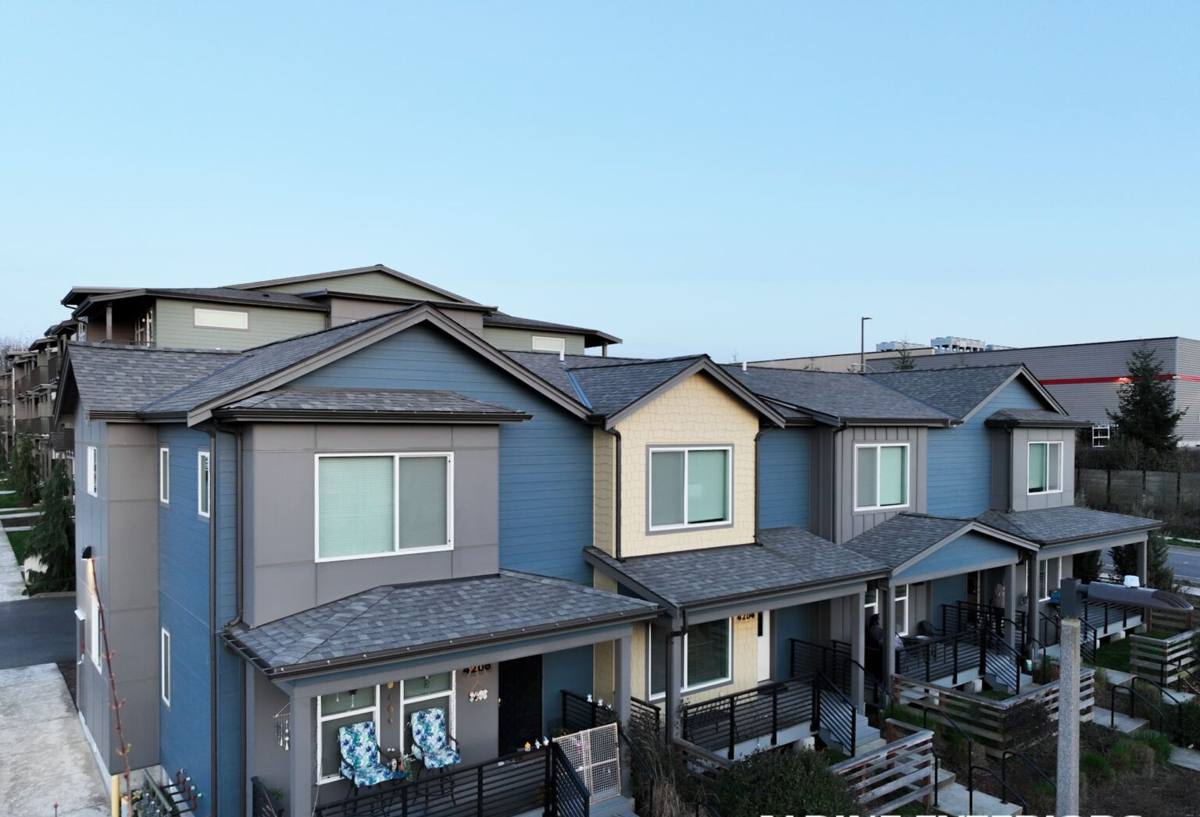
What Flounder Bay's Waterfront Setting Does to Windows and Framing
Anacortes sits in Skagit County on the Salish Sea, and Flounder Bay's homes catch the full effect of that marine exposure. Three things drive most of the window problems we see out here.
Salt Air and Hardware Corrosion
Airborne salt off the water accelerates corrosion on anything metal — fasteners, hinges, cranks, and even some flashing tapes lose their bond faster near the shoreline than a few miles inland. Standard zinc-coated screws and off-the-shelf trim fasteners can start showing rust streaks within a few years in a salt-air exposure. That's a maintenance headache and, worse, a point where water can start tracking into the wall along a corroded fastener shank.
Wind-Driven Rain Off the Water
Storms coming off open water don't just drop rain straight down — they push it sideways into wall assemblies, siding laps, and window perimeters under real pressure. A flashing detail that would be fine on a sheltered inland lot can fail on an exposed waterfront elevation because it was never designed to shed water moving horizontally, not just vertically.
Moss, Algae, and Shaded Elevations
Anacortes' long moss season isn't just a roof problem. North- and west-facing walls that stay damp and shaded grow moss and algae on trim, sills, and siding, and that growth holds moisture against the wall longer than a dry surface would. Around a window, sustained moisture at the sill or head flashing is exactly what eventually finds a gap in the assembly.
What a Correct New-Construction Install Involves
None of this is exotic — it's disciplined sequencing done in the right order, every time, on every opening.
Sloped Sill Pans
Every rough opening gets a sill pan flashing that slopes slightly to the exterior, so any water that gets past the window — condensation, a wind-driven splash, a future sealant failure — drains back outside instead of sitting on the sill framing. On a waterfront lot, we don't treat this as optional; it's the backstop for the other layers.
Shingle-Lap Flashing Sequence
Flashing tape and housewrap have to be layered like shingles on a roof — each layer overlapping the one below it — so water always drains down and out, never behind the layer beneath it. Side flashing goes over the sill pan, the nailing flange goes over the side flashing, and the head flashing goes over the top of the flange, tucked under the housewrap above. Skip a step or reverse the order and you've built a trap instead of a drain path.
Fasteners and Sealant Chosen for Salt Air
Given the corrosion issue described above, we use fasteners rated for coastal exposure rather than standard interior-grade hardware, and we're deliberate about not mixing dissimilar metals in ways that accelerate galvanic corrosion. Sealant at the flange gets applied where the manufacturer specifies it — and nowhere else, since sealing the wrong spot can trap water instead of keeping it out.
Rough Opening Accuracy
New-construction windows need rough openings cut to the size and square tolerance the manufacturer specifies. Too tight and the window can bind or the flange won't seat flat; too loose and you're relying on shims and sealant to do a framing member's job. We check this before the window ever goes in, not after.
Choosing the Right Frame and Glass for This Location
Every frame material has trade-offs, and on a waterfront lot those trade-offs matter more than in a sheltered spot. We'll walk through what fits your budget and your elevation, but here's the honest comparison we start from.
| Frame Material | Coastal Durability | Maintenance | Typical Cost Tier |
|---|---|---|---|
| Vinyl | Good — won't rust or rot; UV-stable formulations hold up well near saltwater | Low — occasional cleaning | Lower |
| Fiberglass | Very good — dimensionally stable, resists the expansion/contraction that stresses seals in a marine climate | Low | Mid to upper |
| Aluminum-clad wood | Good exterior protection, but any breach in the cladding exposes wood to a very wet, salt-laden environment | Moderate — watch cladding seams and finish over time | Upper |
| Bare wood | Weakest fit for this exposure — needs consistent refinishing to resist moisture and salt | High | Varies |
For glass, we typically spec dual-pane, low-E units as a baseline for the Skagit County climate, with the option to step up glazing or gas-fill packages on more exposed elevations. On a west- or north-facing wall that takes the brunt of wind-driven rain and shade, spending a bit more on the frame and glazing package up front is usually cheaper than dealing with sealant failures or fogged units in ten years.
Our Process on Flounder Bay New Builds
We work new-construction window installs as part of the framing sequence, coordinated with your builder or general contractor, not as an afterthought once siding is already up.
- Plan review: we check window schedules and rough opening dimensions against the actual framing before anything is ordered, catching sizing conflicts early.
- Product selection: we help you weigh frame material, glazing, and elevation-specific exposure so the window package matches the wall it's going into.
- Timed installation: windows go in once the WRB is on and before siding starts, so flashing integrates cleanly into the wall system in the correct order.
- Flashing and sealant inspection: every opening gets checked before it's covered — this is the point where a mistake is cheap to fix and expensive to ignore.
- Final walk-through: operation, weatherstripping seat, and hardware function get verified once the building is closed in.
Why Hire a Crew That Already Works This Neighborhood
Flounder Bay isn't a generic Anacortes lot. Wind exposure and salt-air intensity can vary meaningfully between a sheltered inland yard and a waterfront elevation just a short distance away, and that variance should change how an opening gets detailed. A crew that's worked this specific stretch of shoreline knows which elevations need the extra step — heavier flashing tape, upgraded fasteners, a more conservative sealant approach — versus where standard practice is enough.
We're also familiar with how Skagit County and City of Anacortes inspections go on new builds, so window rough-in and flashing details get done in a way that passes review the first time instead of causing delays mid-build. That local familiarity, on both the climate and the permitting side, is the difference between a window package that's engineered for this lot and one that's just engineered for a spec sheet.
Questions Worth Asking Before You Sign
- Does the sill pan slope to the exterior, and can the installer explain the full flashing sequence in order?
- Are fasteners and flashing tapes rated for coastal or marine exposure, not just standard interior-grade hardware?
- Is the frame material and glazing package matched to each elevation's actual wind and shade exposure, not a single spec for the whole house?
- Will windows go in before siding, integrated into the housewrap, rather than face-sealed after the fact?
- Does the installer have experience with waterfront or near-shoreline builds in this specific area, and can they speak to how that changes the detailing?
Getting Started
New-construction windows are a one-shot detail — the flashing and sequencing decisions made during framing are the ones that determine whether your walls stay dry for the life of the house. On a Flounder Bay lot, with salt air, wind-driven rain, and a long moss season all working against a wall assembly, that first-time-right standard isn't optional. If you're planning a new build or an addition in this neighborhood, we're happy to walk your plans, talk through frame and glazing options for your specific exposure, and put together a free, no-pressure estimate — just reach out using the form below.