 Anacortes Siding
 Building New on March Point: What Your Windows Are Actually Up Against
March Point sits close to Fidalgo Bay, which means homes going up here catch salt-laden air off the water almost year-round, on top of the driving rain and long gray moss season that the rest of Skagit County deals with. For a new build, that combination matters more than most homeowners expect. Windows aren't just holes in the wall waiting for glass — they're one of the most failure-prone details in the entire building envelope, and the failures usually don't show up until years two or three, after the framing is buried behind siding and trim.
When you're building new, you get one real shot at doing the window openings right. There's no siding to remove later, no interior finish to protect, no landscaping to work around. That's the advantage of new construction — and it's also why cutting corners here is harder to justify. A window installed correctly during framing will outlast one installed carelessly by decades, especially in a marine climate like ours.
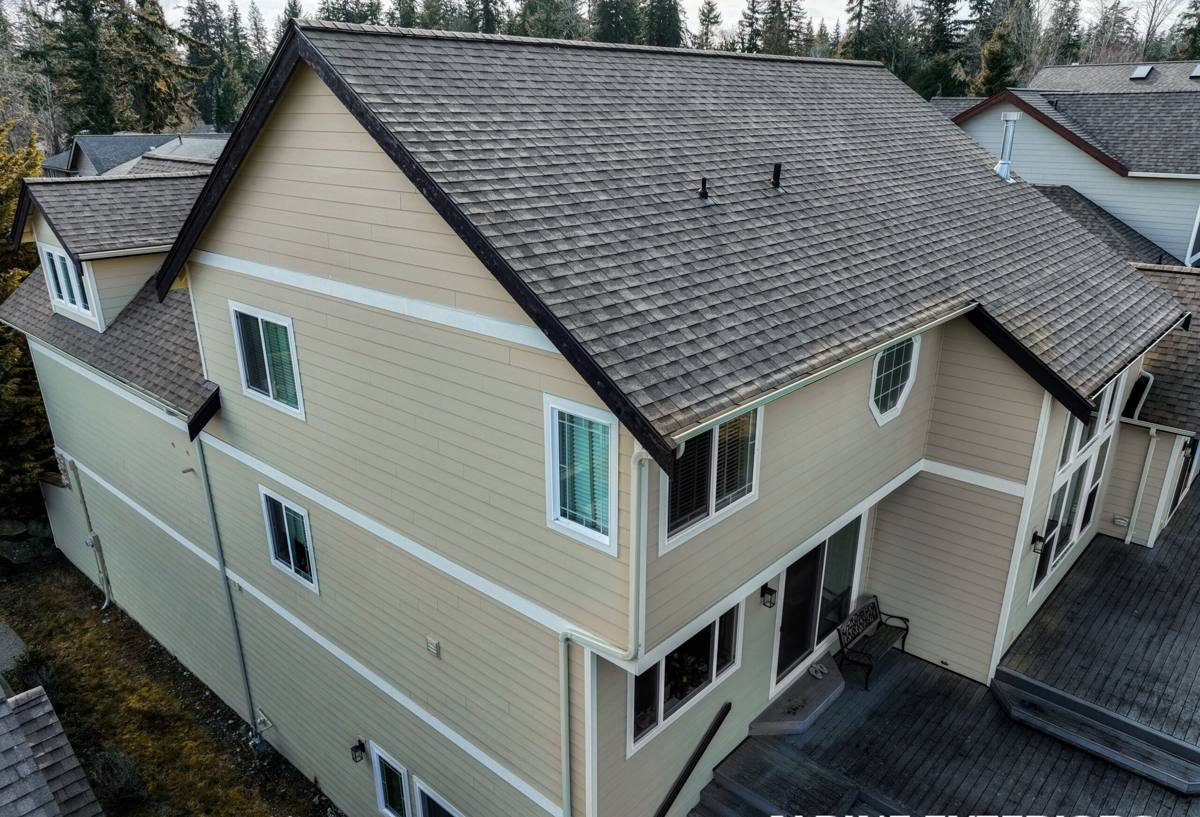
New-Construction Windows Aren't the Same Job as Replacement Windows
A lot of homeowners assume "windows are windows," but new-construction and replacement work are genuinely different trades. Replacement windows get inserted into an existing, already-flashed opening — the goal is a tight fit with minimal disturbance to the surrounding wall. New-construction windows, by contrast, have a nailing fin (or sometimes a block frame) that gets integrated directly into the wall's structural and moisture-management layers before siding ever goes on.
That distinction matters because a new-construction window is only as good as the flashing and water-resistive barrier (WRB) work around it. The window itself can be top quality, but if the sill pan, flashing tape, and weather-resistive barrier sequencing aren't done in the right order, water will find its way behind the siding — and in a location that sees regular wind-driven rain off the bay, it will find that path faster than in a sheltered inland lot.
Why This Matters More in March Point Specifically
Homes closer to open water take wind-driven rain at more aggressive angles than homes tucked into town. Salt air also accelerates corrosion on fasteners, flashing, and hardware that aren't rated for coastal exposure. None of this means March Point is a hostile building site — it just means the margin for sloppy window installation is smaller here than it is a few miles inland.
What a Correct New-Construction Window Installation Actually Involves
Done right, a new-construction window install follows a specific sequence. Skipping or reordering these steps is the single most common cause of window-related water intrusion we see in framed homes:
- Rough opening is checked for square, level, and correct dimensions before the window ever arrives on site.
- A sloped sill pan is installed at the base of the opening so any water that gets past the window sheds outward, not into the wall cavity.
- Flashing tape is applied to the sides and head of the opening in the correct shingle-lap order — bottom first, sides next, top last — so water always flows over the layer below it, never behind it.
- The window is set, shimmed level and plumb, and fastened through the nailing fin per the manufacturer's schedule.
- The WRB (house wrap or equivalent) is integrated over the flashing at the head and sides, maintaining the same shingle-lap principle out to the siding layer.
- Interior and exterior sealant is applied at the specified points only — sealing everything can trap moisture just as badly as sealing nothing.
Every one of those steps is inspectable before siding goes on, which is exactly why we recommend homeowners or their general contractor walk the openings before that window of visibility closes.
Choosing a Window Frame Material for Salt Air and Driving Rain
Frame material affects how a window holds up over 20-plus years of Skagit County weather. There's no single "best" answer for every home — it depends on budget, exposure, and how much long-term maintenance you're willing to take on.
| Frame Material | Moisture & Salt-Air Resistance | Maintenance | Typical Cost Position |
|---|---|---|---|
| Vinyl | Good — won't rot or corrode; UV can affect color over time | Low | Entry to mid-range |
| Fiberglass | Excellent — dimensionally stable, resists moisture and salt exposure well | Low | Mid to upper-mid range |
| Wood-clad (exterior clad, wood interior) | Good on the exterior if the cladding seal is maintained; interior wood is not exposed to salt air | Moderate — clad exterior is low-maintenance, but seal points need periodic checking | Upper range |
| Aluminum | Fair — prone to corrosion in salt air unless properly coated and maintained | Moderate to high near the water | Varies widely |
For homes directly exposed to bay winds, we generally steer clients away from bare or lightly coated aluminum frames — not because aluminum can't perform, but because the maintenance burden to keep it from pitting near salt air is more than most homeowners want to sign up for. Fiberglass and quality vinyl tend to be the more forgiving, lower-maintenance choices for this specific exposure.
Glass Package and Ratings
Beyond the frame, look at the U-factor (heat loss) and the window's air infiltration rating. In our climate, U-factor matters more for comfort and energy cost than solar heat gain, since we don't get the intense summer sun that drives cooling-load decisions in other parts of the country. A lower air infiltration rating also means less opportunity for wind-driven rain to work its way in during a real Skagit County storm.
Our Process for New-Construction Window Installs on March Point Builds
We work directly with the builder or general contractor's framing schedule so windows go in at the right point in the sequence — not too early, not after the WRB is already closed up around the openings. Our process typically looks like this:
- Review the window schedule and rough openings against actual window sizes before delivery, catching sizing mismatches before they become a job-site problem.
- Install sloped sill pans and flashing tape in the correct shingle-lap sequence at every opening.
- Set and fasten each window level, plumb, and square, following the manufacturer's nailing schedule exactly — this preserves the warranty and the structural performance of the fin.
- Integrate flashing with the WRB before siding crews start, so there's no ambiguity about lap order at the trade handoff.
- Photo-document flashing and sill pan work at each opening before it's covered, so there's a record if questions ever come up later.
- Final walk-through with the builder to confirm operation, sealant points, and any punch-list items before drywall closes the interior side.
Common Mistakes We See in New Builds Near the Water
Most of the window problems we get called to diagnose in newer homes trace back to a handful of repeat issues:
- Flashing tape applied in the wrong order (top-to-bottom instead of bottom-to-top), which routes water directly into the wall cavity instead of away from it.
- No sill pan, or a flat sill pan with no slope to drain incidental water outward.
- Over-caulking the exterior, which seals in moisture that gets past the primary defenses with no way to escape.
- Fasteners or flashing components not rated for coastal exposure, leading to early corrosion in homes closer to the bay.
- Window openings framed slightly out of square, forcing the installer to over-shim or force the unit, which stresses the frame and can affect long-term operation.
None of these are exotic problems — they're all avoidable with a careful, in-order installation. They just tend to be invisible until the siding is already up.
What Homeowners Should Expect After Move-In
New-construction windows installed correctly are close to maintenance-free for the first several years. That said, a marine climate still asks a little upkeep of you:
- Rinse accumulated salt residue and grime off exterior frames a couple of times a year, especially on sides facing open water.
- Check exterior sealant joints annually for cracking or separation — this is a five-minute visual check, not a project.
- Keep gutters and downspouts clear so roof runoff isn't sheeting down across window heads during heavy rain.
- Watch for moss or algae buildup on north-facing frames and sills during the wet season, and clean it off before it holds moisture against the frame long-term.
- Operate each window a few times a year, even ones you don't use often, to keep hardware and weatherstripping working properly.
Why a Crew That Already Works March Point Makes a Real Difference
Flashing and sequencing details are the same on paper everywhere, but a crew that's installed windows across Anacortes and Skagit County knows how differently a bay-exposed lot behaves compared to a sheltered one a few miles inland — where the wind actually hits an opening, which elevations take the worst driving rain, and where builders in this area tend to run into framing tolerance issues. That's not something you can fully substitute with a spec sheet. It's the difference between a crew executing a generic install checklist and one that's actually accounting for your specific site and exposure.
It also matters for coordination. New-construction window work sits in the middle of a tight trade sequence between framing, the WRB, and siding. A crew that's used to working alongside other Skagit County builders and trades tends to keep that schedule moving without creating friction — or gaps in the weather barrier — at the handoff points.
Get a Free Estimate for Your March Point Build
If you're framing a new home on March Point, or in the planning stages and want window openings specified correctly from the start, we're happy to walk the plans or the site with you. There's no pressure and no obligation — just a straightforward look at what your project needs, using the form below.