 Anacortes Siding
 Fidalgo Island sits where the Salish Sea meets Skagit County, and that geography shapes what a siding job actually needs to survive here. Homes on the island pick up salt-laden air off Rosario Strait and Guemes Channel, take driving rain straight off the water during winter storms, and sit under a long, damp moss season that keeps shaded and north-facing walls wet for weeks at a stretch. Siding that isn't built for that combination — or wasn't installed with it in mind — tends to fail early, and it usually fails quietly, behind the surface, before anyone notices a problem.
This page is about siding replacement specifically for Fidalgo Island homes: what the local climate demands, what a correct installation actually involves, and why it matters that the crew doing the work already knows this stretch of Anacortes.
What Fidalgo Island's Climate Actually Does to Siding
It's easy to lump "Pacific Northwest weather" into one generic category, but Fidalgo Island homeowners deal with a specific set of stresses that inland Skagit County properties don't see nearly as much:
- Salt air corrosion. Airborne salt off the surrounding water accelerates the breakdown of fasteners, trim, and any siding material that isn't rated to handle it — including corrosion at cut edges and around fastener heads.
- Wind-driven rain. Storms coming off the strait don't just fall on siding, they get pushed into it horizontally, which puts real pressure on laps, seams, and butt joints that a calmer rain never would.
- Extended moss and moisture season. Shaded walls, tree-lined lots, and the region's long wet stretch from fall through spring mean some exterior surfaces stay damp far longer than they would in a drier climate, which is exactly the condition moss, mildew, and rot organisms need to take hold.
- Temperature swings between marine layer mornings and clearer afternoons. Repeated expansion and contraction stresses caulk joints, paint film, and any siding material prone to swelling.
None of this is unique to any one house on the island — it's a function of being surrounded by water in the Salish Sea, in a marine climate that doesn't let up for months at a time. What it means practically is that siding choice and installation quality matter more here than they would in a milder, drier part of the state.
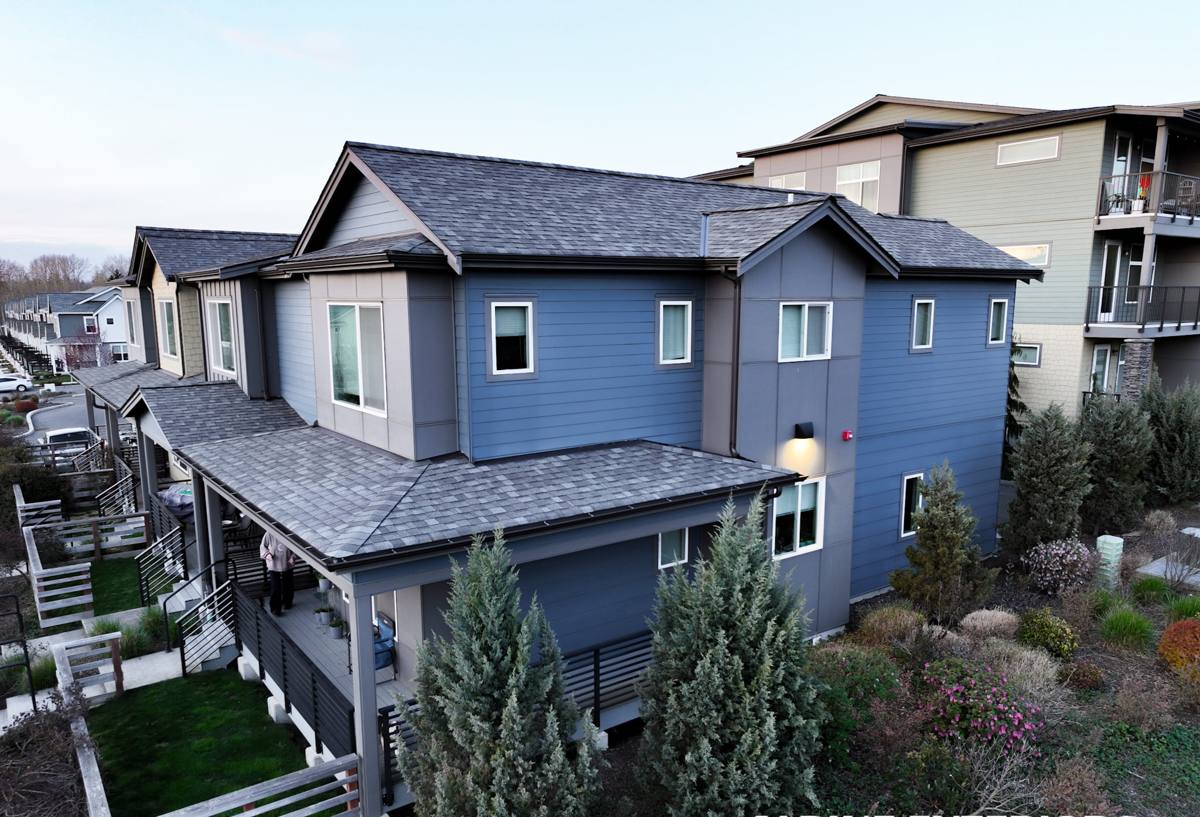
Why We Only Install James Hardie Fiber Cement
We don't install vinyl, LP SmartSide, primed spruce, cedar, or other fiber cement brands like Cemplank or Allura. That's a deliberate standard, not a lack of options. Given what Fidalgo Island's climate does to a wall over the course of a decade or two, we've settled on James Hardie fiber cement as the only product we're willing to put our name behind here, for a few specific reasons:
- It's non-combustible. Fiber cement doesn't feed a fire the way wood-based products can, which matters anywhere in Western Washington with dry summer stretches and nearby vegetation.
- It doesn't absorb and swell the way engineered wood or cedar can. In a climate where walls stay damp for extended periods, a siding material that resists moisture absorption at the core is doing real work, not just cosmetic work.
- The ColorPlus factory finish is baked on, not field-applied. That matters directly for salt-air and UV exposure — a factory finish holds up more consistently than field-applied paint, especially on the sun- and wind-exposed sides of a house.
- HZ5 and HZ10 product lines are engineered for climate zones like this one, with formulations built around moisture exposure rather than a one-size-fits-all product.
- The warranty is transferable and backed by a large manufacturer, which matters to homeowners who may sell within the warranty period — common on the island given how desirable the location is.
We're not going to tell you vinyl or LP SmartSide are junk — they're reasonable products for the right application. But we've made a professional call that on Fidalgo Island, where salt air, driving rain, and a long moss season all stack on top of each other, Hardie fiber cement is the material that holds up the way homeowners expect siding to hold up.
Signs a Fidalgo Island Home Needs Siding Replacement
Because this climate hides problems behind the surface, siding issues here often show up later — and worse — than a homeowner expects. Watch for:
| Sign | What It Usually Means |
|---|---|
| Persistent moss or dark streaking on north/west walls | Chronic moisture retention — the wall isn't drying out between rain events |
| Soft or spongy spots when pressed | Moisture has reached the substrate; possible rot behind the siding |
| Paint that's peeling or bubbling in patches | Trapped moisture pushing out from behind the siding surface |
| Visible warping, cupping, or separation at seams | Material fatigue from repeated wet/dry cycling and wind-driven rain |
| Rust streaking near fasteners | Salt-air corrosion of nails, screws, or trim hardware |
| Rising energy bills with no other explanation | Compromised siding and underlying moisture barrier reducing wall performance |
Any one of these on its own isn't necessarily an emergency. Two or three together, especially on the storm-facing side of a house, usually means the siding system has been letting moisture in for a while and it's worth having a straightforward, no-pressure look before it turns into a bigger repair.
What Correct Siding Replacement Involves Here
Siding replacement isn't just pulling off old boards and nailing up new ones. On Fidalgo Island specifically, a handful of steps matter more than they would somewhere drier and less exposed:
Tear-off and substrate inspection
Once the old siding is off, the sheathing and framing underneath get a real look — not a glance. This is where hidden moisture damage from years of marine exposure usually surfaces, and it needs to be addressed before anything new goes up, not covered over.
Weather-resistive barrier and flashing
A correctly installed weather barrier and properly integrated flashing around windows, doors, and penetrations is what actually keeps wind-driven rain out of the wall assembly. This step is invisible once the job is done, but it's the single biggest factor in whether the new siding performs for its full expected life here.
Proper fastening for a marine environment
Fastener spacing, type, and corrosion resistance matter more in salt air. Hardie's installation specifications call for specific fastener types and placement, and following them isn't optional if the warranty and the performance are both supposed to hold up.
Clearance and drainage detailing
Ground clearance, proper caulking (and knowing where not to caulk, so water can drain and the wall can breathe), and attention to how water sheds off trim and transitions all matter more in a climate that gets this much rain from this many directions.
Ventilation behind the siding
A rainscreen or properly vented assembly gives any moisture that does get behind the siding a way to dry out, instead of sitting against the sheathing through another wet Skagit County winter.
Our Process for a Fidalgo Island Siding Replacement
- Free on-site estimate. We walk the exterior with you, look at problem areas, and talk through what's actually going on with your current siding — no pressure, no hard sell.
- Detailed scope and product selection. We help you choose the right Hardie plank profile, texture, and ColorPlus color for your home, and put together a clear, itemized scope.
- Tear-off and substrate repair. Old siding comes off, sheathing and framing get inspected, and any moisture damage gets repaired before new material goes up.
- Weather barrier and flashing installation. This is the step that determines how the wall performs for the next 20-plus years — done to spec, not shortcuts.
- Hardie installation to manufacturer specification. Correct fastening, spacing, clearances, and joint treatment throughout.
- Final walkthrough. We go over the finished work with you before we call the job done.
Why Local Experience on Fidalgo Island Matters
A crew that already works Anacortes and the surrounding Skagit County waterfront knows things a crew from farther inland has to learn on your dime: which sides of a house tend to take the worst of the wind-driven rain, how much moss buildup is normal versus a sign of a real drainage problem, and how the salt air affects fastener and trim choices over time. That local pattern recognition shows up in the details — the flashing decisions, the fastener spec, where extra attention goes on a given elevation — not in anything a homeowner would necessarily see on day one, but in how the siding performs five and ten years down the road.
It also means realistic scheduling around the region's weather windows, rather than promising timelines that don't account for how often driving rain actually shuts down exterior work here.
What Affects the Cost of a Siding Replacement
Every Fidalgo Island home is different, so we don't publish blanket pricing — but the main cost factors are consistent from job to job:
| Factor | Why It Matters |
|---|---|
| Home size and wall complexity | More square footage and more corners, gables, and trim details mean more labor and material |
| Substrate condition | Hidden rot or moisture damage found during tear-off adds repair scope before new siding goes on |
| Siding profile and texture | Lap width, shingle-style, and panel options carry different material costs |
| Trim and accessory work | Corner boards, window trim, and fascia work are often bundled with a siding job |
| Access and site conditions | Steep lots, limited access, or extensive landscaping can affect labor time |
The only way to get a real number is a walkthrough of your specific home, which is why our estimates are free and come with no pressure to move forward on the spot.
A Practical Pre-Estimate Checklist
If you're trying to decide whether it's time to look into replacement, walk your home's exterior and check for:
- Moss or algae buildup that returns quickly after cleaning
- Any soft, spongy, or crumbling sections when gently pressed
- Visible gaps, warping, or separation at siding seams and corners
- Peeling, bubbling, or chalky paint, especially on storm-facing walls
- Rust staining around nail heads or metal trim
- Interior signs like musty smells, damp drywall, or peeling interior paint near exterior walls
- Higher-than-expected heating bills without another clear cause
If you're seeing more than one of these, it's worth having someone look before winter's driving rain finds every gap.
If you're on Fidalgo Island and wondering whether your siding is holding up the way it should, we're happy to come take a look. The estimate is free, there's no pressure, and you'll walk away with a straight answer about what your home actually needs.