 Anacortes Siding
 March Point sits out on the water, with Fidalgo Bay on one side and Padilla Bay on the other, and that position changes what siding needs to hold up to compared with a home set back a few miles inland. Salt-laden air moves across the peninsula for most of the year, storms arrive with real wind behind them instead of falling straight down, and the wet season here runs long enough that moss and algae rarely get a real break to dry out. We install James Hardie fiber cement siding on March Point homes with that exposure as the starting point, not an afterthought — the material, the detailing, and the fastening all get planned around what this specific spot on the map actually does to a wall over time.
What March Point's Location Actually Does to a House
Every part of Skagit County deals with rain, but not every part of the county deals with it the same way. Being surrounded by open water on multiple sides puts March Point in a different category from a home tucked into a sheltered inland lot, and that difference shows up in three specific ways that matter for siding.
Salt Air and Corrosion
Air moving off two bays carries salt with it, and that salt film settles on everything — siding, trim, flashing, and fasteners alike. It doesn't rot a wall by itself, but it speeds up corrosion on lower-grade metal, accelerates dirt buildup, and works against any finish that isn't built to resist it. Fasteners and flashing that would last for decades in a drier inland setting can start showing wear years earlier out here if the wrong materials get used.
Driving Rain and Wind Exposure
Because there's open water in more than one direction, wind doesn't have much to slow it down before it reaches a March Point wall. That matters because most water intrusion problems aren't caused by rain falling straight down — they're caused by wind pushing rain sideways and upward into seams, laps, and penetrations that were never designed to take water from that angle. A siding system that's forgiving in calm weather can still fail here if the flashing and lap details weren't built with wind-driven rain specifically in mind.
A Moss Season That Doesn't Really End
Shaded walls, north-facing exposures, and anywhere tree cover or a neighboring structure blocks direct sun stay damp longer here than they would somewhere with a real dry stretch in summer. That gives moss and algae a long runway to establish, and once they take hold on a porous or textured surface, they hold moisture against the wall even between rain events. Siding that can't shed that kind of sustained dampness — or that loses its finish once it's scrubbed clean a few times — ages faster than it should.
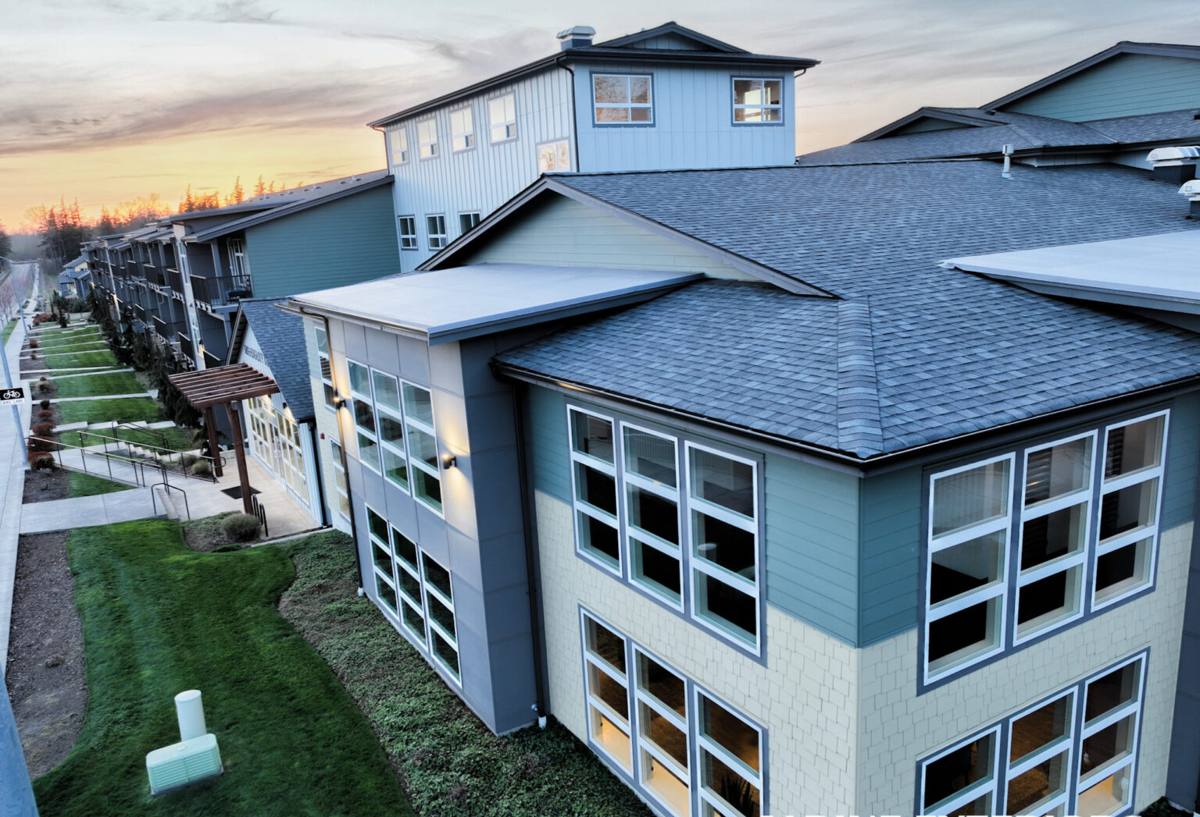
Why Fiber Cement Holds Up Where Other Materials Struggle Here
None of the three factors above are unique to March Point, but the combination of all three, sustained across most of the year, is what makes material choice matter more here than it does in a milder setting. This is why we install James Hardie fiber cement exclusively and don't offer vinyl, LP SmartSide, or other engineered wood alternatives.
Built for Marine-Style Exposure
Fiber cement is made from cement, sand, and cellulose fiber, pressed and cured into a dense board that doesn't expand and contract with temperature the way vinyl and wood-based products do. James Hardie builds region-specific HZ product lines for climates like ours, engineered to handle repeated wetting and drying cycles without the warping, softening, or fastener pull-through that can show up on lesser materials after a few winters of driving rain and salt exposure.
A Factory Finish That Doesn't Depend on the Weather Cooperating
Most of the Hardie siding we install carries the ColorPlus factory finish, which is baked on under controlled conditions no jobsite can match, rather than applied with field paint that has to cure in whatever weather shows up that week. That matters directly on a site like March Point, where a narrow dry window to paint or refinish siding on-site can be hard to count on for weeks at a stretch. A factory finish also holds its color and resists chalking longer against sustained UV and salt exposure than typical field-applied coatings.
Non-Combustible
Fiber cement doesn't burn, which has become a more regular part of the conversation with homeowners and insurers across Washington as dry-season wildfire smoke has become a normal part of late summer. It's a real, practical difference from vinyl siding, which softens and deforms under heat.
What a Correct Installation Involves on a Home Like This
Fiber cement is a strong material, but it isn't a magic one — it still depends entirely on correct installation to deliver the performance it's engineered for. On a March Point property, a few details matter more than they would somewhere calmer:
- Manufacturer-specified clearance from grade, roof lines, and decks, so splashback and standing water can't sit against the bottom edge of the siding
- Flashing at every window, door, and penetration, sequenced to shed wind-driven rain outward rather than relying on caulk alone
- Correct fastener type, spacing, and depth — over- or under-driven fasteners are one of the more common causes of early siding problems we find on this stretch of coastline
- Proper lap and joint detailing at seams, since these are the spots wind-driven rain finds first if they're rushed
- A sound water-resistive barrier behind the siding, because fiber cement is one layer of a larger water-management system, not a standalone waterproof shell
- Correct panel and trim gaps to allow for the material's minimal but real expansion and contraction across seasonal temperature swings
Skip any one of these on a home this exposed, and the siding itself can be sound while the wall behind it still takes on water. That's why we treat installation sequencing as seriously as the material choice.
Our Process for a March Point Fiber Cement Project
- On-site assessment — we walk the exterior, check which walls take the most direct wind and water exposure, and look at the condition of what's currently on the house
- Honest scope and product recommendation — which Hardie product line and profile fits the home's architecture and exposure, explained plainly
- Removal and inspection — old siding comes off carefully, and any hidden sheathing or framing damage gets identified before new siding goes up over it
- Water-resistive barrier and flashing — the weatherproofing layer goes in first, built around this site's wind-driven rain exposure rather than a generic template
- Installation to Hardie's published spec — correct clearance, fastening, and lap detail, with extra attention at penetrations and transitions
- Final walkthrough — we go over the finished work with you before calling the job done
Signs Your Current Siding Is Losing the Fight
Homeowners on March Point often reach out after noticing something specific rather than a general sense that siding is "getting old." A few patterns come up regularly on homes in this kind of exposure: soft or spongy spots near the bottom courses, paint that keeps failing in the same spot no matter how often it's redone, persistent moss growth that comes right back a few months after cleaning, staining or dark streaking at seams and corners, and visible gaps or warping at butt joints. Any one of these is worth a closer look, since on a site with this much wind and moisture exposure, small problems tend to compound faster than they would somewhere more sheltered.
What Fiber Cement Siding Costs to Consider on a March Point Home
We won't quote a number without seeing the house, but the factors that move the price are consistent from job to job. This table lays out what tends to drive cost up or down on a project like this.
| Factor | Tends to Lower Cost | Tends to Raise Cost |
|---|---|---|
| Home size and wall area | Smaller footprint, simple rectangular walls | Larger footprint, multiple stories, complex rooflines |
| Current siding condition | Sound sheathing underneath, straightforward removal | Hidden rot or moisture damage requiring sheathing repair |
| Wind and water exposure | Sheltered walls, limited direct water-facing sides | Multiple walls facing open water, requiring extra flashing detail |
| Product line and profile | Standard lap profile in a common color | Panel or shingle profiles, custom trim, premium ColorPlus colors |
| Access and site conditions | Easy ground-level access | Steep grade, limited equipment access, tall walls |
| Trim and detail work | Minimal window and corner trim | Extensive trim, multiple penetrations, architectural detailing |
Why Hiring a Crew That Already Works March Point Matters
Manufacturer installation guidance is written to a general standard, not to any one site's specific wind and water conditions. A crew that has actually installed siding on this peninsula knows which walls typically take the worst of the wind-driven rain, where flashing needs extra attention beyond the minimum spec, and which fastener and clearance details matter more here than they would on a sheltered inland lot. That kind of judgment doesn't come from a training manual — it comes from having repaired what happens when those details get skipped on a site with this much exposure.
It also means fewer surprises during the project itself. A crew familiar with March Point's weather patterns plans around the wind and rain windows that actually show up here, rather than working from an assumption built for a calmer part of the county. That translates into a cleaner installation and fewer callbacks down the road, which matters most on a house that's going to spend the next several decades facing two bays' worth of weather.
If you're weighing a siding replacement or new construction siding for a home on March Point, we're glad to walk the exterior with you, point out which walls face the toughest exposure, and put together a straightforward, no-pressure estimate for a correctly installed James Hardie system. Use the form below to get on the schedule.